Egg White Omelette Nutrition Calculator
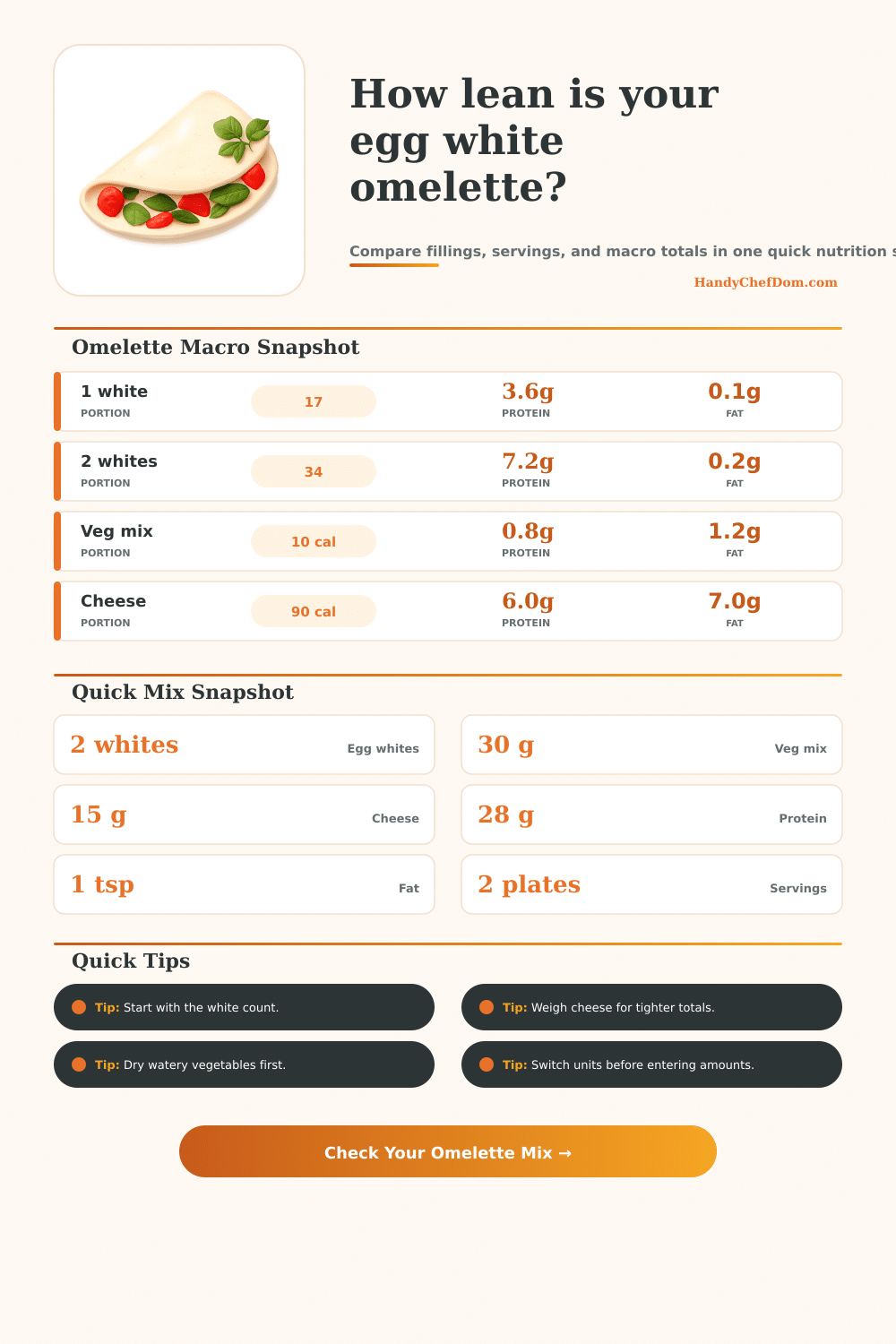
Compare egg whites, vegetables, cheese, protein add-ins, and cooking fat to see a crisp macro breakdown for each serving.
Choose a style, then tune the mix. The calculator updates the nutrition panel as soon as you adjust a field.
| White Count | Calories | Protein | Fat |
|---|---|---|---|
| 1 white | 17 | 3.6 g | 0.1 g |
| 2 whites | 34 | 7.2 g | 0.2 g |
| 3 whites | 51 | 10.8 g | 0.3 g |
| 4 whites | 68 | 14.4 g | 0.4 g |
| Veg Type | Portion | Cal | Fiber |
|---|---|---|---|
| Spinach | 30 g | 7 | 1.3 g |
| Mushrooms | 50 g | 11 | 0.5 g |
| Pepper | 40 g | 12 | 0.8 g |
| Onion | 30 g | 12 | 0.5 g |
| Cheese | Portion | Cal | Protein |
|---|---|---|---|
| Cheddar | 15 g | 61 | 3.8 g |
| Feta | 15 g | 40 | 2.1 g |
| Mozzarella | 15 g | 42 | 4.2 g |
| Cottage | 30 g | 29 | 3.3 g |
| Protein / Fat | Portion | Cal | Macro |
|---|---|---|---|
| Turkey | 28 g | 38 | 7.9 g P |
| Chicken | 28 g | 46 | 8.7 g P |
| Oil | 1 tsp | 40 | 4.5 g F |
| Butter | 1 tsp | 34 | 3.8 g F |
Use this calculator to size an egg white omelette before cooking, then compare the filling mix against your protein goal.
It keeps the numbers clear for light breakfasts, meal prep portions, and fast macro checks on busy mornings.
Egg white omelettes are a food option for individuals that desire the protein content of eggs yet wish to consuming fewer calories from those eggs. Omelettes that utilize egg whites instead of whole eggs exclude the fat content that is contain within the yolks of those eggs. Since the yolks of eggs contain most of the fat content of those eggs, egg whites are a lean source of protein.
Each egg white contain approximately 3.6 grams of protein yet contains almost no fat content. Two or three egg whites can be used to prepare an omelette, and various ingredient can be added to those egg whites to alter the nutritional content of the omelette that is prepared. One group of ingredients that can be added to egg whites to prepare an omelette are vegetables.
How to Make a Healthy Egg White Omelette
Spinach is one vegetable that can be used in an omelette, but spinach contains a high amount of water. If the cook does not sauté the spinach prior to add it to the egg whites, the egg white omelette may become soggy. Bell peppers adds vitamin C to the omelette, and mushrooms adds flavor yet contain few carbohydrate.
Onions can also be added to the omelette, though they contain more carbohydrates than other vegetable that can be added. Cheese can be added to an omelette to provide fat and protein content to the omelette. Cheddar cheese contains protein yet also contains a high amount of saturated fat.
Feta cheese contains a lower amount of calories then cheddar cheese. Cottage cheese can also be added to an omelette; it will add creaminess to the omelette yet contain fewer calories than meats that may be added to the omelette. Because cheese contains fat, those who wish to limit the calories that they consume from that omelette should monitor the addition of cheese to an egg white omelette.
Meat can be added to provide additional protein to the egg white omelette. Turkey and chicken that are lean meats contain high amount of protein yet low amounts of fat. Adding an ounce of lean meat to the egg white omelette will provide more protein than an omelette that contains no meat.
Ham can be added to the omelette, though ham contains a high amount of sodium. High amount of sodium can lead to bloating in the body, thus care should be taken about the amount of sodium content of the meats that are added to the omelette. Fat can be added to the omelette prior to cooking to prevent the eggs from stick to the pan.
Fat can be oil or butter, though both of these ingredients contains calories. Using a non-stick pan may allow for less cooking fat to be used in the preparation of the omelette. Using a cooking spray instead of oil or butter will also reduce the amount of calories that is added to the omelette.
Thus, using less cooking fat reduces the calories that are consume from the omelette. Omelettes can be prepared in a variety of ways. Simple omelettes can be prepared by folding the eggs.
Veggie omelettes can be prepared by adding vegetables to the folded eggs. Protein heavy omelettes can be prepared by adding protein-containing ingredients like meat to the egg whites. These recipes can be prepared in advance by using meal prep methods.
Meal prep methods involve preparing the omelettes in bulk and storing them in airtight container in the refrigerator. In addition to the recipes that can be used to prepare omelettes, care should be taken to avoid certain mistake when preparing an omelette. The cook should not eye out chees and meat portions; instead, the cook should measure the portions to ensure that they contain the desired amount of calories.
Watery vegetable, like tomatoes, should not be added directly to the egg whites without first sautéing them in the pan to remove the water content from the vegetable. The egg whites should be whisked vigorously prior to cooking to ensure they have an even texture. The ingredients for an omelette can be weighed on a scale in gram to ensure they are measured accurately.