🍅 Cherry Tomato Calorie Calculator
Estimate calories, carbs, fiber, and portions from cherry tomato counts, pints, cartons, grams, cups, snack bowls, salads, or skewers.
Choose how you are measuring cherry tomatoes. The calculator converts the entry into grams, estimates count, then totals calories, carbs, fiber, and practical portions.
| Cherry Tomato Label | Avg Each | Calories | Best Input |
|---|---|---|---|
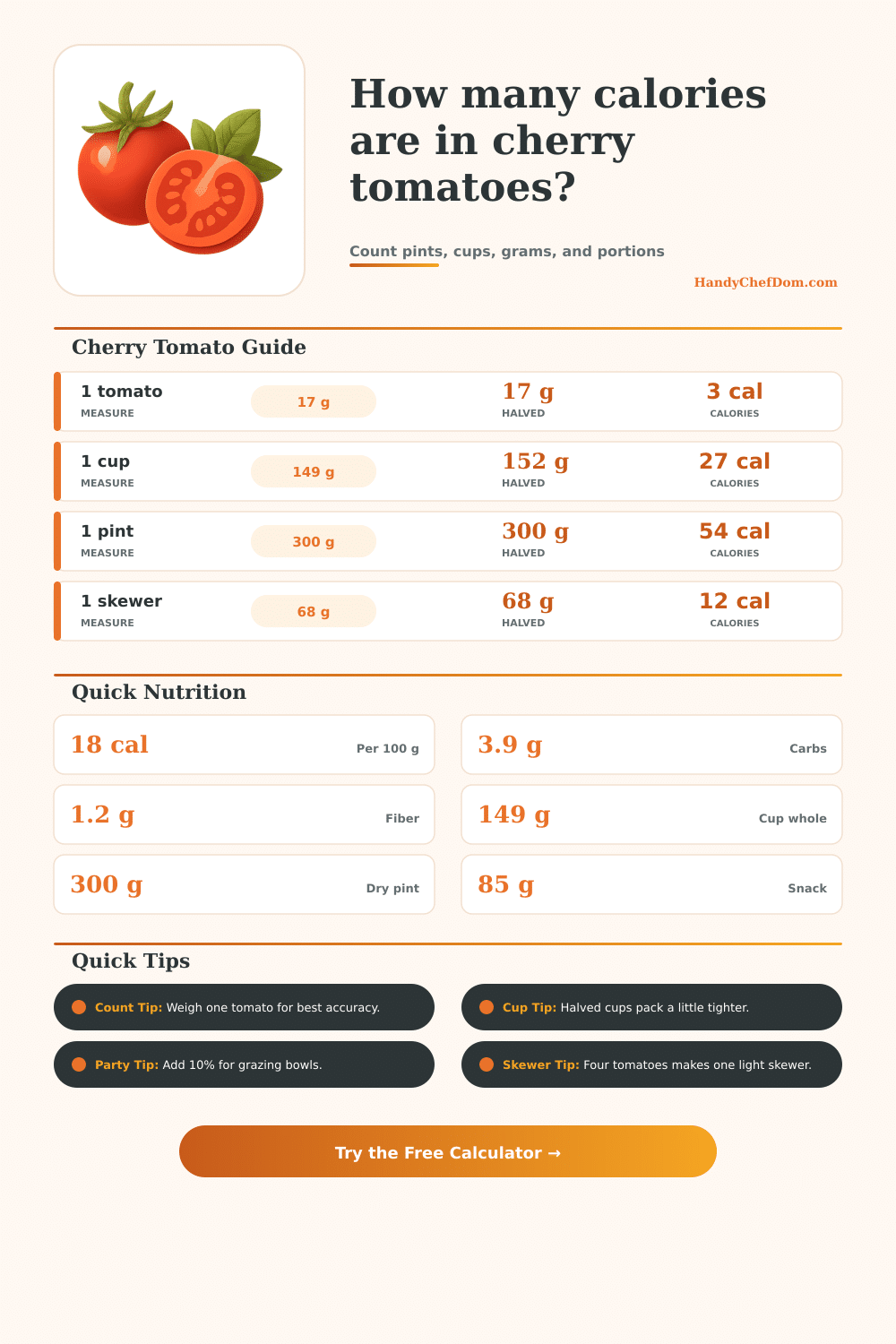
| Red cherry tomatoes | 17 g | 3.1 cal | Count or cup |
| Grape cherry tomatoes | 9 g | 1.6 cal | Count |
| Yellow pear cherry tomatoes | 14 g | 2.4 cal | Count |
| Orange sungold tomatoes | 12 g | 2.3 cal | Count |
| Sweet million cherry tomatoes | 10 g | 1.8 cal | Count |
| Black cherry tomatoes | 16 g | 3.0 cal | Count or gram |
| Mini plum cherry tomatoes | 11 g | 2.0 cal | Carton |
| Mixed medley cherry tomatoes | 15 g | 2.8 cal | Pint |
| Measure | Whole Weight | Halved Weight | Typical Count |
|---|---|---|---|
| 1 cup | 149 g | 152 g | 9 red cherry |
| 1 dry pint | 300 g | 300 g | 18 red cherry |
| 10 oz carton | 283 g | 283 g | 17 red cherry |
| 12 oz carton | 340 g | 340 g | 20 red cherry |
| 16 oz family pack | 454 g | 454 g | 27 red cherry |
| 20 oz party carton | 567 g | 567 g | 33 red cherry |
| Portion Style | Grams Each | Calories | Use Case |
|---|---|---|---|
| Small garnish | 35 g | 6 cal | Plate accent |
| Salad topping | 75 g | 14 cal | Lunch bowl |
| Snack handful | 85 g | 15 cal | Raw snack |
| Skewer pieces | 68 g | 12 cal | Four tomatoes |
| Meal prep side | 120 g | 22 cal | Container side |
| Grazing bowl | 100 g | 18 cal | Shared tray |
| Amount | Calories | Carbs | Fiber |
|---|---|---|---|
| 50 g | 9 cal | 2.0 g | 0.6 g |
| 85 g snack | 15 cal | 3.3 g | 1.0 g |
| 1 cup whole | 27 cal | 5.8 g | 1.8 g |
| 1 dry pint | 54 cal | 11.7 g | 3.6 g |
| 10 oz carton | 51 cal | 11.0 g | 3.4 g |
| 1 lb | 82 cal | 17.6 g | 5.4 g |
For example, cherry tomatoes are acidic and bright, but they’re a touch harder to track because their weight doesn’t always match their volume. One cup of halved cherry tomatoes is heavier then one cup of whole ones, because the former have air filling out their spaces. A half will fit more tightly into a cup than the whole version, affecting your calories in some small way. Keep that in mind if you want to avoid guesswork.
To help with measuring your fruit and veggie intake, there’s also a calculator here to do the math for you. Pick what it is (tomatoes in this case). Choose if they are halved or whole. Pick how many there are (units), and it will convert between cups, grams, ounces, etc. It takes into account how much denser something is than other things; an intuition that many people gets wrong. A cup isn’t always a cup. Physics proves that.
How to Measure Your Tomatoes Easily
Then it uses common data (fiber, carbs, calories) to turn those rough estimates into actual counts. That eliminates the struggle from eating healthy meals and replaces imprecise containers with precise amounts. It is also important to use variety because not all tomatoes weighs the same. A pint of grapes has more individual fruits (each one is smaller and denser) than a pint of large red cherry (or a pint of yellow pear). As those labels indicate, the average weight changes. And that makes a difference when we’re counting, since it might be that five grape tomatoes weigh only half as much as five big reds.
The calculator accounts for this variation, without penalizing you for choosing to grow a certain variety. It normalizes the data, which allows you to compare apples with oranges (er, tomatoes), etc., with ease.
Why: Thinking in servings makes portion control more intuitive than in some vague number of grams. Eighty-five is the ballpark size for a handful of snacks, while a salad topping would be on the order of seventy-five. Before long, those little portions start to stack up at a buffet. To figure out the total yield, type in your intended use case (desk snack? party bowl?), and the tool will tell you how much you’ll have. Party bowl?), and the tool will tell you how many servings that translates into.
Want to leave room for people who will linger with their appetizers? Add a percentage buffer. It knows that nobody lives in text books where meals exactly match serving sizes. Good-looking food gets eaten more. Food right there in front of you gets eaten more. Don’t let your bowl go empty by the time everyone is ready for the main course, plan for ten percent more.
Cherry tomatoes have a sweet flavor yet are good for you. Although they’re low in calories, they contain water and fiber to help promote satiety. That means you can enjoy a large portion without exceeding your calorie ceiling. This makes them great for filling out satisfying meals. They won’t leave you feeling weighed down by heavy refined sugars or fats.
Also take note: Not all carbohydrates are created equal (hence why the calculator notes fiber alongside carbs). Fiber stabilizes blood sugar and promotes slower digestion, keeping energy levels stable over time.
Know the unit of measurement. This thing will only work if you’re honest about what it is you’re measuring: Are we talking per handful or per gram or per pint? It doesn’t matter; nutrition depends on amount. Define your terms and this thing will crunch numbers for you, converting a mound of red spheres into a tidy stack of digits. You don’t have to be good at math to get good food. All you have to do is figure out which side of the scale you’re standing on.
Eating becomes simply eating, not different than any way (the tomatoes taste as delicious no matter the measurement), but somehow more conscious with each bite.