🌰 Walnuts Protein Calculator
Estimate walnut protein, calories, fat, fiber, and omega-3 from halves, pieces, cups, ounces, or grams for snacks, baking, salads, and meal prep.
Choose the way you measure walnuts, then select the walnut label and portion use. The calculator converts the amount to grams before estimating nutrition.
| Walnut Label | Best Use | Gram Estimate | Protein |
|---|---|---|---|
| Raw walnut halves | Snack bowls | 2 g per half | 15.2 g per 100 g |
| Raw walnut pieces | Trail mix | 0.8 g per piece | 15.2 g per 100 g |
| Chopped walnuts | Baking cups | 120 g per cup | 15.2 g per 100 g |
| Finely chopped walnuts | Dense baking | 128 g per cup | 15.2 g per 100 g |
| Toasted walnut halves | Toppings | 1.9 g per half | 15.8 g per 100 g |
| Toasted walnut pieces | Salads | 0.75 g per piece | 15.8 g per 100 g |
| Ground walnut meal | Crusts | 112 g per cup | 15.2 g per 100 g |
| Salad walnut crumble | Bowls | 108 g per cup | 15.2 g per 100 g |
| Measure | Weight | Calories | Protein |
|---|---|---|---|
| 1 walnut half | 2 g | 13 | 0.3 g |
| 7 walnut halves | 14 g | 92 | 2.1 g |
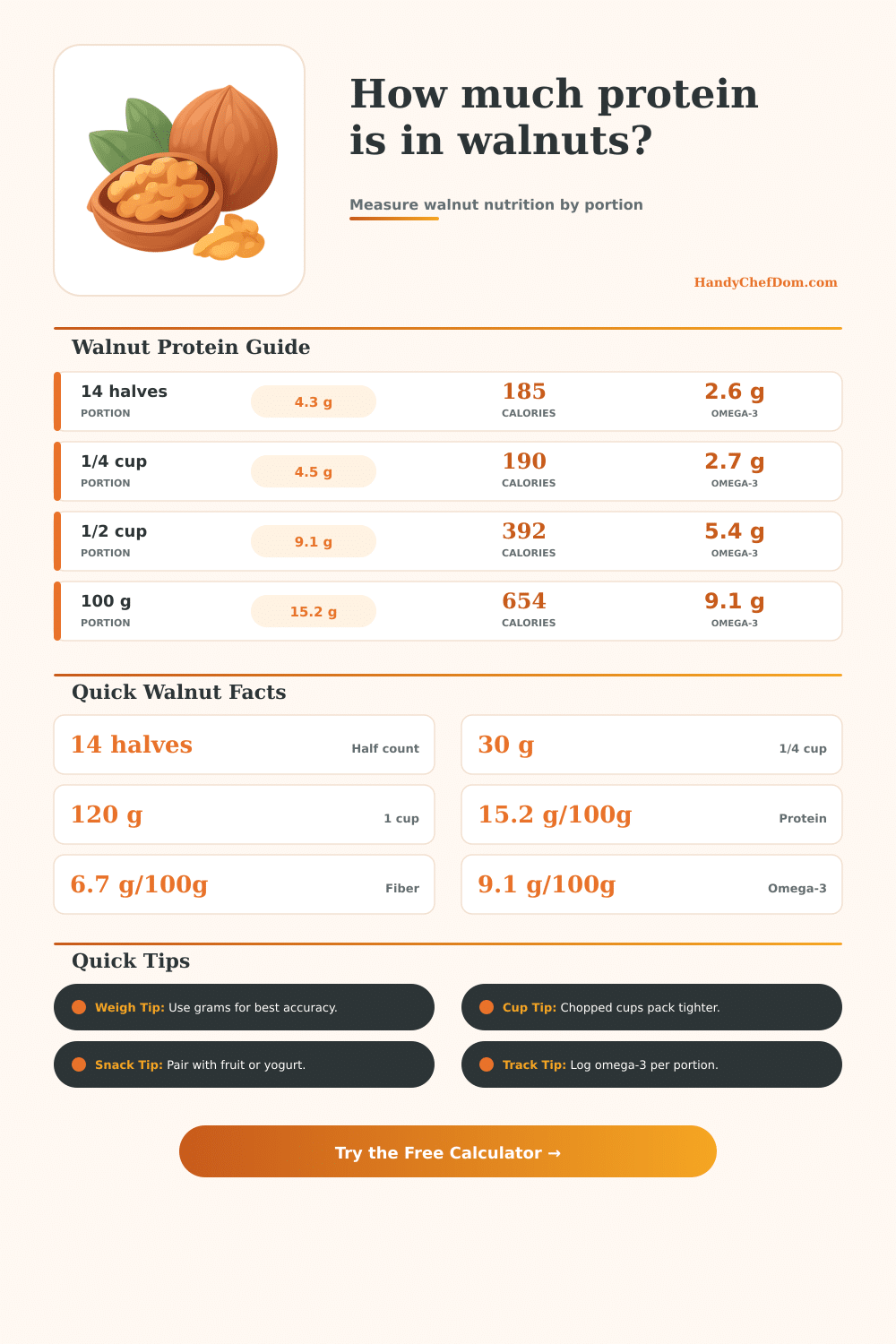
| 14 walnut halves | 28 g | 183 | 4.3 g |
| 1/4 cup chopped | 30 g | 196 | 4.6 g |
| 1/2 cup chopped | 60 g | 392 | 9.1 g |
| 1 cup chopped | 120 g | 785 | 18.3 g |
| Portion Purpose | Typical Amount | Protein Range | Notes |
|---|---|---|---|
| Snack portion | 28-30 g | 4.3-4.6 g | Simple handful size |
| Salad topping | 10-20 g | 1.5-3.0 g | Light crunch and fat |
| Breakfast bowl | 15-25 g | 2.3-3.8 g | Good for oats or yogurt |
| Baking portion | 60-120 g | 9.1-18.3 g | Batch-level nutrition |
| Meal prep serving | 18-24 g | 2.7-3.7 g | Easy to repeat across jars |
| Shared bowl | 150-240 g | 22.8-36.6 g | Total bowl estimate |
| Nutrient | Per 28 g | Per 30 g | Per 100 g |
|---|---|---|---|
| Calories | 183 kcal | 196 kcal | 654 kcal |
| Protein | 4.3 g | 4.6 g | 15.2 g |
| Total fat | 18.3 g | 19.6 g | 65.2 g |
| Fiber | 1.9 g | 2.0 g | 6.7 g |
| Carbs | 3.9 g | 4.1 g | 13.7 g |
| Omega-3 ALA | 2.5 g | 2.7 g | 9.1 g |
Walnuts are a great nut. Healthy and packed with calories in a small package. When you’re snacking on walnuts, you’d be surprised how much of them you can eats before you realize how many calories you’ve actualy had. If you look at the walnuts (or feel them) and try to estimate number of grams of protein, chances are good that you’ll just be making a wild guess.
It’s the form of the walnuts that makes all the differnce in most cases. For example, a cup of whole walnut halves will weigh far less then a cup of chopped walnuts (the latter packs tighter). Since weight = nutrition, this density shift change the calculation.
Why You Should Measure Walnuts by Weight
Once you know whether you’re working with finely ground meal, or more loosely packed pieces (or tightly packed halves), the calculator do the work for you. For example, nuts has irregular shapes, so measuring their volume can be very inaccurate. If you grab a quarter cup from a bag of halves and pour it into your coffee mug, you get a different weight than if you press that same amount down firmly. Then you firmly pack the remainder of the half cup’s worth into your measuring cup… Your results will vary based off those measurements.
To adjust, you have the option to select the type of packing used. From there, it calculate the calories and protein based on that adjusted weight. That’s where the good estimate becomes a wild guess. Trust the numbers if you understand the numbers that went into them The calculator adjusts for the small amount of water lost to the roast when you choose toasted halves. That’s why they’re a little more concentrated by weight.
The same volume will have just a bit more nutrient, including some you may not taste but which count toward your fiber and omega-3s. This matters especially: Walnuts contain one of the highest amount of alpha-linolenic acid (ALA) among all plants, which is one of the reasons to track ALA along with protein. It’s not just about getting bigger muscle, it’s about fighting inflammation and keeping your ticker healthy.
This translates into about four and a half grams of protein from a snack-sized portion (twenty-eight grams). While that may not sound like much (compared to, say, a meat-based serving), keep in mind the healthy fats and fiber that come along with it. These aids in fullness, slowing digestion to make you feel satisfied longer, and also slow the breakdown of protein into glucose, helping maintain stable blood sugar levels. No wonder walnuts pair so nicely with fruit in trail mixes, or anywhere else for that matter!
But what about baking? Most recipes ask for a cup of chopped walnuts. That can add more than one hundred grams of extra weight to whatever you are making. Those extra calories (nearly eight-hundred) and protein (almost eighteen-grams) adds up quickly. This matters if you are watching what you eat.
The beauty of measuring by grams instead of cups is that you can scale recipes up or down, according to your preference. You won’t have to wonder how many extra calories or grams of protein or carbohydrates you’ve added when tweaking things to make them taste just right, either.
While we all tend to lump any nut together, they are actualy not the same. Different nuts contains different amounts of proteins and fats. Switching from walnuts to almonds or cashews, for example, alters your macronutrient breakdown. This calculator takes into account which type of walnuts (and therefore what unique blend of fatty acids) you’re using.
And it will help with meal prep: How much is too much? For those who fill up jars for the week, you can be sure you know exactly how many grams are considered a serving so that you don’t go overboard later in the day.
In conclusion: knowing more helps you make better choices. Of course, this isn’t to say you should of count all of your nuts (unless you want to; I won’t judge), but if you know how much is in each serving, it puts something abstract like “walnuts” into perspective, and gives it a place in your meal plan. That’s what counting calories can do, turn food into numbers so we can indulge guilt-free!
If you’re going to sprinkle them on your salad or bake them into bread, you’ll know exactly how many you ate. Balance beats deprivation. Know yourself; then use the tool to help you find that happy medium between taste and nutrition. Turns out satisfaction comes from both eating well AND eating smart.