🍌 Banana Carb Calculator
Estimate total carbs, net carbs, fiber, and per-serving banana portions from size, length, peeled weight, ripeness, prep state, and recipe use.
Pick the measurement style that best matches your kitchen note. Peeled weight gives the tightest carb estimate, while size and length are helpful when you do not have a scale.
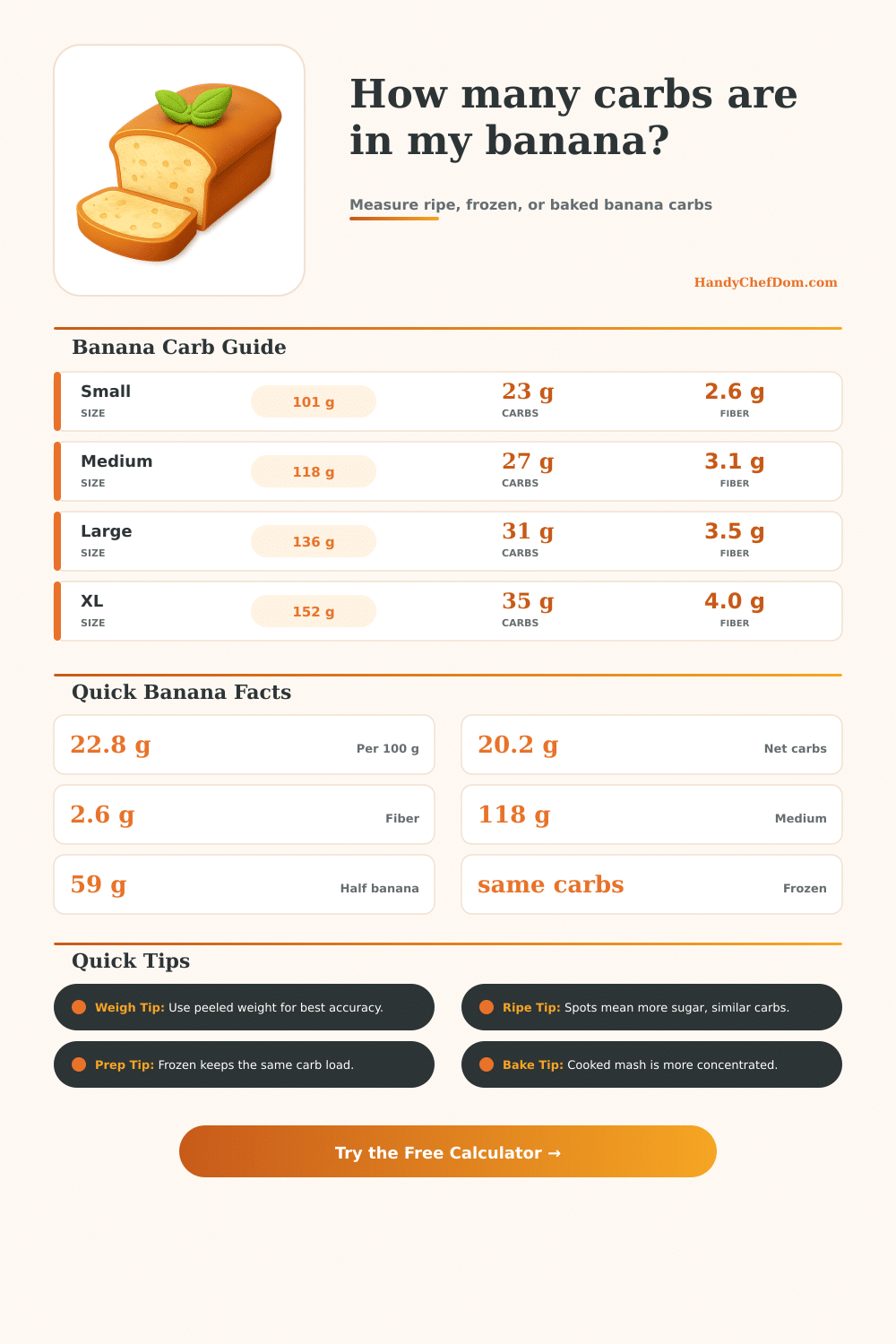
| Banana size | Length guide | Peeled weight | Total carbs |
|---|---|---|---|
| Extra small | Under 6 in | 81 g | 18.5 g |
| Small | 6 to 7 in | 101 g | 23.0 g |
| Medium | 7 to 8 in | 118 g | 26.9 g |
| Large | 8 to 9 in | 136 g | 31.1 g |
| Extra large | Over 9 in | 152 g | 34.7 g |
| Ripeness stage | Carbs per 100 g | Fiber per 100 g | Best kitchen use |
|---|---|---|---|
| Green and firm | 22.0 g | 2.8 g | Slices, bowls |
| Yellow, no spots | 22.8 g | 2.6 g | Snacks, topping |
| Spotted ripe | 23.0 g | 2.3 g | Smoothies |
| Overripe baking | 23.2 g | 2.1 g | Muffins, bread |
| Prep state | Weight effect | Carb effect | Calculator note |
|---|---|---|---|
| Raw sliced | None | 1.00x | Baseline estimate |
| Frozen chunks | None | 1.00x | Same carbs |
| Thawed frozen | Light drain | 1.02x | Slightly denser |
| Cooked warm | Moisture loss | 1.08x | Dense spoonfuls |
| Baked mashed | More loss | 1.15x | Thick batter mash |
| Use style | Typical banana amount | Serving split | Carb planning cue |
|---|---|---|---|
| Fresh snack | 1 medium | 1 serving | Log full banana |
| Smoothie jar | 1 large | 1 to 2 servings | Split by jars |
| Oat bowl | 0.5 medium | 1 serving | Use count 0.5 |
| Pancake batter | 1 medium | 2 to 4 servings | Divide batter |
| Muffin batch | 2 to 3 ripe | 8 to 12 servings | Use recipe share |
| Banana bread | 3 overripe | 10 slices | Slice evenly |
Nutrition estimates use standard banana values per 100 g and adjust them for ripeness, edible portion, serving split, and moisture concentration from cooked or baked prep.
But now you face a banana: Will it screw with your day’s carb allotment? Is it a risk? Or is there no way to know unless you grab it, look at it, and see it transform from a thing into something else? The problem isn’t the banana; it’s how much banana you actualy consume.
A medium yellow banana contain about 27 grams of carbohydrates. It sounds easy enough. But things change when you cut off a bit, leave some on the counter, peel and freeze it whole, mash it into a loaf of bread, or eat it while it’s still green. The actual amount youre consuming changes slightly, which make a difference when your tracking strictly.
Why Your Banana Matters for Carbs
With this calculator, though, you can plug in your own information and let the calculator handle the rest. You won’t need to calculate in your head whether that patchy peel equals increased sweetness or simply increased aesthetic appeal.
For most folks, however, a banana is a banana, an equivalent amount of energy. It’s not exactly true. Because they’re all ripe to some degree or another, each one has different level of perceived sweetness and a different consistency. However, the total amount of carbohydrates remain fairly constant.
A greener banana have less digestible starch; instead, it contains a higher proportion of resistant starches that act more like dietary fiber inside your digestive system. Those complex starches gets broken down into simpler sugars by enzymes once the fruit turns yellow and begins to sport some brown patches. Both contain roughly the same number of grams of carbs per 100 grams of fruit.
However, it depends on whether you want to restrict your intake based off a daily gram count or monitor your blood sugar response. In the latter case, ripeness becomes the deciding factor different than size. But none of those visual size category-based estimates is very precise; they’re all riddled with error. A big banana can be heavy (full of water) or light (dried out a bit). Who knows what the water content/density of this particular banana are? It could look like a lot but actualy weigh very little.
That’s where weighing the banana removes that guesswork. Enter the actual weight of the meaty part (the edible parts! And there), you get a precision that just doesn’t exist with size labels. But don’t worry about having to get one of those fancy scales that cost a pretty penny; a regular ol’ food scale for kitchens is enough here. The only caveat: peel the banana before weighing it, or subtract its peel weight, since we want to count only the edible bits of our carbs.
But even beyond this, we have preparation methods to consider (something very few tracking apps account for). While freezing a banana won’t alter its carb count, when thawed those ice crystals disrupt the cells, turning the food mushy but leaving the macronutrients intact, cooking or baking will lead to some moisture loss. If you mash your bananas for a batch of muffins, or bake them into bread, all that water is going to cook off, leaving a concentrated dose of the rest of the stuff inside. For example, one cup of fresh banana slices has fewer carbs than a cup of baked banana mash because there isn’t as much water taking up space in the cup.
The calculator accounts for this concentration effect and also considers that cooked portions is inherently “denser” in terms of nutritional value (even if they started life as the same-size piece of fruit).
Most tracking falls apart at the serving split. Did you blend up a banana smoothie for yourself plus one for a friend? Do you enter in the whole thing, or half of it? Enter in a share percentage and the number of servings per recipe. This is important when you’re doing some batch cooking. For example, you’ll have three overripe bananas on your counter and you bake a dozen muffins with them, you want to divide those carbs evenly across all servings, not just based off how much each person consumes!
Over time, this makes your logs accurate and helps you think of your portion sizes as shares from a larger whole instead of a single fixed amount. It’s less about weighing out grams, more about learning the trends of your consumption. It’s about knowing when to use an over-ripe banana (to sweeten a dessert batter) or a green one (in a salad where you want it to retain its firmness). You’ll learn which banana goes where, so that each one is used best based on its state of ripeness and preparation.
Frozen as ice cubes, sliced onto a snack plate, blended into smoothies… There’s no wrong way to eat a banana. With those numbers, you have options, not limitations. You know what you’re eating, and that allows you to enjoy the food with confidence, without any guesswork. To me, this makes what was just a snack become a meaningful part of your day.