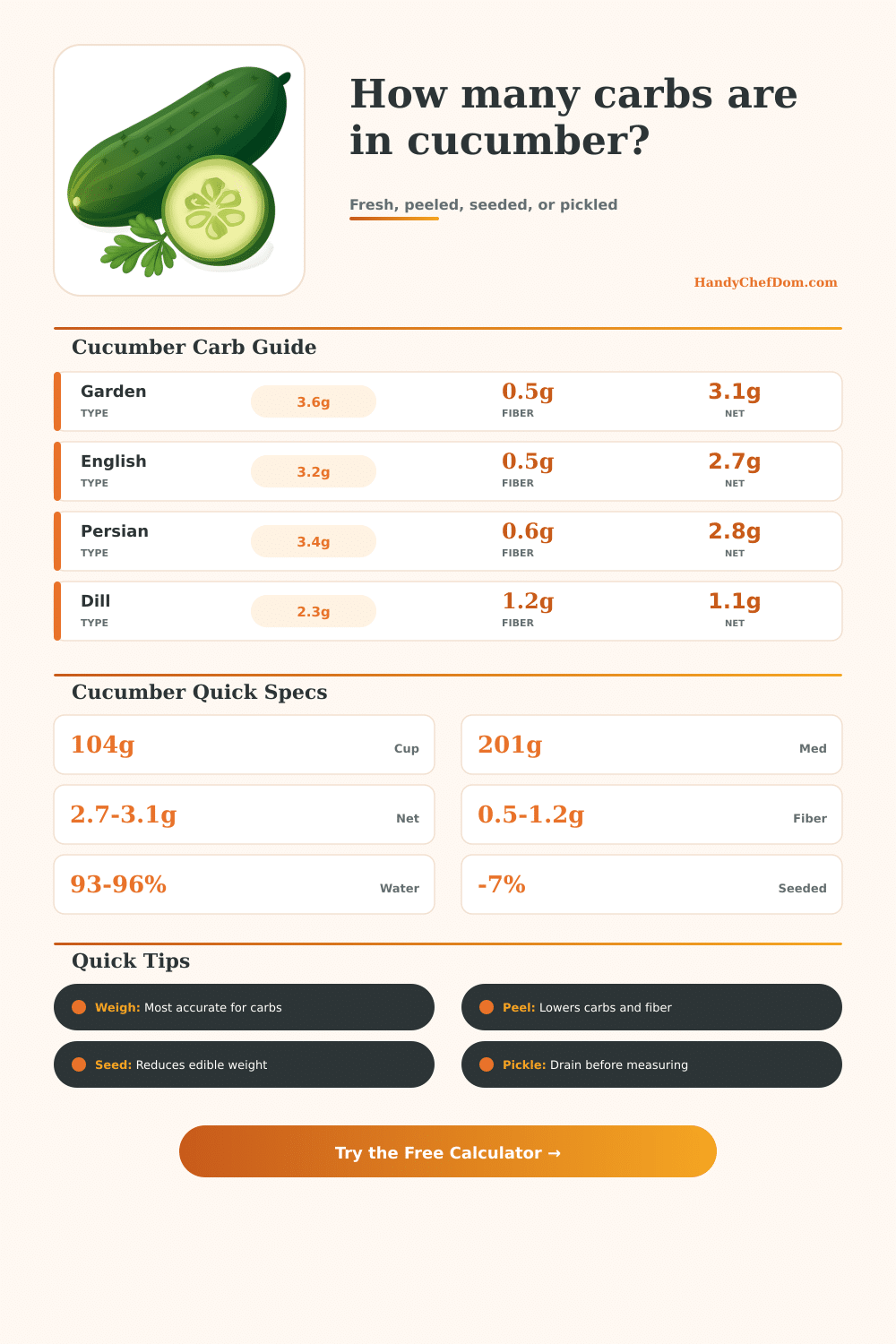
Cucumber Carb Calculator
Estimate total carbs, net carbs, fiber, sliced cups, servings, and salad hydration yield for fresh or pickled cucumbers.
Full cucumber breakdown
Garden slicing
Best for: count-based salads and trays.
Carb note: unpeeled medium cucumbers keep more fiber.
English seedless
Best for: long thin slices and tea sandwiches.
Carb note: slightly lower carb density per 100 g.
Persian mini
Best for: snack boxes and meal prep cups.
Carb note: small size makes serving counts easier.
Drained pickles
Best for: low-volume sides and chopped toppings.
Carb note: dill is lower than sweet pickle styles.
| Cucumber type | Total carbs | Fiber | Net carbs | Water estimate |
|---|---|---|---|---|
| Garden slicing cucumber, unpeeled | 3.63 g | 0.50 g | 3.13 g | 95% |
| English seedless cucumber | 3.20 g | 0.50 g | 2.70 g | 96% |
| Persian mini cucumber | 3.40 g | 0.60 g | 2.80 g | 95% |
| Kirby pickling cucumber, fresh | 3.70 g | 0.60 g | 3.10 g | 94% |
| Lemon cucumber | 3.80 g | 0.60 g | 3.20 g | 94% |
| Japanese cucumber | 3.30 g | 0.50 g | 2.80 g | 96% |
| Armenian cucumber | 3.50 g | 0.50 g | 3.00 g | 95% |
| Dill pickle cucumber, drained | 2.26 g | 1.20 g | 1.06 g | 93% |
| Cut style | Estimated grams per cup | Approx ounces per cup | Best use in calculator |
|---|---|---|---|
| Thin sliced rounds | 104 g | 3.7 oz | Salads, trays, sandwiches |
| Half moons | 110 g | 3.9 oz | Chopped salad bowls |
| Diced cucumber | 120 g | 4.2 oz | Salsa-style toppings |
| Spear pieces | 96 g | 3.4 oz | Snack plates and sides |
| Shredded and drained | 88 g | 3.1 oz | Pressed salads and sauces |
| Prep choice | Weight impact | Carb impact | Fiber impact | Hydration note |
|---|---|---|---|---|
| Unpeeled, seeds included | No reduction | Baseline | Baseline | Highest edible yield |
| Partly peeled stripes | 2% less weight | 3% lower | 8% lower | Good salad balance |
| Fully peeled | 6% less weight | 8% lower | 22% lower | Softer texture |
| Lightly seeded | 4% less weight | 4% lower | 4% lower | Less watery center |
| Fully seeded | 8% less weight | 7% lower | 7% lower | Better for dressed salads |
| Dill pickle, drained | Use drained weight | Lower net carbs | Higher fiber ratio | Less free water after draining |
| Serving plan | People | Light side amount | Salad amount | Approx sliced cups |
|---|---|---|---|---|
| Snack plate | 2 | 104 g | 156 g | 1 to 1.5 cups |
| Family lunch salad | 4 | 208 g | 312 g | 2 to 3 cups |
| Meal prep bowls | 6 | 312 g | 468 g | 3 to 4.5 cups |
| BBQ tray | 12 | 624 g | 936 g | 6 to 9 cups |
| Party salad | 24 | 1248 g | 1872 g | 12 to 18 cups |
A few slices on your sandwich or a handful in your salad bowl start the process. And cucumber looks innocent enough. It is crisp and hydrating, so it’s no problem for your blood sugar. But unless you do the math, assuming so could of be risky if your net carb count is tight.
Cucumbers come in all shapes, sizes, and forms, depending on whether they are skin-on or peeled, seeded or unseeded, and fresh from garden or pickled. A drained dill pickle isn’t just different in taste: It’s different in terms of water weight and fiber content, each a factor to consider when every gram is counted toward your daily limit.
Why Accurate Carb Counting Matters for Cucumbers
This takes all those factors into account and run the math for you (check out the calculator up top). Instead of slicing, most people guess at the number of carbs using the slice count. Guessing based off slices isn’t very accurate. This is because different shapes and sizes of cuts has different densities (for example, a cup of shredded cucumber doesn’t weigh as much as a cup of diced).
Once you choose your type of cut in the tool, it take that into account and makes sure your carb count matches real world instead of an educated guesstimate. It turns an imprecise notion of serving size into a true nutrition fact.
The other big variable is whether or not you’re going to be peeling it. The skin has more fiber than any other part. Removing the skin take away some of those carbs and lowers your net carb count instead. And if you do end up peeling the whole thing, what’s left behind isn’t just less fibrous, it’s smaller by a couple of percent, too. This is accounted for automatically by the tool. It’ll tell you that you’ve reduced both amount of carbs AND fiber, so the overall net carb effect tends to stay roughly unchanged. (That’s one of those subtleties nobody thinks about before whipping out the veggie peeler.)
In almost every case where you peel it, keeping the skin intact will retain more fiber but little extra sugar. Removing seeds (which store moisture) has less of an impact on carb content then on water content. Because cucumbers have moist seeds that can turn your salad mushy, removing them will enhance the texture but diminish total yield by weight. Whether you choose seedless cucumbers, or those with just a few seeds, or those with plenty of seeds, your choice changes how much actual cucumber flesh you get. This also affects how much waste you avoid if you prefer to skip the watery centers. However, removing seeds will also mean a slightly reduced amount of moisture in finished dish. Is a slightly drier salad worth the slight loss of edible volume?
In a whole other category are pickles (which include cucumber pickles), which swap out some of the natural water for vinegary salty solution, or pickle-brine. While fresh cucumbers may be lower in fiber on a gram-for-gram basis than some other foods, they lose volume when cured into pickles, so those pickles tends to have slightly more grams of fiber per pound or kilogram than their originals did fresh off the vine. Traditionally drained dills have different carb contents then quicker pickling types, and the device takes this into account, though it’s not always obvious.
If you’re using them, drain first, since that liquid will increase the total weight but not the carbs, throwing off the per-gram calculation. Weigh drained for accurate results, as ever.
The input side helps you understand what cucumbers you have (and don’t) to plan your recipes so you hits your macro targets while still enjoying food. If you get a big batch of fresh cukes, you’ll know it’s not going to mess up your carb count much. If you want to use pickles but are unsure which ones to choose, you’ll know how to keep them within target by choosing low-density ones or just using fewer.
All that information is spelled out in the reference tables that come with the calculator, explaining differences in size and density between Persian mini cucumbers and the more typical English types. Match the info to real life in your fridge, and then eat!
In short, carb counting isn’t about limiting you, but about being accurate. There’s no need to count and restrict to the letter of the law, just enjoy eating cucumber without sneaking a few extra grams here and there. Knowing how peeling changes fiber content and realizing that slice thickness matter helps you portion with confidence. The math gets left up to the calculator while you eat the food.
When you take a bite during lunch next time, you’ll have a clear idea of its macro cost, transforming a humble veggie into an easy dietary ally.