🍇 Green Grapes Calorie Calculator
Estimate green grape calories, carbs, fiber, net carbs, sugar, grape count, cups, grams, ounces, servings, and daily target impact.
Choose the way you measured your grapes. The USDA basis below uses green seedless raw grapes per 100 g; seeded mode subtracts a small edible-yield adjustment before nutrition math.
| Nutrition basis | Calories | Total carbs | Sugar | Fiber |
|---|---|---|---|---|
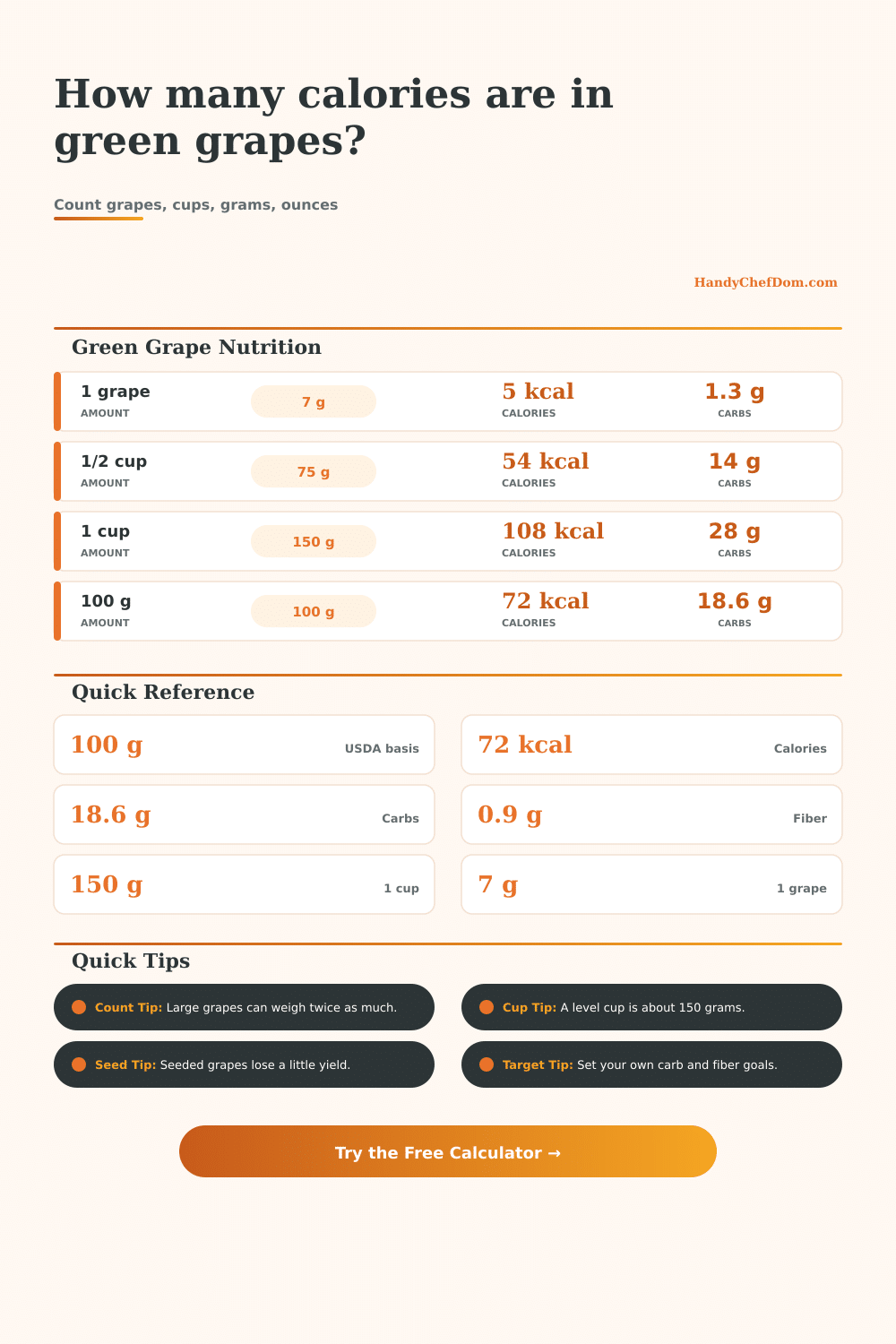
| Green seedless grapes, 100 g | 72 kcal | 18.6 g | 16.1 g | 0.9 g |
| Green seedless grapes, 1 cup | 108 kcal | 27.9 g | 24.2 g | 1.4 g |
| Green seedless grapes, 1/2 cup | 54 kcal | 14.0 g | 12.1 g | 0.7 g |
| Green seedless grapes, 1 ounce | 20 kcal | 5.3 g | 4.6 g | 0.3 g |
| Grape count | Small grapes | Medium grapes | Large grapes | Jumbo grapes |
|---|---|---|---|---|
| 10 grapes | 50 g, 36 kcal | 70 g, 50 kcal | 90 g, 65 kcal | 110 g, 79 kcal |
| 20 grapes | 100 g, 72 kcal | 140 g, 101 kcal | 180 g, 129 kcal | 220 g, 158 kcal |
| 30 grapes | 150 g, 108 kcal | 210 g, 151 kcal | 270 g, 194 kcal | 330 g, 237 kcal |
| 40 grapes | 200 g, 144 kcal | 280 g, 201 kcal | 360 g, 259 kcal | 440 g, 316 kcal |
| Kitchen measure | Typical weight | Calories | Total carbs | Best use |
|---|---|---|---|---|
| 1/4 cup green grapes | 38 g | 27 kcal | 7.1 g | Small topping |
| 1/2 cup green grapes | 75 g | 54 kcal | 14.0 g | Kids side |
| 1 cup green grapes | 150 g | 108 kcal | 27.9 g | Lunch side |
| 3 ounce snack | 85 g | 61 kcal | 15.8 g | Snack cup |
| 1 pound green grapes | 454 g | 326 kcal | 84.4 g | Shared bowl |
| Daily target check | Portion weight | Carb target share | Fiber target share | Net carbs |
|---|---|---|---|---|
| Light snack | 75 g | 5% of 275 g | 2% of 28 g | 13.3 g |
| Standard snack | 100 g | 7% of 275 g | 3% of 28 g | 17.7 g |
| One cup serving | 150 g | 10% of 275 g | 5% of 28 g | 26.6 g |
| Large bowl | 250 g | 17% of 275 g | 8% of 28 g | 44.3 g |
Most of us eat green grapes without thinking about what they do to our diet. After all, it’s just a “healthy” snack, right? But here’s the thing: One cup has almost one-hundred ten calories in it. Seems reasonable, right? Not so fast. That number accumulate fast because we think of this food as our personal buffet instead of a measured portion size.
Enter the calculator (above). It will run calculations for you, transforming your vague estimates into concrete numbers and showing you exactly where your snack fit within your day.
Why Size Matters for Green Grapes
Grape size is largest factor in their nutritional makeup. While a small seedless grape weigh roughly five grams, a jumbo variety can weigh 11 grams or more. If you imagine each grape as weighing the same amount, your total calories will slowly drift away from true counts. That’s why we made this tool so you could choose the approximate size of average grape rather than add them one by one.
Maybe you think you’re eating two hands full of grapes? But those grapes is big, so that handful is practically twice the weight of a handful of small grapes. In fact, a single large grape contain about 30 extra calories compared to medium sized grape. Small things, but important if you’re trying to tally energy consumed with precision.
But then there are also complications with measurement by volume. A cup of grapes sounds like it should of been easy. Except, do they get packed tight? The more space there is between round object, the fewer grapes will fit in a cup when they are loose compared to when they is pressed down. Nutritional information for most foods is based off assuming a flat cup measuring about one hundred fifty grams. Pouring those grapes into a bowl without pressing them down, though, can result in an under-estimate of up to ten or fifteen percent. To make up for this, the calculator provide weight measurements as well as volume conversions, connecting math and kitchen intuition.
Finally, there is seed factor. The seeds themselves also come into play with yield estimation. Because they occupy space, you’ll get fewer grams of edible flesh from a seeded variety than an unseeded one, all else being equal. That said, you don’t actualy consume those seeds; you just consume the flesh surrounding them. So the tool reduces yield by a bit when you choose a seeded grape, since it knows that there will be fewer actual fruit tissue per unit of count or volume. Most folks won’t even think about this. I’m sure some people would argue it doesn’t matter, but it does ensure that the carbohydrate number reflect only what goes into your body. If you’re not accounting for seed weight, you’ll end up with a bit over-estimated nutrient content.
This all goes back to the idea of setting a target number for each day. It’s helpful to know that there are approximately twenty eight grams of carbs in a cup of green grapes. That matters once you realize it is ten percent of your two hundred seventy five gram per day target. This tool will map out how much of your specific portion matches your own goal. Maybe it’s managing carbohydrates? Or maybe it’s getting enough fiber? What matters to you? It converts statistics into useful percentages. No more guessing. Now it’s about knowing.
Unlike certain fruits, green grapes contain little dietary fiber and provide more naturaly sugars. That reduced fiber content also makes their total carbs a bit higher than the net carb content. This difference may be important for people on low-carb diets or those tracking their blood sugar. Grapes are an instant source of fuel in a bowl, though they won’t fill you up as much as items rich in fiber will. Combining them with a food containing protein (such as nuts or cheese) can offset the blood sugar spike.
All in all, there’s very little of “don’t eat this” about eating fruit, and much more “know this.” And the information on the page makes that plain. The chart on the page shows how much of one food is equal to a certain amount of another. Learn to eyeball the difference between large and small grapes, and you can control portion size without counting calories (or weighing each piece). Now you are seeing caloric density instead of guessing. That’s a big shift, not just for grapes but for anything else you like to eat. Reach into that bag the next time and you’ll know precisely what you’ve got going into today.