Celery Fiber Calculator
Convert celery stalks, grams, chopped cups, trimmed yield, cooked or soup use, and snack tray servings into practical fiber totals.
Celery Fiber Results
| Celery form or use | Typical amount | Estimated fiber | Best calculator setting |
|---|---|---|---|
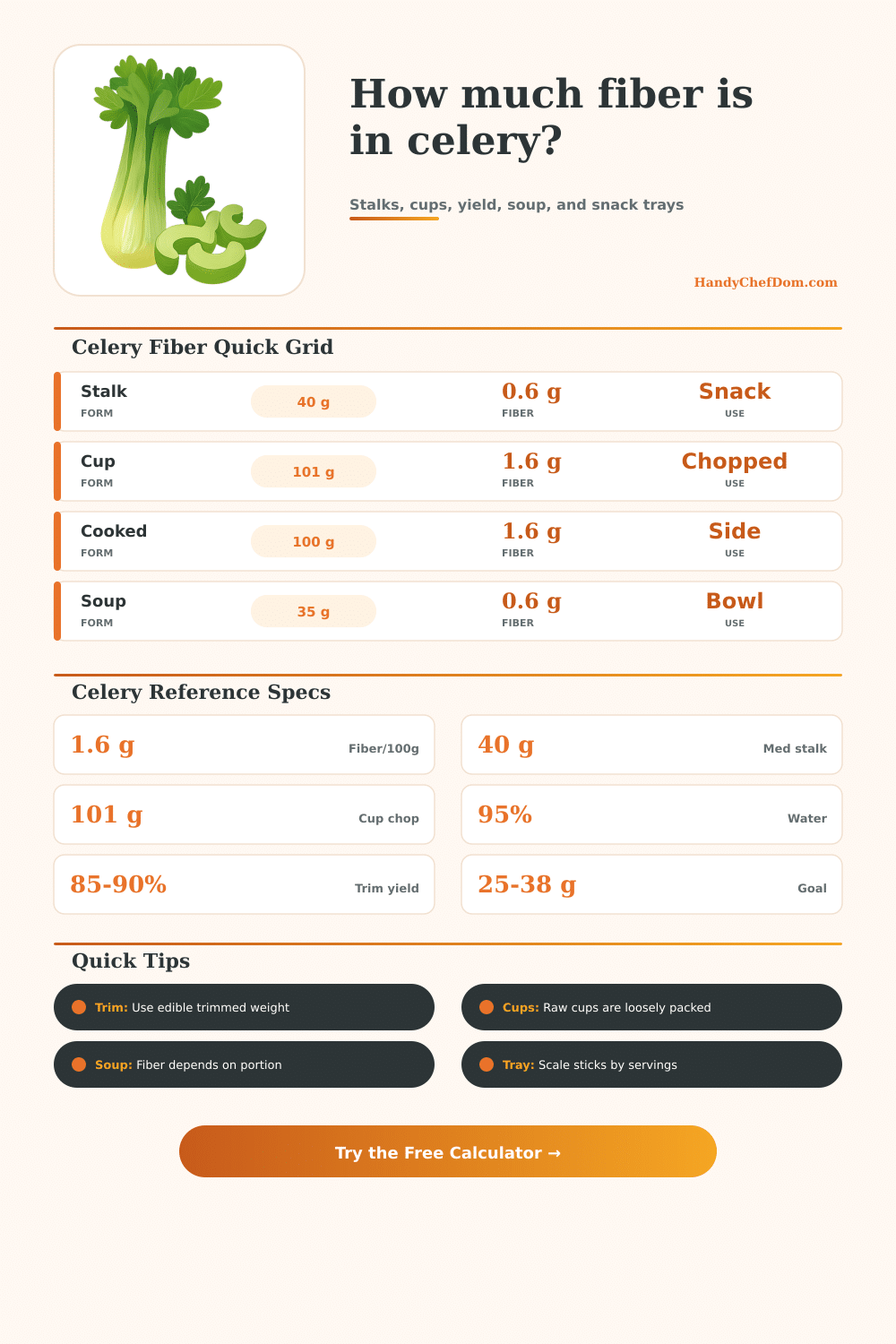
| Medium raw stalk | 40 g before custom trim | About 0.6 g | Stalk count with medium raw stalks |
| Large outer rib | 64 g before custom trim | About 1.0 g | Stalk count with large outer ribs |
| Chopped raw celery | 101 g per loose cup | About 1.6 g | Chopped cups with raw chopped salad |
| Cooked celery pieces | 150 g per cooked cup | About 2.4 g before portioning | Weight or cups with cooked side dish |
| Soup base dice | 35 g raw celery per bowl | About 0.6 g per bowl | Soup or stew base use style |
| Snack sticks | 8 sticks at 10 g each | About 1.3 g | Snack tray scale with raw celery |
| Starting measure | Gross celery | At 88% trim yield | Fiber after trim |
|---|---|---|---|
| 4 medium stalks | 160 g | 141 g edible | 2.3 g fiber |
| 1 chopped cup | 101 g | 89 g edible | 1.4 g fiber |
| 1 celery bunch | 450 g | 396 g edible | 6.3 g fiber |
| 2 cooked cups | 300 g cooked volume | 264 g edible equivalent | 4.2 g fiber |
| 10 soup bowls | 350 g raw celery | 308 g edible | 4.9 g fiber |
| Use style | Celery per serving | Fiber per serving | Portion context |
|---|---|---|---|
| Raw snack tray | 80 g edible celery | 1.3 g | About 8 snack sticks per person |
| Chopped salad crunch | 50 g edible celery | 0.8 g | Visible crunch without taking over the bowl |
| Cooked side celery | 90 g cooked serving | 1.4 g | Uses lower water-weight after cooking |
| Soup or stew base | 35 g raw celery | 0.6 g | Fiber is diluted across each bowl |
| Stuffing or casserole | 45 g raw celery | 0.7 g | Good for recipe scaling by servings |
| Guests | Edible celery | Approximate stalks | Total celery fiber |
|---|---|---|---|
| 4 snack servings | 320 g | 8 medium stalks | 5.1 g fiber |
| 8 snack servings | 640 g | 16 medium stalks | 10.2 g fiber |
| 12 snack servings | 960 g | 24 medium stalks | 15.4 g fiber |
| 24 snack servings | 1.92 kg | 48 medium stalks | 30.7 g fiber |
| 40 snack servings | 3.2 kg | 80 medium stalks | 51.2 g fiber |
Celery is one of those foods that most people purchase more for its crunch than its nutrition. Think of it as a brightly colored stick that tastes like vegetables + some water. Dip it in your ranch dressing at the party or throw it in your soup, whatever.
In terms of nutrition, it are pretty much low in calories and high in moisture. In fact, approximately 95% of raw celery, on a weight basis, is water. Translation: Unless you plan on eating a lot of celery (which requires taking up a lot of space), it doesn’t do much for most macros. Volume > Intensity applies here.
Why Celery Is Hard To Count
You don’t get a huge dose of fiber from a single stalk alone. However, if you think about how much of the plant is actualy edible, you can expect a steady stream of this macro. This is true even if you only add one or two stalks at a time, provided you stop thinking of celery solely as sticks.
I have discovered that market varieties of celery range widely in density and thickness. The thickest part of the outside of a stem has more weight than the slimmest part near the middle. Trying to eyeball a fiber goal like this… Whether aiming to get at least X grams per day. Is likely going to result in an underestimate.
By entering which version (above) of celery you have, the calculator crunches numbers for you. Enter “whole” if using it as a snack-stick on a cheese platter, or “chopped cups,” if you’re making a salad. No need to weigh each individual item by hand beforehand.
You also won’t escape seeing how much gets trimmed away. Celery needs a lot of trimming. You have to get rid of the rough ends of roots, the stringy outer layers, and the dried-out tips that stay too long in fridge. When you purchase a four-hundred-fifty-gram bunch, you don’t consume four-hundred-fifty grams of celery.
Depending on its freshness, you’ll be losing anywhere from ten to fifteen percent of your weight to trimming, subtracting the waste makes sense, since failing to account for it will inflate your expectation of just how much fiber you’ve eaten. It’s a minor adjustment, but one worth noting. It matters if you’re cooking for yourself and trying to hit exact portion sizes, or cooking for a crowd and making things scale up or down more properly.
But then cooking factors back in. Because heat causes water to evaporate, there’s less total water left; and thus the solid stuff that remains is now slightly more concentrated by volume. Raw chopped celery fits loosely in a cup. Once cooked, the same amount packs down more tightly and weighs more than a cup because the structure of raw cells give way to heat. Its fiber isn’t gone, exactly, but the fact that it’s measured in volume instead of weight alters its fiber content different than what it was before cooking.
When you’re simmering celery in soup, for example, it disintegrates somewhat into the liquid. Sure, there’s still fiber… But it’s spread throughout the whole bowl, not present as a clearly defined lump when you stab at it with your spoon. That explains, in part, how soup portions can have lower fiber-per-gram-of-ingredient content then if you were munching on a crunchy celery stick.
The other logistical problem is snack trays. If you’re feeding a crowd, it doesn’t take long to go from 8 sticks per person (a good starting point for a decent serving) to a lot of sticks required. In terms of total stalks? It adds up fast. The reference tables that come with the tool break out those types of scenarios.
For example, they’ll tell you how much edible celery is in a certain number of medium stalks and its weight in grams. This also tells you amount of fiber it contains. Turns out: to feed twenty-four people, you’d need close to two kilograms of edible celery. That is about forty-eight medium stalks.
Seeing the mountain of produce helps avoid the all-too-common mistake of not buying enough bunches. After all, the tray usually looks empty because the dip bowls and the gaps between sticks take up so much space.
But then all these inputs make this seemingly humble vegetable something real in your meal-planning toolbox. No more guesswork, just knowing: How many bites am I going to get with my green? What’s the crunch factor here? What will it take to feed myself (or others) with this ingredient over the next few days? That’s the connection between, “I should eat more vegetables,” and actually doing so: measuring out enough to count in some way toward your nutritional goal.
The slow accumulation of fiber counts, provided you do it right. When you pull that waxy, crinkly bag off the shelf the next time, consider where those stalks are headed after they’re boiled or cut or otherwise processed. There may be less than meets the eye, but what there is, might surprise you when it comes to counting calories and meeting any nutritional goals you’ve made for yourself day-to-day.
Crunch, yes. But now you have knowledge.