Kale Fiber Calculator
Estimate total fiber, per-serving fiber, edible leaf yield, cooked shrink, massage volume, and meal-prep scaling for curly, lacinato, baby, red, and mixed kale.
Your kale fiber breakdown
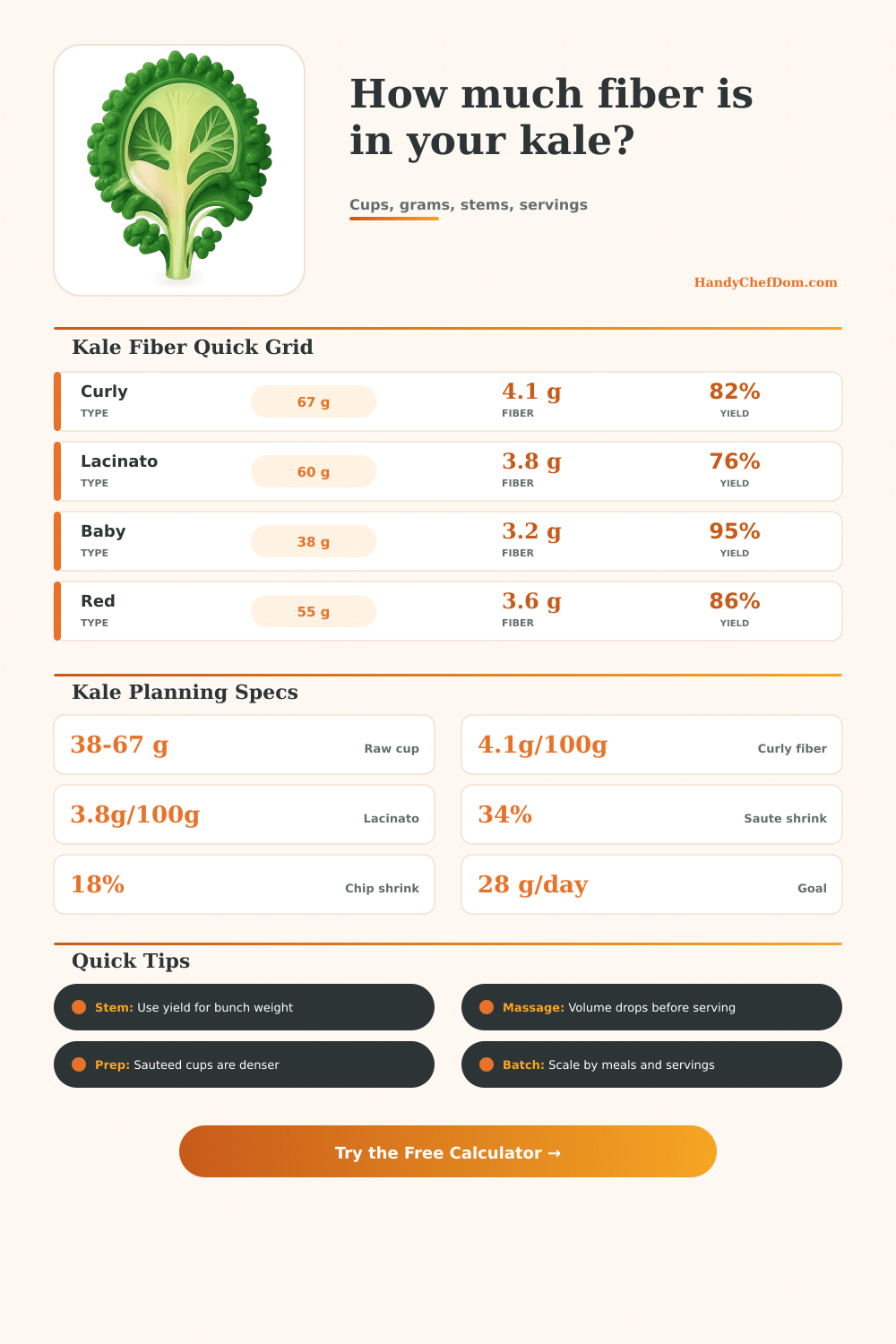
| Kale type | Typical chopped cup | Fiber per 100 g raw edible | Stemmed leaf yield | Best calculator use |
|---|---|---|---|---|
| Curly green kale | 67 g / 2.4 oz | 4.1 g | About 82% | Salads, sauteed sides, chips |
| Lacinato / dinosaur kale | 60 g / 2.1 oz | 3.8 g | About 76% | Ribbon salads, soups, braises |
| Red Russian kale | 55 g / 1.9 oz | 3.6 g | About 86% | Tender salads and quick wilting |
| Baby kale leaves | 38 g / 1.3 oz | 3.2 g | About 95% | Smoothies, boxed greens, soft salads |
| Standard green kale | 65 g / 2.3 oz | 4.0 g | About 80% | General bunch or bag planning |
| Mixed chopped kale | 62 g / 2.2 oz | 3.9 g | About 83% | Prepared bags and mixed bunches |
| Frozen chopped kale, thawed | 130 g / 4.6 oz | 3.6 g | About 100% | Thawed greens with no stem trimming |
| Prep style | Fiber retained | Final cup factor | Final weight factor | Kitchen note |
|---|---|---|---|---|
| Raw chopped salad | 100% | 1.00× | 1.00× | Use when leaves are served fluffy and unmassaged. |
| Massaged kale salad | 100% | User shrink | 0.92× | Massage reduces volume but keeps fiber in the bowl. |
| Sauteed kale | 96% | 0.34× | 0.52× | Water leaves the greens, making each cup denser. |
| Baked kale chips | 93% | 0.18× | 0.16× | Very dry chips shrink dramatically by weight and cup. |
| Blanched or soup greens | 95% | 0.48× | 0.60× | Works for wilted greens stirred into soups or bowls. |
| Raw smoothie packs | 100% | 0.88× | 1.00× | Packed leaves compress slightly in bags or cups. |
| Scenario | Raw cups per serving | Curly raw grams | Lacinato raw grams | Fiber range per serving |
|---|---|---|---|---|
| Small side salad | 1.0 cup | 67 g | 60 g | 2.3 to 2.7 g |
| Dinner side greens | 1.25 cups | 84 g | 75 g | 2.9 to 3.4 g |
| Grain bowl topping | 1.5 cups | 101 g | 90 g | 3.4 to 4.1 g |
| Main kale salad | 2.5 cups | 168 g | 150 g | 5.7 to 6.9 g |
| Meal prep lunch base | 2.0 cups | 134 g | 120 g | 4.6 to 5.5 g |
| Goal level | Daily fiber target | Fiber from 1.5 cups curly kale | Approximate goal share | Use in calculator |
|---|---|---|---|---|
| Light planning | 20 g | 4.1 g | 21% | Lower personal target or gradual increase. |
| Common daily goal | 25 g | 4.1 g | 16% | Often used for general meal planning. |
| Balanced planner | 28 g | 4.1 g | 15% | Default goal for this calculator. |
| Higher target | 38 g | 4.1 g | 11% | Use for larger daily fiber goals. |
Most folks purchase kale with best of intentions. “I’ll chop up some for my salad,” they think as they walk out of market feeling virtuous. Or, “This would be great in a smoothie.” In reality, though, things get messy. And slimy. Because before you know it, the kale has been pushed to the back of crisper drawer.
It is not because you’re weak-willed, but simply because you didn’t have a real plan for how exactly to get more fiber into your diet. Until you begin logging your fiber, it remains an abstract concept. You should aim to consume about 25-30 grams per day. That’s helpful information, except…does that mean four ounces of cooked greens, or two cups of raw? How do you fill in this blank space between intent and action? That’s where most diets fall short.
A Tool to Help You Plan Your Kale Meals
This calculator on the page fills that gap, making fuzzy targets concrete: How much do I need to eat? Well, how many ounces of kale? Or spinach? Or chard? It’s not just a unit converter; it factors in what you actualy use from any given vegetable, specifically leafy green vegetables.
A bunch of curly kale are about 18 percent tough stems and thick stalks that aren’t very useful. Don’t bother weighing your ingredients if you’re going to ignore all that loss, which will mean thinking you’ve eaten more then you have. You also get to play with adjusting the stem discard percentage, which affects the yield you’ll be eating, and thus your fiber count. A hefty-looking bunch might go in the compost bin halfway through, leaving only half a serving at best.
Another key variable is how recipe is prepared. Kale is an example of where raw volume isn’t representative (raw kale shrinks so much after being massaged or sautéed), so your finished dish won’t be as full if you prepare it as cooked instead. Whether wilting greens into soup or baking chips to crisp them up, the cook time factor takes shrinkage into account. That way you can see what’s going onto your plate, not just what’s on your cutting board, and plan accordingly.
Variety of kale matters too. For example, weight per cup varies depending on your choice. Baby kale weighs differently than regular kale. Also, dense curly green kale weigh more than tender, lighter kale. Dinosaur lacinato kale will yield differently in terms of thickness, as well. So instead of having to estimate which type of kale is heavier then another, there are presets for all those varieties within the calculator. You simply tap what you purchased, and it does the conversion for you.
This eliminates one reason that planning meals can get frustrating and cause your enthusiasm to wane. Fiber isn’t just a number, a reminder that when considering our fiber consumption, we should think more completly about food balance. Yes, kale is full of nutrients, but no one food source can deliver the mix of fiber that your gut bacteria requires. Fruits, oats, and beans contains various forms of insoluble and soluble fiber that complement greens’ contribution. The calculator allows you to plan how much space to allocate to these other foods so that you reach your target intake. With 40 percent of your day’s fiber already accounted for from kale, now you know you’ve got some room for whole grains or legumes in the remainder of your meal. It makes eating for nutrition feel like a puzzle instead of a deprivation diet.
This reason connects to batch cooking. Small mistakes compound fast when you’re prepping for five days. If you don’t prepare enough greens, you will run out of salad by Wednesday. Cooking too much food would of led to hungry evenings. Before you buy any food, you can use the meal prep scaling feature to test these scenarios. To put it differently: This is your kitchen’s sandbox. Use it to fiddle with serving sizes until your plan begins to feel realistic. Adjust up and down for changing appetites or uneven batches of food, all without wasting real produce.
So really? Is it perfect? No. No one cares if tracking their fiber is perfectly accurate. What matters is that most of us vastly overestimate the amount required to meet our bodies’ needs using greens as our only source. Knowing what comes off the stem and onto your plate makes you think differently when shopping, cooking, and prepping. And that helps you buy smarter, with intent versus hoping for enough. When you’re standing there staring at all the options in the produce section, you’ll have a clear idea of how many bunches to grab to meet your goals for the week.
That’s what makes kale, and other leafy greens, a dependable friend on the journey toward good health. It shows the way to plan meals. It turns hope into habit.