Corn Fiber Calculator
Estimate fiber from ears, kernels, cups, grams, canned drained yield, cornmeal, popcorn, and scaled recipe batches.
Corn Fiber Results
| Corn form | Typical serving | Approx grams | Fiber estimate |
|---|---|---|---|
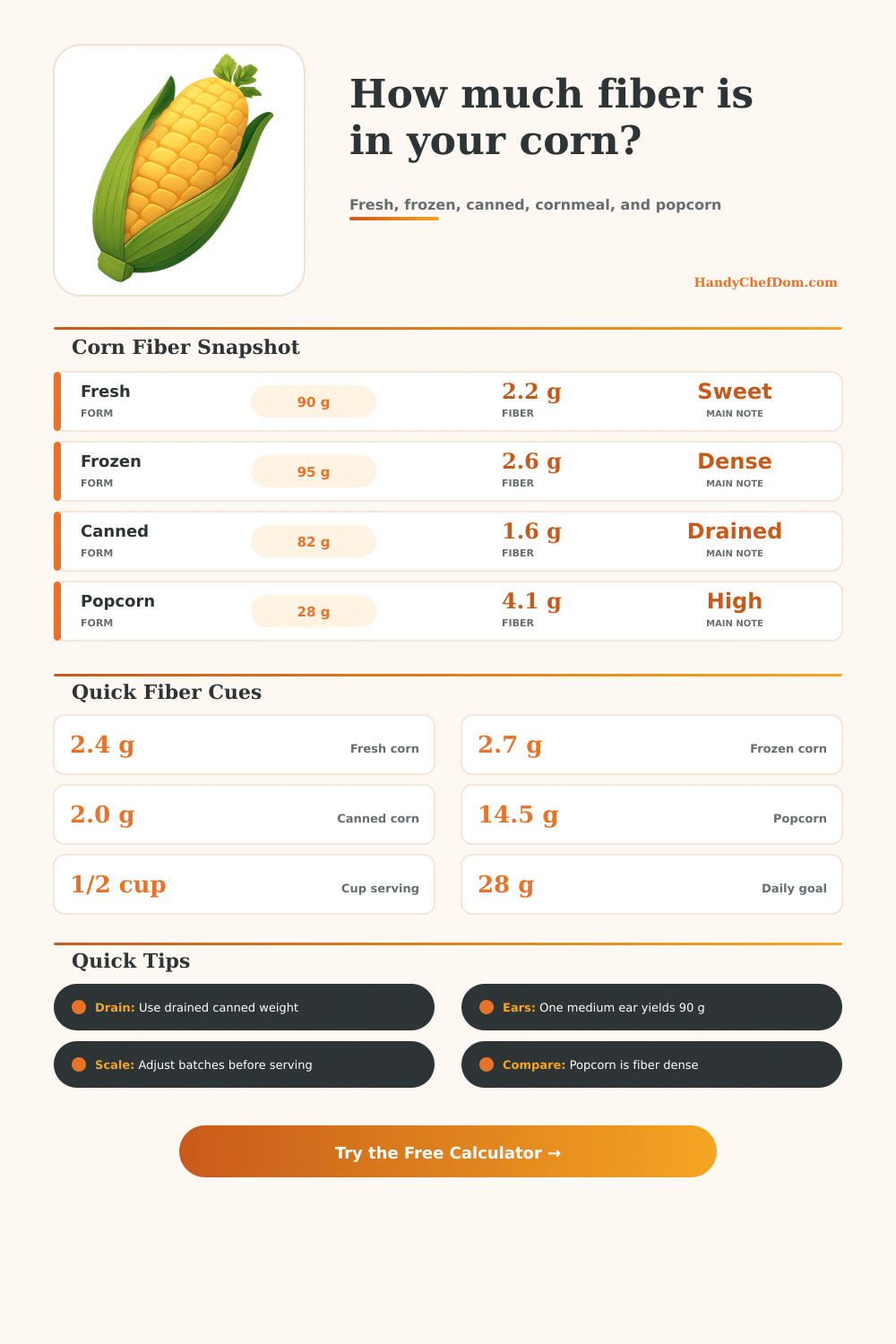
| Fresh sweet corn kernels | 1 medium ear or 1/2 cup | 90 g | 2.2 g |
| Frozen sweet corn | 1/2 cup heated kernels | 95 g | 2.6 g |
| Canned whole-kernel corn | 1/2 cup drained | 82 g | 1.6 g |
| Cream-style corn | 1/2 cup | 128 g | 1.8 g |
| Dry yellow cornmeal | 1/4 cup dry | 39 g | 2.8 g |
| Air-popped popcorn | 3 1/2 cups popped | 28 g | 4.1 g |
| Measure | Fresh or frozen kernels | Canned drained corn | Popcorn or cornmeal note |
|---|---|---|---|
| 1 medium ear | About 90 g kernels | Not usually measured by ear | Compare as 2.2 g fiber |
| 1 cup kernels | About 165 g | About 164 g drained | Dry cornmeal cup is much heavier |
| 1 ounce by weight | 28.35 g edible corn | Use drained weight | Popcorn ounce gives about 4.1 g fiber |
| 15 oz can | Not applicable | Often 260 g to 285 g drained | Use label if available |
| Recipe scaling | Multiply edible grams | Scale after draining | Scale dry cornmeal before cooking |
| Serving plan | Fresh ears | Kernel cups | Estimated total fiber |
|---|---|---|---|
| Weeknight side for 4 | 4 medium ears | About 2.2 cups | 8.6 g fresh corn fiber |
| Family side for 6 | 6 medium ears | About 3.3 cups | 13.0 g fresh corn fiber |
| Potluck salad for 12 | 12 medium ears | About 6.5 cups | 25.9 g fresh corn fiber |
| Buffet cup portions for 25 | 25 medium ears | About 13.6 cups | 54.0 g fresh corn fiber |
| Event sample cups for 50 | 25 to 35 ears | About 14 to 19 cups | 54.0 g to 76.0 g fresh fiber |
Maybe you think corn just provides carbohydrates; nothing else. But you are overlooking fiber component of any food. Canned corn isn’t just more convenient or different in texture; it’s quite different than fresh-ear corn in terms of nutrient content. Why does this matter? Because it changes how much fiber you get (but doesn’t decrease your meal satisfaction).
More important then the brand name of the corn is its form: What kind of corn form are you getting? Dried forms has more fiber per gram compared with fresh sweet corn, which contains some water. A medium ear of fresh corn offer a reasonable amount of fiber. When measured by weight, frozen corn contain a little more fiber per cup compared with fresh corn. To keep some of their nutrients intact, frozen foods are processed and may holds on to a bit more nutrition.
How Corn Forms Change Your Fiber Intake
Watch out for canned corn. The liquid that comes in the can contribute weight but no fiber. For nutritional purposes, count only drained yield.
Want maximum fiber? Eat popcorn: Popcorn is your best friend if you want to maximize fiber. When we pop corn, we keep all the kernel hull, the part of the corn containing most of its insoluble fiber (shown below). Because popcorn has no water weight, a small bowl of air-popped popcorn can deliver more fiber then a full ear of fresh corn.
Use the calculator on this page for perspective. Enter two cups of popcorn and four ears of fresh corn to compare results. Then enter your desired amount into the calculator so you know how much you need in order to hit your target. There’s no guesswork involved with converting pounds to ounces; that’s where people goes wrong when they try to plan meals by volume alone.
Recipes are complicated beyond just scaling up ingredients. When you double a recipe for corn-salad, the fiber contribution scale linearly with amount of corn. You don’t see this because the perceived “bulk” doesn’t scale as well as the fiber. A serving of cornmeal is dense and dry before cooking, while popcorn is voluminous and airy after popping. Cooked popcorn are light and fluffy, taking up much more room. Because these two have very different weights, their volume (measured in cups) differ greatly.
Compare by weight instead; that gives you a better idea. Enter the actual ounces or grams into the calculator, it’s far more accurate than just entering cups. It can be particularly helpful if you’re comparing dry versus wet ingredients, such as meal vs. Canned corn.
Preparation methods also shifts the balance between soluble and insoluble fiber. Soluble fiber absorbs water, forming a gel-like substance that can helps reduce glucose and blood cholesterol levels. Insoluble fiber aids digestion, helping food pass more quickly through the stomach and intestines; it also increases the bulk of your stool. Both are present in corn, though processing change their ratios. Whole kernels has a good mix. Fine-grinding (as in finely ground cornmeal) may result in greater surface area and therefore different behavior once eaten.
If you’re concerned about digestive comfort or metabolic health, this distinction is important. Fiber is an afterthought for most. It’s added, when possible, once fats and proteins has been allocated space at dinner. Because of that approach, too many people don’t reach their daily targets. If you want to plug those gaps with corn, choose the type (form) wisely and then measure carefuly. Decide between air-popped kernels or corn from a drained can. Both matter.
Use this page to explore variable against your own needs. See exactly what each ingredient provides toward your goal. Shift from thinking about corn as simply a food containing carbs, and begin thinking about it as a variable fiber-containing food. That shifts your cooking (and shopping) behavior: Rather than focus on the total can size, you’ll check the drained weight. Or think of topping a low-fiber dish with popcorn rather than bread.
Yeah, those yellow things are more useful then most people expect, if you just learn how much of them you are actualy eating. And that’s where the math gets easy: When you shift to weighing, and stop guessing, calculations becomes straightforward. You should of checked this earlier!