🥩 Pork Tenderloin Protein Calculator
Estimate pork tenderloin protein, calories, fat, cooked yield, slices, and servings from raw or cooked tenderloin weight.
Enter raw or cooked pork tenderloin weight. The calculator applies trim and cooking shrinkage, then estimates protein, calories, fat, slices, and per-serving nutrition.
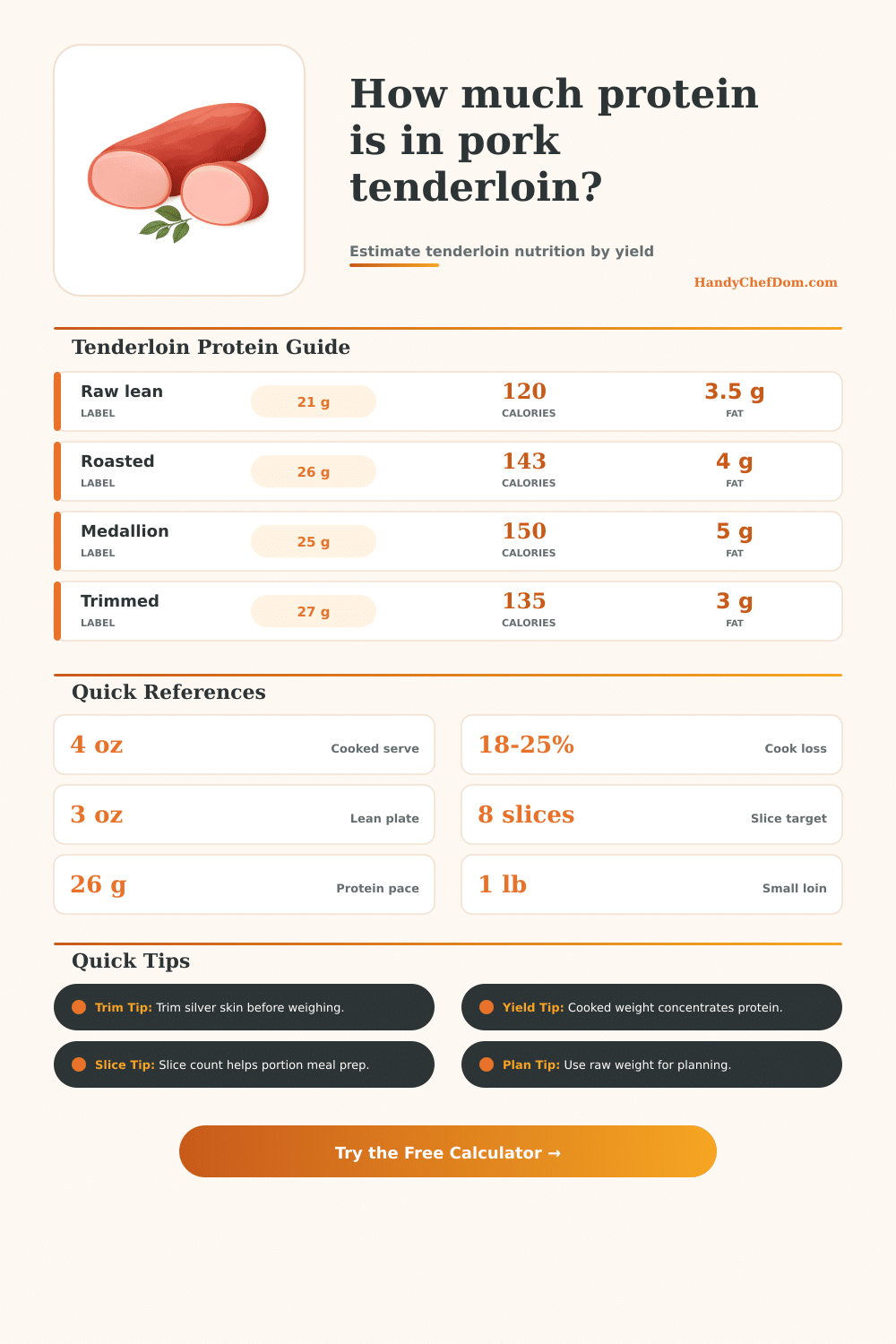
| Tenderloin Label | Protein / 100g | Calories / 100g | Fat / 100g |
|---|---|---|---|
| Plain raw tenderloin | 21 g | 120 kcal | 3.5 g |
| Extra trimmed lean tenderloin | 22 g | 118 kcal | 2.8 g |
| Roasted tenderloin | 26 g | 143 kcal | 4.0 g |
| Grilled tenderloin medallions | 27 g | 150 kcal | 4.5 g |
| Pan-seared tenderloin slices | 26 g | 158 kcal | 5.2 g |
| Marinated pork tenderloin | 25 g | 155 kcal | 4.8 g |
| Stuffed tenderloin estimate | 22 g | 178 kcal | 7.0 g |
| Smoked tenderloin slices | 27 g | 148 kcal | 4.2 g |
| Cooking Yield | Yield Factor | Shrinkage | Best Use |
|---|---|---|---|
| Juicy roast | 82% | 18% | Whole tenderloin |
| Standard roast | 78% | 22% | Dinner slices |
| Seared slices | 75% | 25% | Medallions |
| Firm cooked | 72% | 28% | Thin slices |
| Cooked entered | 100% | 0% | Leftovers |
| Extra trimmed | 80% | 20% | Lean prep |
| Portion Style | Cooked Portion | Protein Estimate | Slice Count |
|---|---|---|---|
| Snack plate | 2 oz | 15 g | 1-2 thin |
| Light meal | 3 oz | 22 g | 2-3 slices |
| Standard meal | 4 oz | 29 g | 3-4 slices |
| High protein | 5 oz | 37 g | 4-5 slices |
| Meal prep box | 4.5 oz | 33 g | 3 medallions |
| Party platter | 2.5 oz | 18 g | 2 slices |
| Servings | Raw Tenderloin | Cooked Yield | Protein Total |
|---|---|---|---|
| 2 servings | 12 oz | 9.5 oz | 70 g |
| 4 servings | 1.5 lb | 19 oz | 140 g |
| 6 servings | 2.25 lb | 28 oz | 207 g |
| 8 servings | 3 lb | 38 oz | 280 g |
| 12 servings | 4.5 lb | 56 oz | 414 g |
| 16 servings | 6 lb | 75 oz | 555 g |
Pork tenderloin is like most tender meats, everyone thinks it’s just some lean meat … until they take it out of the oven and half the meal has vanished due to moisture loss and fat rendering. If you’re following a high performance diet or trying to reach a certain amount of protein per meal, the panic can set in rather fast. The loss alters plans in the kitchen, changing an appetizing piece of raw meat into something that barely fills a plate.
“What happened? I purchased so many pounds on paper. Yet now my nutrition scale say something else. What happened between the raw piece you bought and the final cooked product you serve yourself? Understanding the difference between what you buy uncooked and what you eat cooked is the difference between hitting your macros or being hungry again by 7 PM.
Why Pork Loses Weight When You Cook It
You can plug in the weight of your start and choose a method of cooking (the tool above), and the number-cruncher will do its thing so you don’t have to guess how silver skin or moisture loss will impact your yield. Home cooks tend to underestimate the losses from trims. That sliver of silvery connective tissue doesn’t look like much; but it adds up. Log any weight left attached after trimming and you’re logging weight you’ll never turn into edible protein. The calculator takes trimming level into account so that your numbers represent what winds up on the table; not what winds up in the trash bin.
There’s a big difference between searing thin medallions and roasting an entire tenderloin: Moisture evaporates faster from greater surface area, meaning those sliced pieces will shrink more aggressively than a dense roast. A dense roast retains some of that moisture in a protective crust, while the sliced portions contract further then they otherwise would of have. That’s not magic; it’s concentration (see the reference table on the page). As water exits the meat, the protein becomes denser.
You don’t need any special powers to understand why four ounces of cooked meat has more protein than four ounces of raw. It’s simply a question of fact: When you boil away the water and render the fat, there are now fewer ounces of cooked meat left… And each contains more protein then before. Most folks need to learn how to calculate their portion sizes.
When something comes off the big roast, even though the cook’s serving size is normally 4 oz after cooking, it doesn’t seem like much. It doesn’t look like enough. It makes sense if you think about it in terms of how many slices you have. There are 8 slices in this tenderloin. I’m serving 3 people. Now we has perspective. No more food scale required at the table. We’re just counting our way to healthy eating now.
Numerous other recipes simply skip all this physics altogether and assume that an ounce of raw meat is the same as an ounce of cooked meat. But that’s not true at all: As soon as heat comes into play, this false comparison falls apart; the calculator fills in the missing piece with a set of yield factors that depend both on the cut style and its final doneness. Because well-done meat will be firmer and less juicy than its raw version, it also loses some water… Thus changing the protein density. And if you’re eating for health reasons (i.e., to consume lots of protein), losing a few percentage points of water over the span of a week does matter to you. The data matters; without it, you can’t optimize your diet.
Trimming before weighing is worth the extra minute it takes. It ensures your baseline is accurate and prevents overestimating your nutrient intake. With leftovers, I switch to using cooked weight in MyFitnessPal to eliminate double counting shrinkage that occurs when you turn last night’s leftover pork tenderloin into a salad or a sandwich later in the week. I want to know what I’m eating with clarity. And be confident enough in my numbers to stay on target!
After adjusting for shrinkage, pork tenderloin is something I can use as a weapon for keeping myself fed well. Weigh it. Cook it. Eat it. Numbers on paper align with numbers on plate.