🍎 Apple Sugar Calculator
Estimate natural apple sugar, prepared yield, serving sugar, fiber-to-sugar ratio, and recipe scaling for sliced apples, applesauce, cooked filling, and more.
Use count, raw weight, or target prepared yield. The calculator applies apple variety sugar, average apple size, peel/core trim, prep shrinkage, serving count, added sugar, and recipe scaling.
| Apple variety | Sugar per 100 g | Fiber per 100 g | Best calculator use |
|---|---|---|---|
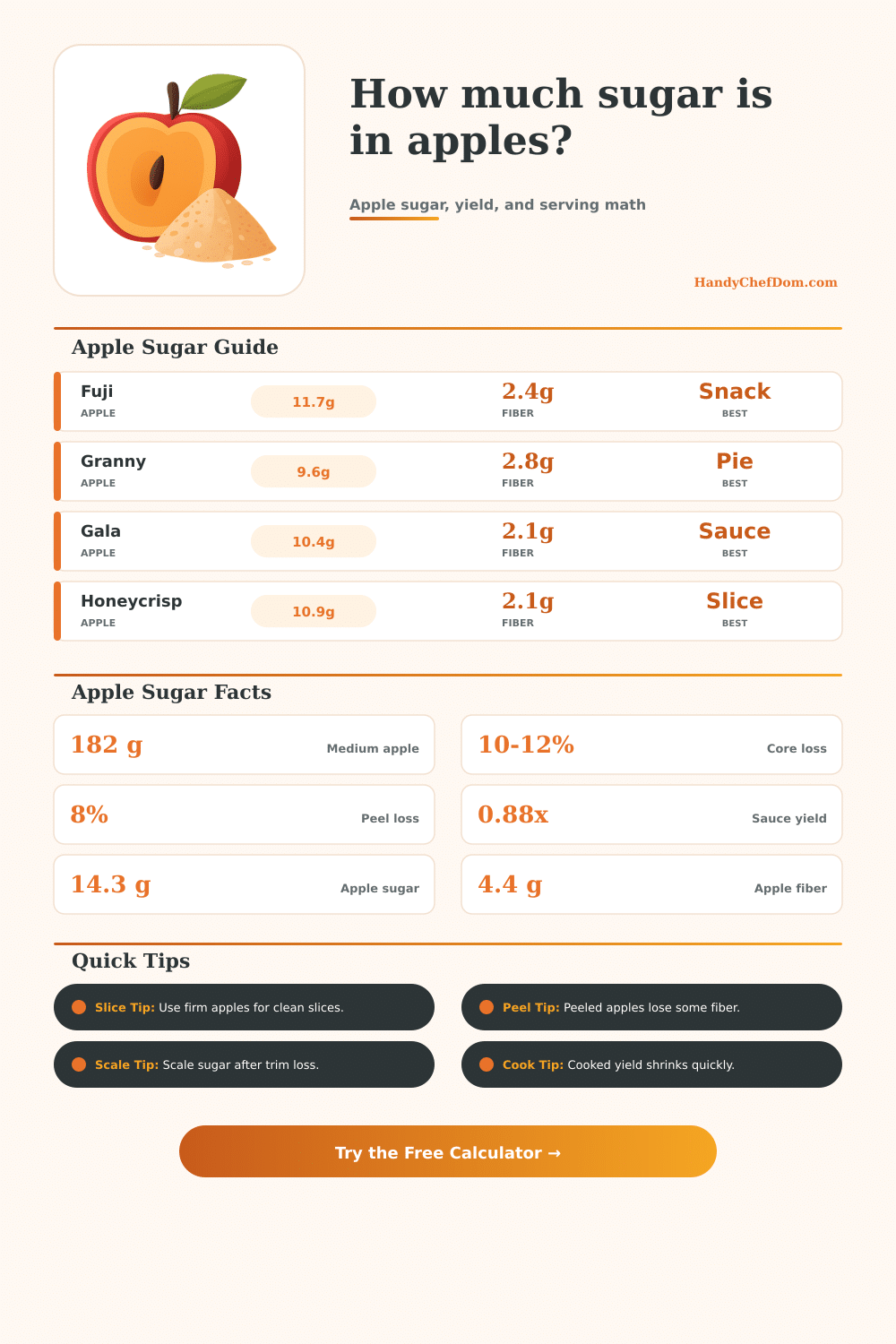
| Fuji | 11.7 g | 2.4 g | Sweet snacks, dried rings, no added sugar batches |
| Honeycrisp | 10.9 g | 2.1 g | Fresh slices, snack trays, salad wedges |
| Pink Lady | 10.6 g | 2.3 g | Fresh slices and lightly cooked desserts |
| Red Delicious | 10.5 g | 2.3 g | Fresh eating and soft sauce blends |
| Gala | 10.4 g | 2.1 g | Applesauce, lunchbox slices, mixed prep |
| Braeburn | 10.3 g | 2.4 g | Cooked apple filling and compote |
| McIntosh | 10.1 g | 2.2 g | Smooth sauce, puree, soft cooked apples |
| Golden Delicious | 10.0 g | 2.2 g | Balanced sauce and pie-style fillings |
| Granny Smith | 9.6 g | 2.8 g | Tart pie filling, crisp, baked apples |
| Mixed apples | 10.4 g | 2.3 g | Default estimate for mixed bags and orchards |
| Apple size | Average raw weight | Natural sugar each | Typical count use |
|---|---|---|---|
| Lunchbox apple | 100 g / 3.5 oz | 9.6-11.7 g | Kids portions, small snack boxes |
| Small apple | 150 g / 5.3 oz | 14.4-17.6 g | Side servings, small salads |
| Medium apple | 182 g / 6.4 oz | 17.5-21.3 g | Most recipe count estimates |
| Large apple | 223 g / 7.9 oz | 21.4-26.1 g | Pie filling, sauce, compote |
| Extra large apple | 270 g / 9.5 oz | 25.9-31.6 g | High-yield prep or thick slices |
| Preparation | Yield after trim | Sugar effect | Common serving |
|---|---|---|---|
| Sliced fresh apples | 0.98x edible weight | Total sugar is mostly unchanged after cutting | 85-120 g prepared slices |
| Diced salad apples | 0.97x edible weight | Small surface loss, sugar stays in the apple | 55-85 g in salads |
| Applesauce | 0.88x edible weight | Water cooks down, sugar per spoonful rises | 120 g sauce cup |
| Cooked apple filling | 0.78x edible weight | Liquid reduction concentrates natural sugar | 100-140 g dessert portion |
| Baked apple portions | 0.72x edible weight | Moisture loss makes a sweeter bite | 1 baked apple half or cup |
| Dried apple rings | 0.18x edible weight | Sugar is highly concentrated by drying | 25-35 g dried snack |
| Apple dish | Typical apple weight | Natural sugar range | Scaling note |
|---|---|---|---|
| Lunchbox slices | 1 medium apple | 17.5-21.3 g | Scale by apple count first |
| Snack tray | 6 medium apples | 105-128 g total | Divide by guests after trimming |
| Applesauce batch | 3 lb raw apples | 131-159 g total | Use sauce yield before portions |
| Pie filling prep | 2.5 lb raw apples | 109-133 g total | Cooked yield lowers final weight |
| Apple crisp bowl | 2 lb raw apples | 87-106 g total | Add recipe sugar separately |
| Dried apple tray | 2 lb raw apples | 87-106 g total | Small final weight, same sugar |
How much homemade applesauce does it take to make? How do I get enough without adding too much sugar? When I cut up an apple, will it fill my kid’s lunchbox (or even two)? These are all questions we might ask ourselves when looking at a bag of apples, but the math doesn’t seem so obvious once we consider the peel, the core, moisture lost as things cook, etc.
This is where the apple sugar calculator come in, which converts fuzzy guesswork into accurate nutrition info, whether you’re tracking blood sugar levels or planning what you’ll feed your kids.
Why Apple Type and Size Matter
What’s important to know: Most people don’t realize how much the type of apple matter. For example, a Granny Smith has more fiber and is tarter than say, a Fuji, which is loaded with naturaly-occurring sugars. That means that eating a slice as a snack will have different glycemic effects on your body, and will also affect flavor of a pie. The reason you choose one over another in the tool up top isn’t just choosing a name, you’re creating a starting place for sweetness, and all other calculations builds off this.
Because if you happen to get a mixed bag at the grocery store, an average guess helps keep things accurate. It is a tiny thing, but it keeps the rest of the numbers grounded.
Another thing that catches folks out is size. An apple is not necessarily one thing; a big Honeycrisp contain about 3x more sugar by volume than a little Lunch Box Gala. The calculator lets you put in raw weight, count, or even desired yield for cooked items. Selecting the right starting point will save time. For example, do you have three pounds of apples sitting around? That’s quicker then picking them apart and estimating their individual sizes. It’s also flexible enough to work with whatever fits into your process. You can analyze it post-cooking or pre-shopping, depending on what makes more sense.
However, those same numbers change with preparation; when you peel, core, and cook something it shrinks. Peeling alone takes off roughly one slice, depending on how thick the skin is. You will also lose about ten percent of apple’s original mass in the form of a core. Water also evaporates from things like applesauce, reducing your yield even more. This is why the tool will adjust for those losses, allowing your serving size to be based on what actualy makes its way onto the plate rather than what began in the bowl. To understand this difference is to ensure that you don’t underestimate the sugar density or overestimate the portion size.
Don’t forget: Cooked apples are more concentrated then raw apples. If there’s also additional sugar added, then it makes the situation even more complicated. Sugar may be sprinkled onto the fruit as a topping, such as cinnamon sugar over the crisps. It can also be mixed into a puree, such as when sweetening baby food with sauce. By keeping added and natural sugar separated in your mental accounting, you’ll get a clear sense of how much added sweetness come from the recipe itself vs. The ingredients. This distinction is especially important if you’re closely watching your carb intake.
The calculator will account for both natural and added sugars. You can scale up or down a batch size, and all calculations will adapt to match.
This is where fiber comes into play, and it is an important factor. Even though two apples has roughly the same number of carbohydrates, a sweeter Fuji will be absorbed more quickly then a Granny Smith. Thanks to its lower amount of fiber. This creates context around those large numbers: That tool will show a fiber-to-sugar ratio, which tells you how slowly the energy is released. A higher number mean energy is released more slowly. Many simple calorie-counters fail to include this, yet it is vital for metabolic health and feeling full. Having this ratio tells you how to balance your meal even more, such as adding fat and/or protein to a sweeter apple to further blunt the blood glucose rise.
In conclusion, there are no hard and fast rules here. Fruit is fruit, but knowing what they do can make all the difference in how well or poorly they perform in your kitchen. And while it’s true that you probably won’t have a food scale at your side on most days, that’s okay! If we’re talking estimation; estimation is going to get you through the day just fine. But if you need precise measurements, for whatever reason (consistency across recipes, managing diabetes, etc.), knowing a method for running the numbers accurately takes out the guessing game.
Next time you grab an apple, keep in mind that you aren’t simply snacking on a fruit. You’re eating a combination of water, sugar and fiber that changes with every cut and every cook.