🥚 Egg Whites to Whole Eggs Converter
Convert whole eggs, separated whites, and carton egg whites with baking, binding, leavening, and yolk-removal adjustments.
Use large eggs as the default for most recipes, or switch sizes when your eggs are clearly labeled. Carton whites are treated as liquid egg white unless your carton gives a different serving rule.
| Egg Size | Whole Egg | White | Yolk |
|---|---|---|---|
| Small | 38 g / 2.5 tbsp | 23 g / 1.5 tbsp | 14 g / 0.9 tbsp |
| Medium | 44 g / 3 tbsp | 27 g / 1.8 tbsp | 16 g / 1 tbsp |
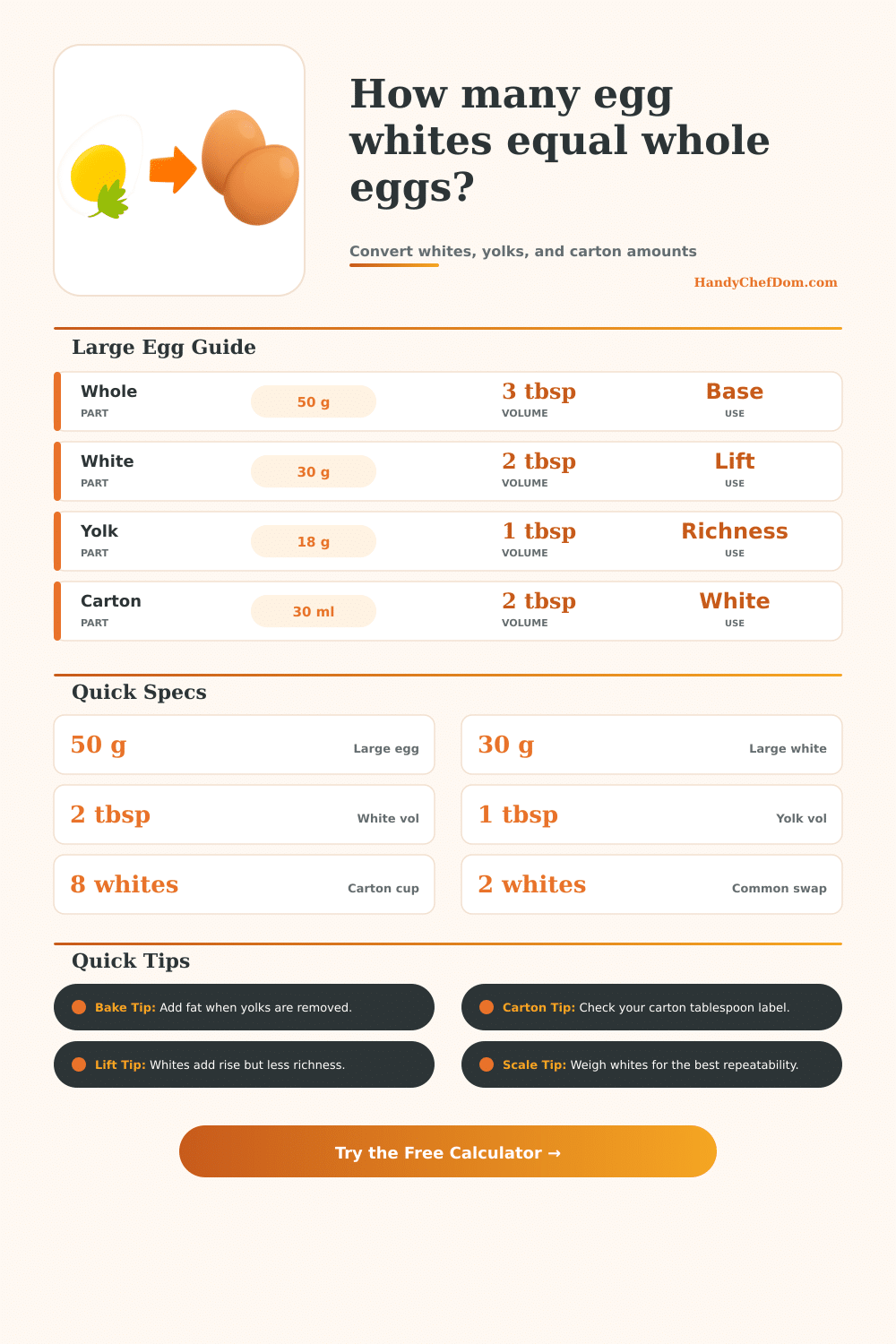
| Large | 50 g / 3 tbsp | 30 g / 2 tbsp | 18 g / 1 tbsp |
| Extra-large | 56 g / 3.7 tbsp | 33 g / 2.2 tbsp | 21 g / 1.3 tbsp |
| Jumbo | 63 g / 4.2 tbsp | 38 g / 2.5 tbsp | 24 g / 1.5 tbsp |
| Goal | Large Egg Swap | Best For | Adjustment |
|---|---|---|---|
| Volume match | 1.5 whites | General measuring | Closest liquid volume |
| Balanced baking | 1.75 whites | Cakes and loaves | Better structure |
| Common lean swap | 2 whites | Lower-yolk bakes | May need fat |
| Protein match | 1.75 whites | Firm batters | Matches protein |
| Strong binding | 1.9 whites | Patties and bars | More set |
| Exact separated egg | 1 white | Removing yolk only | Not a whole-egg swap |
| Use Case | White Change | Yolk Issue | Helpful Output |
|---|---|---|---|
| Cake | +5% | Less tenderness | Fat and leavening |
| Muffin | 0% | Slightly lean | Fat add-back |
| Cookie | -10% | Less richness | Binding check |
| Pancake | +5% | Less color | Rise check |
| Savory binder | +15% | Lean texture | Firm binding |
| Foam base | 0% | No yolk wanted | White-only amount |
| Carton Measure | Large Whites | Whole Egg Equivalent | Metric |
|---|---|---|---|
| 2 tbsp | 1 white | 0.5 to 0.7 egg | 30 ml |
| 3 tbsp | 1.5 whites | 1 volume egg | 45 ml |
| 1/4 cup | 2 whites | 1 common swap | 60 ml |
| 1/2 cup | 4 whites | 2 common swaps | 120 ml |
| 1 cup | 8 whites | 4 common swaps | 240 ml |
| 1 lb carton | 15 whites | 7 to 10 eggs | 454 g |
Say the recipe asks for three eggs, but all you have is liquid-y pasteurized version of just the whites. Maybe you reason you’ll just add some protein in liquid form and call it good. But cooking is chemistry; while both parts play a role, the yolk do things the white can’t. To get equivalent results when swapping out one for the other, it’s not as simple than 1:1. That’s where this calculator comes in: Plug in how many eggs you want to use, along with their size, and let it crunch the numbers. Your loaf won’t collapse or rise because you guessed wrong.
But an egg isn’t just an egg. It’s a mix of solids (the whites) and liquid fats (the yolk). Each has its own properties. The proteins in the white provide structure. The yolk provides color, flavor, and emulsifying qualitys. By separating them, you’re losing both the richness and the stabilizing factor of moisture. Most home baker don’t realize this, as most of us think of eggs as indivisible items.
Why You Should Use This Egg Calculator
Take away the yolk and what do you get? The baked good is dry. Why? Because you’ve stripped it of the fats that make the crumb tender. The typical substitution; two whites per whole egg, is still a bit low on fat. The output is fine, but it’s also about understanding the inputs. That means choosing the right-sized eggs: a small egg weigh less than a jumbo white egg. Metric grams makes that clear; a tablespoon isn’t ambiguous at all, unless you’re wondering what sloshed into your measuring bowl.
And with the tool, you can adjust by intention (to achieve a specific goal such as leavening or binding). If baking a cake: Structure! So maybe the calculator will tell you to add some fat back in to duplicate yolk’s tenderness. Want a lean omelet or meringue? Pure protein and lift. No add-back required.
The other wrinkle: Because carton whites are more viscous than fresh-separated ones, and may even include some type of stabilizer so they don’t separate, they will behave differently when bound or whipped. (The chart breaks this down nicely.) For instance, one cup of carton whites equal about eight large whites. This is a handy tip if you’re baking from recipe that calls for egg whites but you’ve got a giant bottle of carton whites and need to use them up while they are still fresh.
If you’re separating eggs yourself, keep in mind where those yolks are going to go, too. If you want to save them for an ice cream base or pasta sauce, things change, since now there’s a reason not to just throw away the yolk along with the white. That’s what it all boils down to: pantry limitations and diet restrictions. Perhaps you’re reducing your cholesterol. Or maybe you were halfway through baking before realizing you only had whites left.
What do you do then? Use the calculator to determine how much fat to replace from the yolks by adding yogurt or a teaspoon of oil. Adding this little bit can rescue an otherwise heavy texture. It provide a balance of mouthfeel and the strength of protein. Bottom line: Estimating is not as precise as measuring. When fat and volume is coming out of something, whether it’s a cookie or a burger patty, you need to know with exactness what that means so you can plan ahead, rather than react to a less-than-perfect baked outcome.
With the tool at hand, you’re armed with numbers; but it’s up to you to understand the why behind them, so the outcome will taste like you want it to. The structure remains intact and recipe quality is maintained, which proves that there is still room for craft even when substituting.