🍠 Sweet Potato Sugar Calculator
Estimate natural sugar from sweet potato type, raw weight or count, peel yield, cooking method, serving count, and batch scaling.
Use raw weight when you have a scale, count when you are shopping by potatoes, or blended mode when you want the calculator to use weight if entered and count as a backup.
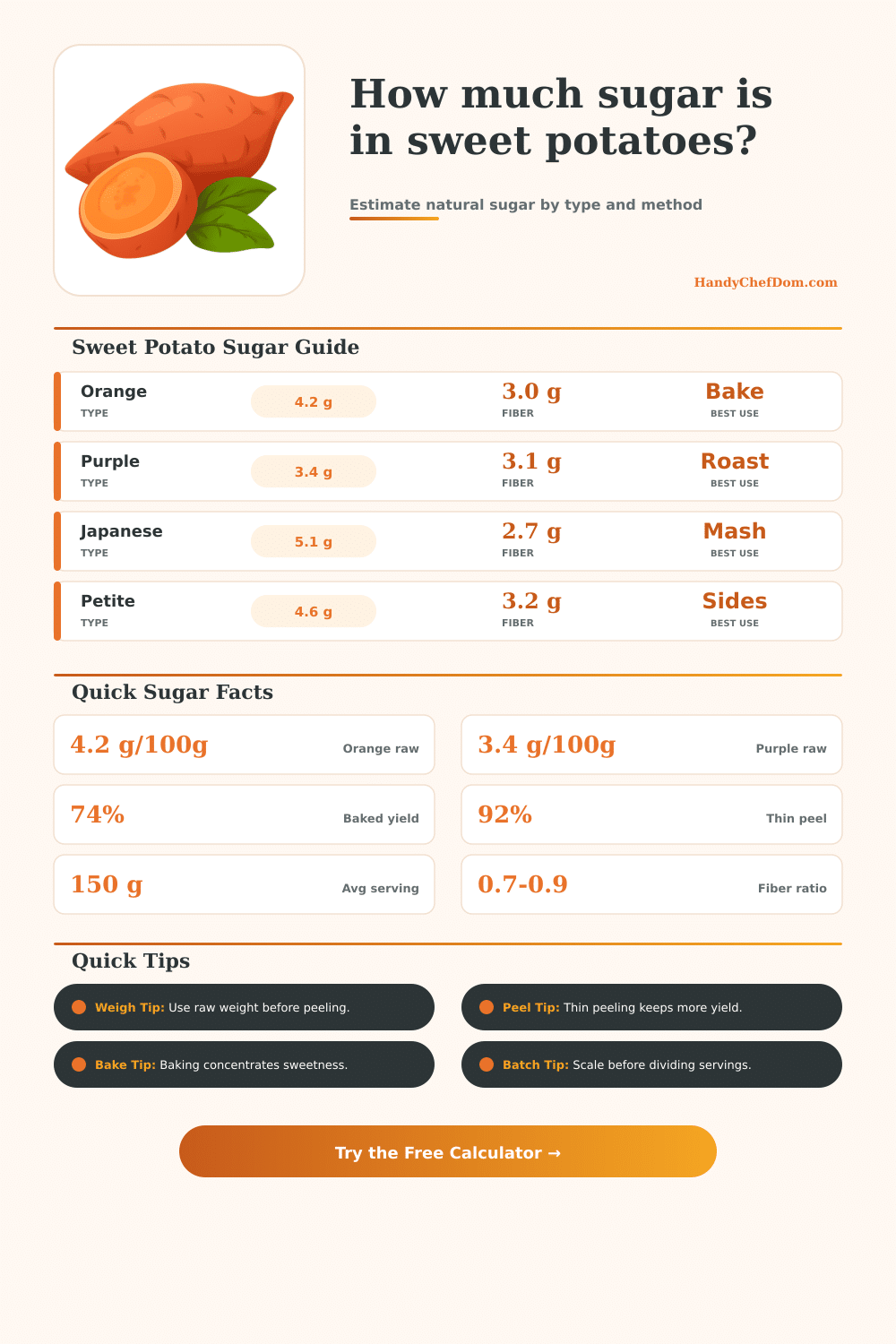
| Sweet potato type | Color cue | Natural sugar | Fiber | Average whole size | Best calculator use |
|---|---|---|---|---|---|
| Orange Garnet | Deep orange | 4.2 g per 100 g raw | 3.0 g per 100 g raw | 8 oz / 227 g | Balanced default for baked sides |
| Orange Jewel | Bright orange | 4.5 g per 100 g raw | 3.1 g per 100 g raw | 7.5 oz / 213 g | Family dinner portions |
| Purple Stokes | Purple flesh | 3.4 g per 100 g raw | 3.1 g per 100 g raw | 6.5 oz / 184 g | Dense roasted wedges |
| Okinawan Purple | Lavender purple | 3.8 g per 100 g raw | 2.9 g per 100 g raw | 7 oz / 198 g | Firm slices and bowls |
| Japanese Murasaki | White flesh | 5.1 g per 100 g raw | 2.7 g per 100 g raw | 6 oz / 170 g | Snack potatoes with higher sweetness |
| White Hannah | Cream flesh | 3.9 g per 100 g raw | 2.8 g per 100 g raw | 7 oz / 198 g | Milder mashed sides |
| Petite Orange | Small orange | 4.6 g per 100 g raw | 3.2 g per 100 g raw | 3.5 oz / 99 g | Count-based servings |
| Canned Drained | Orange pieces | 5.0 g per 100 g drained | 2.5 g per 100 g drained | 15 oz can drained | Quick mash estimates |
| Cooking method | Cooked yield from edible flesh | Sugar effect | Fiber effect | Use when |
|---|---|---|---|---|
| Baked whole | 74% | 1.12x concentration | 0.98x retained | You want a sweet, dense cooked potato |
| Roasted cubes | 68% | 1.16x concentration | 0.97x retained | Edges caramelize and moisture drops |
| Mashed after boiling | 88% | 0.96x after drain | 0.94x retained | Water dilutes or carries off some sugars |
| Steamed chunks | 91% | 1.00x nearly neutral | 0.98x retained | You want moist pieces with little leaching |
| Microwaved whole | 80% | 1.08x concentration | 0.98x retained | Fast single-potato planning |
| Air-roasted coins | 65% | 1.18x concentration | 0.96x retained | Small pieces lose the most moisture |
| Canned warmed | 96% | 1.00x drained basis | 1.00x retained | You start from drained canned pieces |
| Peel choice | Edible yield | Typical sugar impact | Typical fiber impact | Best fit |
|---|---|---|---|---|
| Skin-on edible, ends trimmed | 98% | Keeps nearly all natural sugar | Highest fiber ratio | Whole baked or roasted wedges |
| Thin peel for cubes | 92% | Removes small surface loss | Moderate fiber reduction | Breakfast cubes and meal prep |
| Thick holiday peel | 84% | Lower total sugar from less flesh | Lower fiber ratio | Smooth mash or gratin prep |
| Baked flesh scooped from skin | 86% | Sweet flesh counted, skin left out | Fiber drops noticeably | Baby mash and casseroles |
| Extra blemish trimming | 78% | Best for imperfect storage roots | Lowest retained fiber | Large batches with heavy trimming |
| Serving plan | Suggested cooked portion | Orange baked sugar | Purple roasted sugar | Batch note |
|---|---|---|---|---|
| Toddler tasting | 60 g cooked | 3.8 g sugar | 3.5 g sugar | Use count mode for petite roots |
| Bowl topping | 90 g cooked | 5.7 g sugar | 5.2 g sugar | Roasted cubes concentrate quickly |
| Dinner side | 150 g cooked | 9.5 g sugar | 8.6 g sugar | Most family plates land here |
| Meal prep container | 180 g cooked | 11.4 g sugar | 10.4 g sugar | Scale before dividing containers |
| Large vegetarian main | 240 g cooked | 15.2 g sugar | 13.8 g sugar | Pair with protein and greens |
What’s in an orange or purple-skinned sweet potato? Most of us don’t think about that when we buy sweet potatoes. We reach for a package of Garnets for dinner, stick them in the oven and assume they’ll taste like our holiday mash. But there are many varieties; and how you prepare your potatoes affects their sweetness, too.
Boil them until water leeches out some of their depth, or bake them whole, so that syrup drips out; and natural sugar will change. Understanding these factors lets you find the perfect balance without needing maple syrup or tracking carbs for health reasons. By inputting the raw weight and how you’ll cook it in the calculator (above), you do the math. And that’s what eliminates the guesswork of how losing moisture concentrate the sugars.
How to Control Sweet Potato Sugar
The type of potato determine the basic sugar level. A popular side dish option is the sweet-tasting Orange Garnet, which is reliable in its sweetness and complements most any savory herb combination. Some purple spuds, such as Okinawan or Stokes, tend to be lower in sugar but hold up better to roasting, with a more dense texture. Japanese Murasaki taters can be naturaly high in grams-per-gram sugar, making them powerful snack food. By choosing your potato type, you control where you start and ensure you get the final flavor you want.
And then there’s the skin. While many cooks think of sweet potatoes as dirty things they have to peel off in a big hunk to get clean, the skin add structure and a lot of fiber. Keeping the skin on retains almost all natural sugars and provides much more fiber per bite. But if you’re aiming for something smooth (like toddler mash, or an expensive gratin), peeling is your way to get there. Thinning the skin or keeping it on maintains more nutrients, though, if you are going for maximum yield at minimum waste. This small decision changes final nutrient profile.
The way you cook it matter, too; physics-wise. When you bake a sweet potato whole, the loss of water reduce its size by roughly 12 percent. This concentrates the remaining sugars. Even though total sugar content does not change, roasted potatoes taste a little sweeter then steamed ones. Mashed and boiled sweet potatoes retain fiber but add back some water, which reduces the perceived sweetness just a bit. Roasting or air-frying cubes increases the surface area for moisture loss, which results in higher concentrations. It’s a tradeoff between lightness and intensity (i.e., water weight for flavor).
For example, if you are making grain bowl for yourself, use less than if it is just a side dish. One hundred fifty grams of cooked potato might be plenty for a side, but not for a main dish. When cooking something sweet, you want enough per serving to reach your ideal level of sweetness. However, don’t use so much that it overpower other items in the meal. When doubling for meal prep, the number of servings increase, but the amount of sugar per serving stays the same while total sugar load increases. This is another thing people miss: they see one potato and ignore the fact that all those portions compound throughout the day.
There are good reasons to buy raw weight rather than peeled: Potatoes differ in size and shape; scales beat eyeballing. Using count mode works fine for uniform petite varieties, but blending modes help bridge the gap between shopping by the piece and cooking by the gram. And this isn’t calorie-counting calculus, it’s flavor-chemistry math. We explain everything in our reference table on this page.
Controlling Sweet Potato Sweetness: When you’re managing sweetness in a sweet potato, you select a variety based off that sweetness level. Then, you pick an amount of cooked moisture to reduce. Finally, you decide how much of the fibrous nature to retain depending on your peeler strategy. How does this all play out on the plate? This lets you control how sweet any meal is, whether you are feeding athletes or just your family. It’s no longer guesswork; now you cook with purpose. If you know what you want from the sweet potato, you could of made it work for whatever dish you need.