🍚 Rice Cups to Pounds Converter
Convert dry or cooked rice cups into pounds using real kitchen weights for long-grain, jasmine, basmati, brown, sushi, arborio, and wild rice blends.
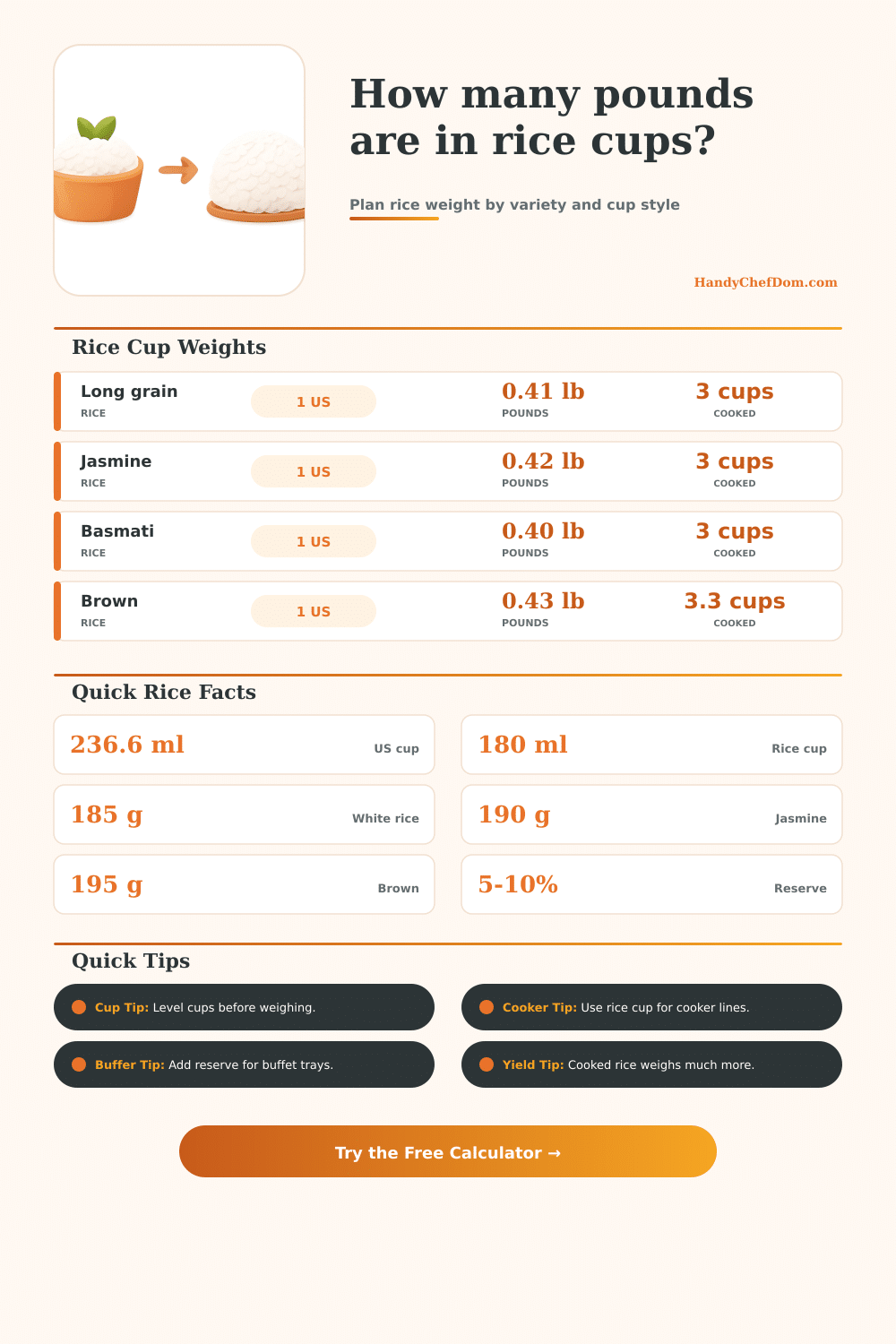
Use the cup measurement you actually scooped with. A rice cooker cup is about 180 ml, so it weighs noticeably less than a level US cup.
| Rice Variety | Dry g per US Cup | Dry lb per US Cup | Cooked Cup Yield |
|---|---|---|---|
| Long-grain white rice | 185 g | 0.41 lb | About 3 cups cooked |
| Jasmine rice | 190 g | 0.42 lb | About 3 cups cooked |
| Basmati rice | 180 g | 0.40 lb | About 3 cups cooked |
| Medium-grain white rice | 195 g | 0.43 lb | About 2.8 cups cooked |
| Brown rice | 195 g | 0.43 lb | About 3.3 cups cooked |
| Sushi rice | 200 g | 0.44 lb | About 2.7 cups cooked |
| Arborio rice | 200 g | 0.44 lb | About 3 cups cooked |
| Wild rice blend | 160 g | 0.35 lb | About 3.4 cups cooked |
| Cup Type | Volume | Weight Scale | Best Use |
|---|---|---|---|
| US measuring cup | 236.6 ml | 1.000x | Most home recipes |
| Metric cup | 250 ml | 1.057x | Metric recipe books |
| Rice cooker cup | 180 ml | 0.761x | Cooker water lines |
| Half US cup scoop | 118.3 ml | 0.500x | Small batches |
| Level fill | To rim | 1.000x | Best conversion |
| Heaped fill | Above rim | 1.100x | Estimate only |
| Serving Style | Dry Rice Per Person | Cooked Rice Per Person | Kitchen Note |
|---|---|---|---|
| Side dish | 45 g | 100 g | Small plate or saucy meal |
| Main bowl | 75 g | 180 g | Rice-forward bowl |
| Meal prep | 60 g | 150 g | Standard lunch box |
| Buffet or potluck | 50 g | 120 g | Add reserve for repeats |
| Sushi tray | 65 g | 160 g | Sticky rice portions |
| Light tasting | 30 g | 70 g | Small sample servings |
| Cooked Rice Type | Cooked g per Cup | Cooked lb per Cup | Dry Cup Equivalent |
|---|---|---|---|
| Cooked long-grain white | 158 g | 0.35 lb | About 0.33 dry cup |
| Cooked jasmine | 160 g | 0.35 lb | About 0.33 dry cup |
| Cooked basmati | 155 g | 0.34 lb | About 0.33 dry cup |
| Cooked brown rice | 195 g | 0.43 lb | About 0.30 dry cup |
| Cooked sushi rice | 170 g | 0.37 lb | About 0.37 dry cup |
| Cooked risotto rice | 240 g | 0.53 lb | About 0.33 dry cup |
Why do most home cooks mess up rice? Because we don’t measure accurately; we eyeball amount. We’ll read a recipe calling for two cups, then grab a heaping scoopful out of a drawer and dump it in the pot. The rice is sticky. The rice are crunchy. The water ratio is wrong and weight is wrong.
Why is this annoying? For one thing, cooking by volume is a lousy method for tracking how much food there is. Rice come in many types, each with very different densities (mass per unit of volume). Fluffy long-grain white rice has more volume than dense sushi rice, which means a cup of one will weigh less then a cup of the other. The calculator up top convert your vague cups to pounds, using correct type of grain and fill style you used.
Why Accurate Rice Measurement Is Important
The first variable is what kind of rice you use. The default, which is the one against which all others are compared, is long-grain white rice. Depending on the source, that’s roughly 0.41 pounds in US cups. Other varieties (short-grain types like sushi rice) weighs heavier; switching to those will increase your weight for a given volume. And since those kinds have shorter, rounder grains, they’ll take up less space but pack more individual grain into each serving.
Brown rices also include their bran layers, which means the extra volume causes weight to vary depending on how tightly the grains is packed; there, too, the grains themselves are slightly heavier. Wild rice mixes get even lower, as those grains is irregular and light-weight. Why that means a one-size-fits-all conversion just doesn’t cut it if you need exact quantities; see comparison chart on that same page.
And then there is the cup. Which cup? Not all cups are created equal. There’s the regular ol’ US measuring cup, which measures approximately 236 milliliters. There’s the metric cup, which measure 250 milliliters. You probably also have a rice cooker cup that came free with your rice cooker. These is generally smaller and typically measure out around 180 milliliters.
Unless you adjust accordingly when transferring your water into a bigger pot, using the small cooker cup to measure the rice means too little rice and too much water. With this tool, however, you can actualy choose exactly what kind of vessel you’re scooping from, so it takes those differences into account. It may seem like a very small thing but going from 180 milliliters to 236 milliliters changes your resulting weight by almost 30 percent. That’s where people mess it up.
It also matters what kind of fill you’re using. If you use a level cup, your grains will be flush with the edge of the pan but not packed down. If you use a heaped cup, there’s a mound of excess rice on the surface and that adds weight. Using a packed or shaken cup packs all the air out of your pile, making it far more dense. These tiny differences compound fast when cooking for large numbers of people.
A small difference of two cups might seem trivial on a single serving. However, when multiplied by twenty, it becomes the difference between wasted food and enough food for everyone. But even then it’s still not done. Rice continues to change when you cook it. Rice will absorbs liquid. This triples its volume. It picks up some extra weight, as well, due to all that liquid now inside.
One pound of dry rice doesn’t equal one pound of cooked rice. Instead, it equals over three pounds of cooked rice. If you’re serving a crowd at a buffet or meal prepping, you want to make sure there’s enough for everyone, so how much should you plan on? The converter takes into account the typical expansion ratio for different types of grains to help you guess your end result. You can also add an extra percentage. I think this is a good idea if you’re taking something to a potluck where folks like to load up their plates with seconds.
The takeaway here is that rice measurement take the guessing game out of cooking. You don’t have to hope the ratio is right; instead, you know that it is. And whether it’s a big pot of jasmine to feed a crowd or some delicate risotto, when you can be certain about how much rice is in there, you’ll get just the right texture. From then on, it’s a matter of science rather than art.
Measure twice (not with your eyes, but with your scale) and rest assured that your rice will come out the way it’s supposed to. You should of used a scale from the start.