🥥 Coconut Water Sugar Calculator
Estimate coconut water sugar by bottle, cup, milliliter, or ounce volume, then compare plain versus flavored drinks, servings, hydration use, smoothie mix-ins, potassium context, and sugar-to-potassium balance.
Choose the package or measuring unit, set the coconut water type, add smoothie fruit if needed, and enter serving count. Plain unsweetened coconut water is still naturally sweet, while flavored bottles can climb quickly.
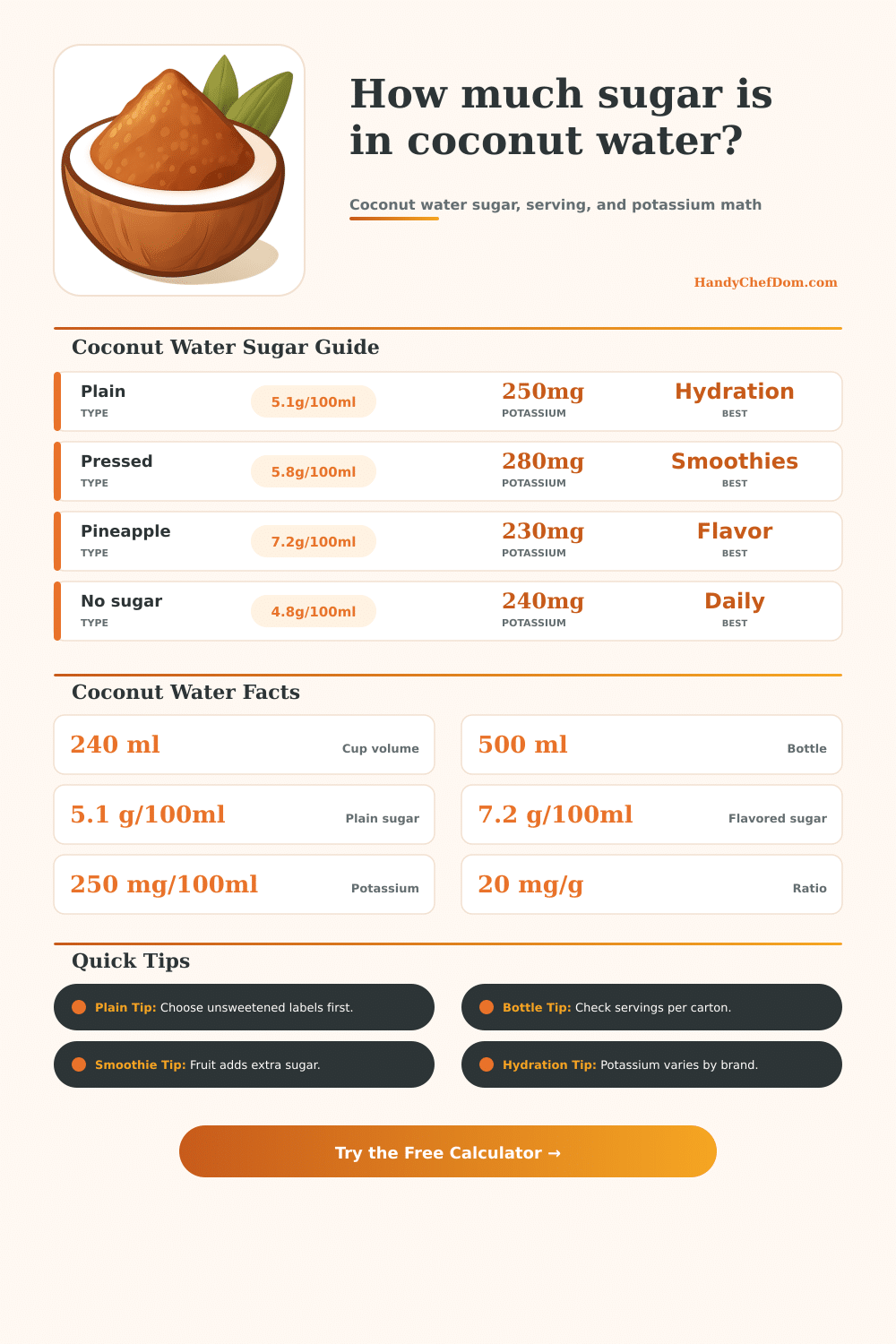
| Coconut water type | Sugar per 100 ml | Potassium per 100 ml | 500 ml bottle sugar | Best use |
|---|---|---|---|---|
| Plain unsweetened | 5.1 g | 250 mg | 25.5 g | Daily hydration and cooking liquid |
| No sugar added label | 4.8 g | 240 mg | 24.0 g | Lower-sugar brand comparisons |
| Light or diluted | 3.6 g | 170 mg | 18.0 g | Long sipping or kid portions |
| Pressed coconut water | 5.8 g | 280 mg | 29.0 g | Creamier smoothies and shakes |
| Young Thai style | 5.6 g | 260 mg | 28.0 g | Fresh coconut flavor |
| From concentrate | 6.2 g | 220 mg | 31.0 g | Shelf-stable cartons |
| Pineapple flavored | 7.2 g | 230 mg | 36.0 g | Mocktails and tropical drinks |
| Mango flavored | 7.8 g | 225 mg | 39.0 g | Sweet smoothie bases |
| Sweetened flavored blend | 8.4 g | 210 mg | 42.0 g | Occasional treat drinks |
| Package or pour | Volume | Plain sugar estimate | Flavored sugar estimate | Serving planning note |
|---|---|---|---|---|
| Small pour | 120 ml / 4 fl oz | 6.1 g | 8.6 g | Good tasting pour for kids or mocktails |
| One cup | 240 ml / 8.1 fl oz | 12.2 g | 17.3 g | Common recipe and smoothie measure |
| Mini carton | 250 ml / 8.5 fl oz | 12.8 g | 18.0 g | Usually one small serving |
| Small box | 330 ml / 11.2 fl oz | 16.8 g | 23.8 g | Can be split into two lighter servings |
| Can | 414 ml / 14 fl oz | 21.1 g | 29.8 g | Check whether the label lists one or two servings |
| Bottle | 500 ml / 16.9 fl oz | 25.5 g | 36.0 g | Often marketed as a single grab-and-go bottle |
| Carton | 1000 ml / 33.8 fl oz | 51.0 g | 72.0 g | Batch smoothies, party drinks, meal prep |
| Hydration use | Typical volume | Sugar context | Potassium context | Calculator setting |
|---|---|---|---|---|
| Casual sipping | 180-250 ml | Moderate natural sugar | Helpful label comparison | Casual sipping |
| Post-workout bottle | 330-500 ml | Higher if the whole bottle is one serving | Often the reason people choose coconut water | Post-workout bottle |
| Hot day hydration | 250-500 ml | Split servings can reduce sugar per pour | Pair with water when drinking repeatedly | Hot day hydration |
| With a meal | 120-240 ml | Count it like a sweet drink alongside food | Potassium adds context but not a free pass | With a meal |
| Mocktail or mixer | 90-180 ml | Juice, syrups, and fruit can double sugar | Usually diluted by ice or sparkling water | Mocktail or mixer |
| Kid-sized serving | 90-150 ml | Small cups are easier to portion | Use label values for younger kids | Kid-sized servings |
| Smoothie mix | Added sugar estimate | Best coconut water type | What to watch |
|---|---|---|---|
| Greens and ice | 2 g | Plain or light coconut water | Mostly the coconut water sugar drives the total |
| Berry smoothie | 12 g | Plain unsweetened | Berries add sugar plus texture and tartness |
| Banana smoothie | 18 g | Plain or pressed coconut water | A ripe banana can rival the bottle sugar |
| Mango tropical smoothie | 32 g | No sugar added or light | Mango plus flavored coconut water can stack quickly |
| Protein shake base | 5 g | Plain unsweetened | Check protein powder sweeteners separately |
Calculator estimates are for kitchen planning and label comparison. Coconut water nutrition varies by coconut maturity, brand, concentrate level, flavoring, and package serving size.
The label reads: Coconut water. The sugar content are barely lower than your usual soft drink. You feel good about yourself for buying this bottle instead. That is, until you look at the nutrition information and find the sugar level isn’t realy much less than what you’d get in your typical soda. What gives? Usually, that means you’re confusing naturaly occurring sugar with sweeteners added during processing. Or maybe you think you can just count it as hydrating, since it’s coming from a fruit. Nope. All those natural sugars still contributes to your total daily allotment.
After you enter your serving size and volume and hit calculate, the math is done for you (see calculator above). You won’t have to guess how much you’re consuming through servings and conversions. Everyone reaches for their usual fifty milliliter bottle and assumes that’s what they’re drinking in terms of a modest amount of hydration. Unfortunately, unless it’s plain unsweetened water from mature coconuts, that single bottle will contain upwards of twenty-five grams of sugar. If you go with a flavored variety, say mango or pineapple blends (then the numbers rises even further). To counter any bitterness, manufacturers adds sweeteners or juice concentrates. With the tool you’ll know just how many grams of sugar are going into your body prior to taking a swig. What was previously a vague number on a label becomes something real and personal to your pour.
Is Coconut Water Healthy?
The other half of this equation is potassium. Potassium get most of the attention on marketing materials. This is because it’s genuinely high in coconut water, aiding in fluid balance and muscle function post-exercise. Looking at potassium by itself misses the bigger picture: what else we are eating matter too. Even though the electrolytes may be good for you, a higher sugar intake may spike our blood glucose levels. To weigh the tradeoff, the calculator will show you the ratio between potassium and sugar. You can then decide whether to split a serving, dilute it down, or just go ahead and chug the whole thing at once. Your choice depends on how much pure re-hydration you need versus the sugar load.
Many home cooks miss another layer of complexity: adding coconut water to smoothies. Yes, you’re thinking “healthy,” adding things like berries and greens, but fruit-based smoothies themselves has a lot of sugar in them. Just a single banana adds almost twenty grams of sugar to whatever else is in your blender. Add that to an already-sugary (five grams of sugar per every hundred milliliters) base liquid and you get up to sugar-town fast. Use the calculator to add on your mix-ins so that you don’t end up drinking something like dessert rather than a breakfast beverage.
This is also where brand variation matters. The nature of coconut water depends heavily off how and when the coconuts are picked. There’s a big difference between young (green) coconuts which contain a lighter, less sweet water and older (brown) mature coconuts which contains a richer, sweeter water. Depending on how the water is processed (from concentrate vs. Pressed), this can further affect the final concentration level. Certain brands may fortify their product; some will dilute theirs. If you want to get grounded in the actual differences between products different than generic averages, look up the exact data on each product’s label and compare them to the reference tables on the page.
The easiest solution to managing sugar intake with this drink is to simply portion control it. If you want something hydrating and sweet, but only have the room for half a bottle, boom… You just split the sugar intake in half without sacrificing anything else. You can also choose to mix it into drinks or pair it with water (which will further dilute the sweetness) to extend the health benefits without overdosing on sweetness. It depends on how you use it, such as for kid-sized pour. You might enjoy casual sipping. If you use it for post-workout recovery, knowing your usage context will help you see whether that natural sugar fits your dietary needs.
And that’s the key: knowing what exactly you’re getting when you look at that bottle. Once the liquid comes out of the shell, it is no longer just water. It becomes a flavored beverage, one with actual caloric impact. A good way to get a balanced perspective on whether that drink should be part of your everyday diet or something reserved for special treats is to keep an eye on two things: The potassium benefit and the sugar total. After all, you would of wanted to feel better by choosing coconut water, so make sure you looked past the tropical branding and checked the numbers first.