Cornmeal Sodium Calculator
Estimate sodium from dry cornmeal cups or grams, cornmeal type, cooking use, added salt, serving count, daily sodium limit, and batch scaling.
1Cornmeal Sodium Presets
2Dry Cornmeal, Type, Salt, Serving, and Scaling Inputs
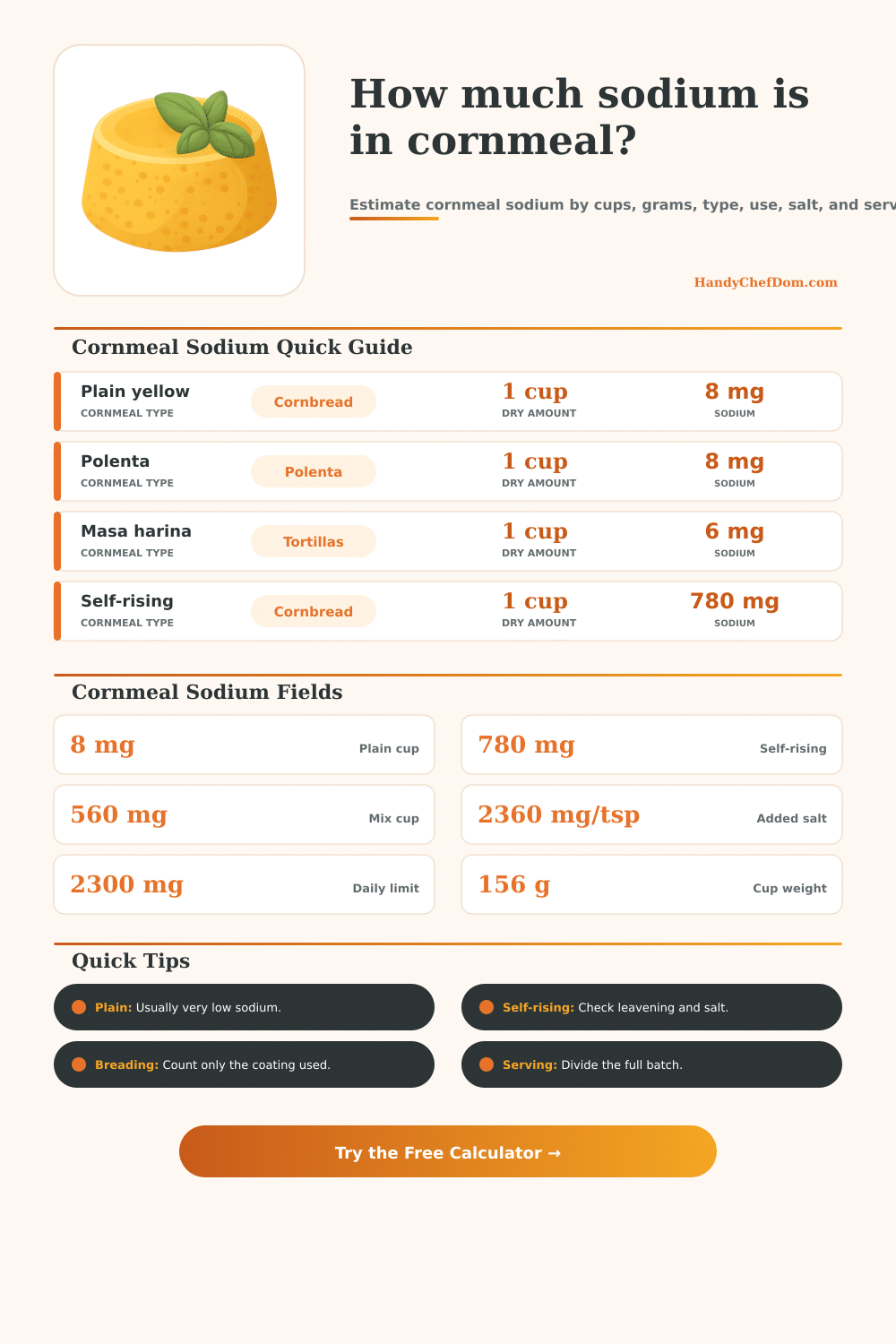
Plain cornmeal and masa are usually very low sodium. Self-rising cornmeal, cornbread mix, and seasoned breading can be much higher because salt, leavening, or seasoning is already included.
Cornmeal sodium result
Enter cornmeal, salt, servings, and batch scale to estimate sodium.
3Live Batch Snapshot
4Cornmeal Type, Use, and Sodium Grid
| Cornmeal type | Typical use | Approx sodium per 100 g | Approx sodium per dry cup |
|---|---|---|---|
| Plain yellow cornmeal | Cornbread, dusting, coating | About 5 mg | About 8 mg per 156 g cup |
| Plain white cornmeal | Cornbread, spoonbread | About 5 mg | About 8 mg per 156 g cup |
| Whole-grain stone-ground cornmeal | Rustic cornbread, porridge | About 4 mg | About 6 mg per 156 g cup |
| Plain polenta or grits | Polenta, mush, breakfast bowls | About 5 mg | About 8 mg per 156 g cup |
| Masa harina | Tortillas, arepas, tamales | About 5 mg | About 6 mg per 120 g cup |
| Self-rising cornmeal | Fast skillet cornbread | About 520 mg | About 780 mg per 150 g cup |
| Prepared cornbread mix | Muffins, casserole topping | About 400 mg | About 560 mg per 140 g cup |
| Seasoned cornmeal breading mix | Fish, okra, chicken coating | About 1600 mg | About 1440 mg per 90 g cup |
5Dry Cup and Gram Conversion Table
| Dry amount | Plain cornmeal grams | Masa harina grams | Self-rising or mix note |
|---|---|---|---|
| 1/4 cup | About 39 g | About 30 g | Use one quarter of label sodium |
| 1/2 cup | About 78 g | About 60 g | Small muffin batch amount |
| 1 cup | About 156 g | About 120 g | Check sodium if self-rising |
| 1 1/2 cups | About 234 g | About 180 g | Common skillet cornbread amount |
| 2 cups | About 312 g | About 240 g | Common family batch amount |
| 4 cups | About 624 g | About 480 g | Large prep or breading bowl |
6Use Case Sodium Watch Table
| Use case | What usually drives sodium | How this calculator treats it | Kitchen check |
|---|---|---|---|
| Cornbread or muffins | Added salt, baking powder, self-rising meal, mix | Counts all cornmeal and added salt in the batch | Add label sodium for baking powder if needed |
| Polenta or porridge | Salt, broth, cheese, salted butter | Plain cornmeal stays low until salt or add-ins are entered | Broth can dominate the sodium total |
| Breading or coating | Seasoned breading mix and how much sticks | Pickup factor can count 10% to 100% | Weigh the leftover coating for best accuracy |
| Dusting a peel or pan | Small pickup from a larger dusting amount | Use 10% pickup for light dusting | Most of the cornmeal is often discarded |
| Masa tortillas | Salt added to masa dough | Masa sodium is low unless salt is added | Divide by the actual tortilla count |
7Serving and Daily Limit Table
| Example batch | Servings | Approx sodium per serving | Percent of 2300 mg limit |
|---|---|---|---|
| 2 cups plain cornmeal, no added salt | 8 | About 2 mg | Less than 1% |
| 2 cups plain cornmeal plus 1/2 tsp salt | 8 | About 149 mg | About 6% |
| 1 1/2 cups self-rising cornmeal | 8 | About 146 mg | About 6% |
| 2 cups cornbread mix | 12 | About 93 mg | About 4% |
| 1 cup seasoned breading at 50% pickup | 6 | About 120 mg | About 5% |
| 1 tsp added table salt in any batch | 8 | About 295 mg | About 13% |
8Two Cornmeal Sodium Tips
When you grab a bag of cornmeal, I’m guessing sodium isn’t the first thing that pops into your mind. It looks just like sand or flour, just innocent-looking ground grains. And you figure any salt come later, once you mix it in. If you purchase plain yellow cornmeal from the bulk bin, you’d be right… It’s practically devoid of sodium, plain old cornmeal. Unless you’re making cornbread out of it (which, by itself, has little-to-nothing to contribute to your daily allowance), the grain doesn’t even count towards your intake. Add a sprinkling of salt while cooking, and finished product won’t be too heavy.
Here’s where the trap comes in: Convenience products. Sure, maybe self-rising cornmeal is convenient (it doesn’t require you measuring out baking powder or salt!). But guess what else? You’re not just buying ground corn; this stuff is a pre-mixed concoction, which means there’s baking powder, plus salt. Sounds convenient if you need a quick skillet bread, right? Only problem: Your sodium count has now skyrocketed well before you pull anything from the fridge. A cup of self-rising mix packs about 780 milligrams of sodium. That is more than a third of your suggested daily intake of 2300 milligrams. And you haven’t even added any salt yet. The package beat you to it.
Read the Label: Plain Cornmeal Has Less Salt Than Mixes
The same is true for prepared mixes like cornbread. Albeit, occasionaly slightly less aggressively. Hidden within those mixes are leaveners and salt. Even seasoned breading mixes are worse culprits, as they depends on an immediate shot of salty goodness to give flavor. A single cup of seasoned breading contains upwards of 1400 milligrams of sodium. It’s easy to assume that not much of that seasoning will stick when you dredge some chicken or fish through the mixture. You shake off most of it that falls back down in the bowl. Plug your pickup rate and amount of use into the calculator above, and it’ll do the math for you, no guesswork required about what actualy sticks to the food.
If you’re counting your intake for any reason; health, balance (these differences is important to know). Tortilla makers use plain masa harina that has virtually no salt, either. Add water, a pinch of seasoning, and you have a finished product whose ultimate salt level is up to you. Same goes for polenta. As with grits, it’s the broth you prepare it in, or the cheese you mix into it at serving time, which adds the salt.
So what? The tool notes a distinction between self-rising cornmeal and plain, which is not hard to see when you are looking at the labels. So you’re thinking: Cornmeal = low sodium. The thing to know is that that’s the part most people skip over. The way the calculator functions is that it calculates the effect of your added manual salt vs. This refers to the dry ingredient, which is cornmeal in this case. And the quantity of serving size… Because if you double a recipe and now have two times the cornmeal to serve, you also has double the amount of sodium per serving. But it depends how many servings you have to split it among.
Cornmeal cooking is simple until you remember that convenience foods change the nutritional picture completely. Read those labels! If there’s already leavening and/or salt in the mix, scan a little deeper to check if it includes any other additives (such as oil) to avoid going overboard without realizing it. Fried fish? Cornbread? Forget ’em! Watching your sodium doesn’t mean giving up these treats; you just need to know if the main ingredient uses up too much of your salt allowance.
Next time you bake with corn, read the type first. Know what you have: Plain is a blank slate. Mixes and self-rising are a head start, and a big dose of salt, too. With knowledge comes power; adjust the balance of your meal to match. If there’s enough salt in that self-rising mix, maybe you don’t need more elsewhere. Maybe you want to be in control, so pick up the plain kind of cornmeal. Either way, paying attention makes all the difference.
But it’s not the grain. The problem with convenient blends is that they surprise you with their secret additives. Since you know how much stuff is already in the bag, maintaining sodium levels are as easy as subtracting numbers instead of guessing at them. There’s no mystery as to where the salt is coming from. With this clarity comes familiarity, turning a routine food choice into something under your dietary control.