Chickpeas Iron Calculator
Estimate non-heme iron from cooked chickpea cups, canned drained yield, dry-to-cooked batches, hummus, roasted snacks, salad portions, daily value percent, and vitamin C pairing.
Chickpea Iron Estimate
| Chickpea Form | Typical Measure | Gram Weight | Iron Estimate |
|---|---|---|---|
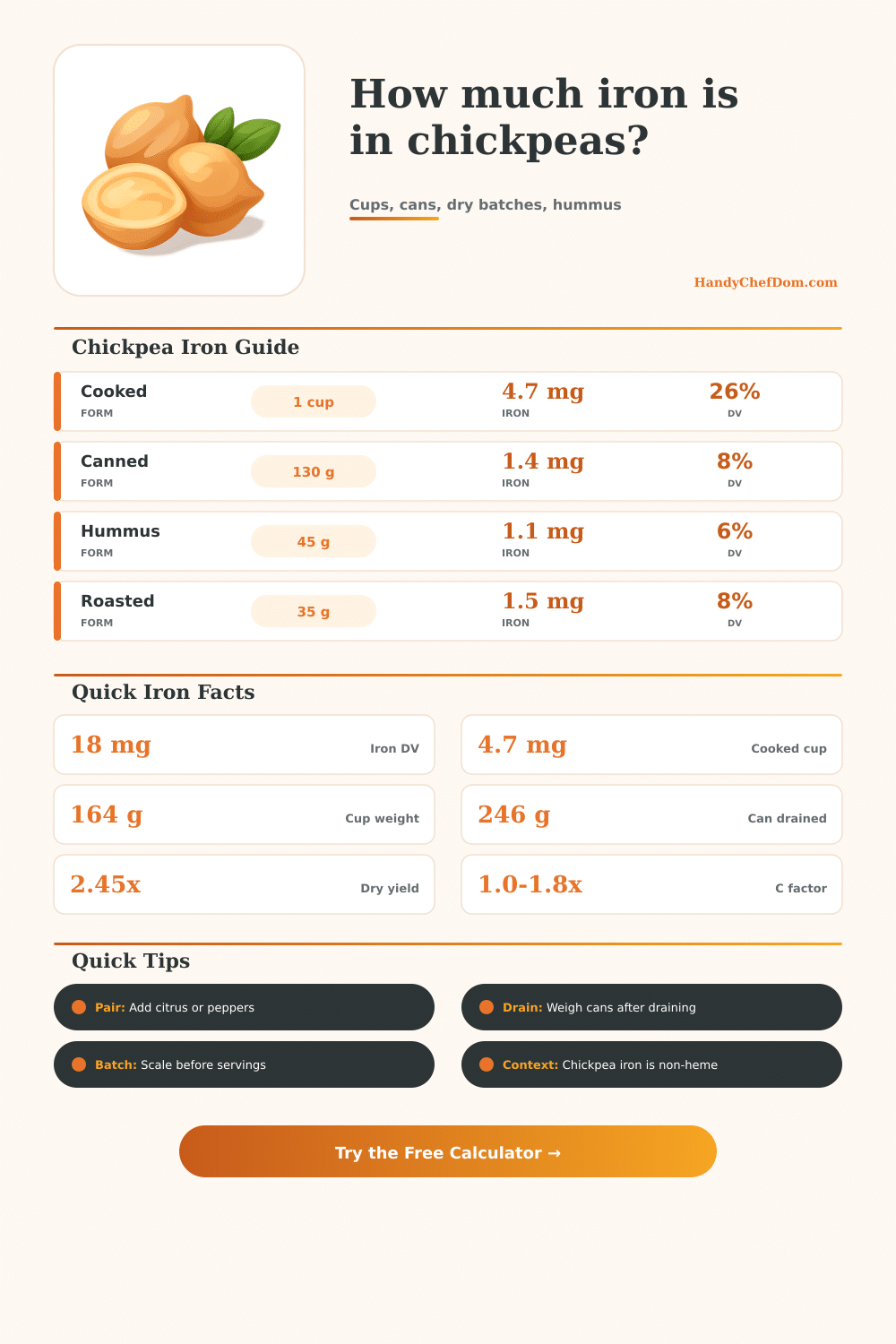
| Cooked whole chickpeas | 1 cooked cup | 164 g | 4.74 mg |
| Canned drained chickpeas | 1 label serving | 130 g | 1.40 mg |
| Dry chickpeas, raw | 100 g dry | 100 g | 6.24 mg |
| Hummus or chickpea dip | 3 tbsp | 45 g | 1.10 mg |
| Roasted chickpea snack | Small handful | 35 g | 1.5 mg |
| Yield Conversion | Starting Amount | Finished Chickpeas | Iron Planning Note |
|---|---|---|---|
| Dry to cooked weight | 100 g dry | About 245 g cooked | Use finished cooked grams for servings |
| Dry cups to cooked cups | 1 dry cup, about 200 g | About 3 cooked cups | Best for batch scaling |
| Canned drained yield | 1 standard 15 oz can | About 246 g drained | Change the field if the label differs |
| Cooked cup weight | 1 level cooked cup | About 164 g | Drain surface liquid before weighing |
| Serving Use | Common Portion | Chickpea Role | Iron Per Person |
|---|---|---|---|
| Salad topping | 1/4 cup cooked | Light add-in | About 1.2 mg |
| Grain bowl | 1/2 cup cooked | Main bean portion | About 2.4 mg |
| Chickpea meal | 3/4 cup cooked | Large portion | About 3.6 mg |
| Hummus snack | 45 g hummus | Dip portion | About 1.1 mg |
| Roasted snack | 35 g roasted | Crunchy portion | About 1.5 mg |
| Vitamin C Pairing | Example Add-In | Factor | Non-Heme Context |
|---|---|---|---|
| No pairing | Plain chickpeas | 1.0x | Use baseline absorption index |
| Small enhancer | Tomato, parsley | 1.25x | Helpful with bean salads |
| Strong enhancer | Lemon, bell pepper | 1.5x | Good default for chickpea bowls |
| High enhancer | Citrus and peppers | 1.8x | Best paired estimate in this calculator |
Beans are good for you, most of us know that. And it makes sense that theyre an energy food.
Iron is tricky. It tends to lurk in plain sight. If you don’t pay attention to absorption rates, you could be eating three cups of chickpeas per day…and still have no energy come lunchtime. That’s where it gets tricky. It is rarely because you aren’t eating enough iron; instead, it is because the food doesn’t stay in your system long enough to make a difference.
How to Get More Energy from Beans
Iron in legumes, like chickpeas, isn’t heme iron (like meat’s) but non-heme iron; which requires additional work by your body to be absorbed. Why does it matter? Because it impact meal-planning strategy. For example: One cup of cooked chickpeas alone provides fewer absorbable grams of iron then one cup of cooked chickpeas topped with lemon juice, or alongside sliced bell peppers.
That’s because vitamin C is a trigger that opens up plant-based minerals and allows them to get in your bloodstream more easily. This is why the tool on this page factors in pairing factor. It doesn’t only count iron in the bean; it calculates how many grams of iron you may actualy retain given everything else that’s taking up space beside it on plate.
Measure your mistakes to get to know what you start with. A regular can of chickpeas always appear the same, right? Wrong. Depending on the packer and how tightly they pack them, the drained weight will be all over the place, some cans is only two hundred grams; some get up to two-fifty. If you don’t realize that not all canned goods weigh the same, you’re never going to have correct inputs for any nutritional tracking program.
By weighing the amount of beans you drain off, you eliminate that variable completely. The weight becomes known, no longer a guess, just a precise input. Plug it in, tell me your form and weight, and the calculator do the rest. No more messing with yield coefficients when you’re trying to get dinner on the table after a long day.
The second part, and what trips most people up about batch cooking, is that dry chickpeas triple (or more) in size after they’re soaked and then cooked. So if you’re planning on making a big pot to meal-prep with, do you measure by the amount of raw ingredient you have? Or do you measure by the number of cups it will become when finished? One cup dry will yield about three cups cooked, so make sure to know which one you’re looking at when scaling up. Otherwise, you risk way-too-large portions that won’t fit in your fridge … or underwhelming portions that dissapears before they’re supposed to.
The right scale-up means you’ll be getting the same level of nutrition per serving, no matter how many servings you’re cooking. To make it even more complex: Hummus and roasted chickpeas can either dilute or concentrate nutrients based off their textures. By weight, dense and crispy roasted snacks contains more iron than a thin, runny dip stuffed with oil and tahini.
And while each bite may have the same amount of food (a spoonful), the density differ based on its form, which is why it’s important to factor in this difference when aiming to meet certain daily nutrient targets. Not just “eat more chickpeas,” but eat the right kind to achieve your desired outcome.
The point is that no food exists in a vacuum: Your body doesn’t digest food alone, so it perceives a meal as an interconnected system of ingredients. The addition of parsley (or tomato, or whatever) may appear to be mere decoration, but it changes how your body can absorb the whole dish. Awareness is all that’s required; there’s no need to turn into a nutrition scientist to reap the rewards of this information. Pairing matters.
The problem with using one static number as your benchmark for daily value is that it change depending on your sex, age, and even your life stage. For example, what supports a pregnant woman? What about an adult man? Or an adolescent? Raising the starting point allows the percent you’re seeing to reflect your own lived experience instead of some hypothetical average. (And this is where most folks go wrong in tracking nutrients blindly.)
All in all, however, if you’re looking for something solidly iron-rich and easily adaptable to nearly every kind of food, it doesn’t get much better than chickpeas: they’re economical, non-perishable, and as versatile as they come. Just give ‘em some extra attention, more than perhaps you’d extend to a bag of potato chips, and you’ve got yourself a meal.
Measure out your servings, add something sour or sharp to those beans, and cook up another batch. When you finally put down the guesswork, you’ll see that the distance between good meals and good feelings shrinks pretty fast.