Dates Iron Calculator
Estimate iron in Medjool, Deglet Noor, date paste, and chopped dates by count, grams, cups, servings, pitted yield, and batch size.
✨Quick date iron presets
📝Date amount and use
Full dates iron breakdown
📊Current serving and nutrition snapshot
This grid updates after each calculation so the same date amount can be read as count, grams, chopped cups, paste cups, and per-serving nutrition.
🌿Date type, form, and iron grid
| Date type or form | Iron mg per 100 g | Typical edible weight | Best calculator use |
|---|---|---|---|
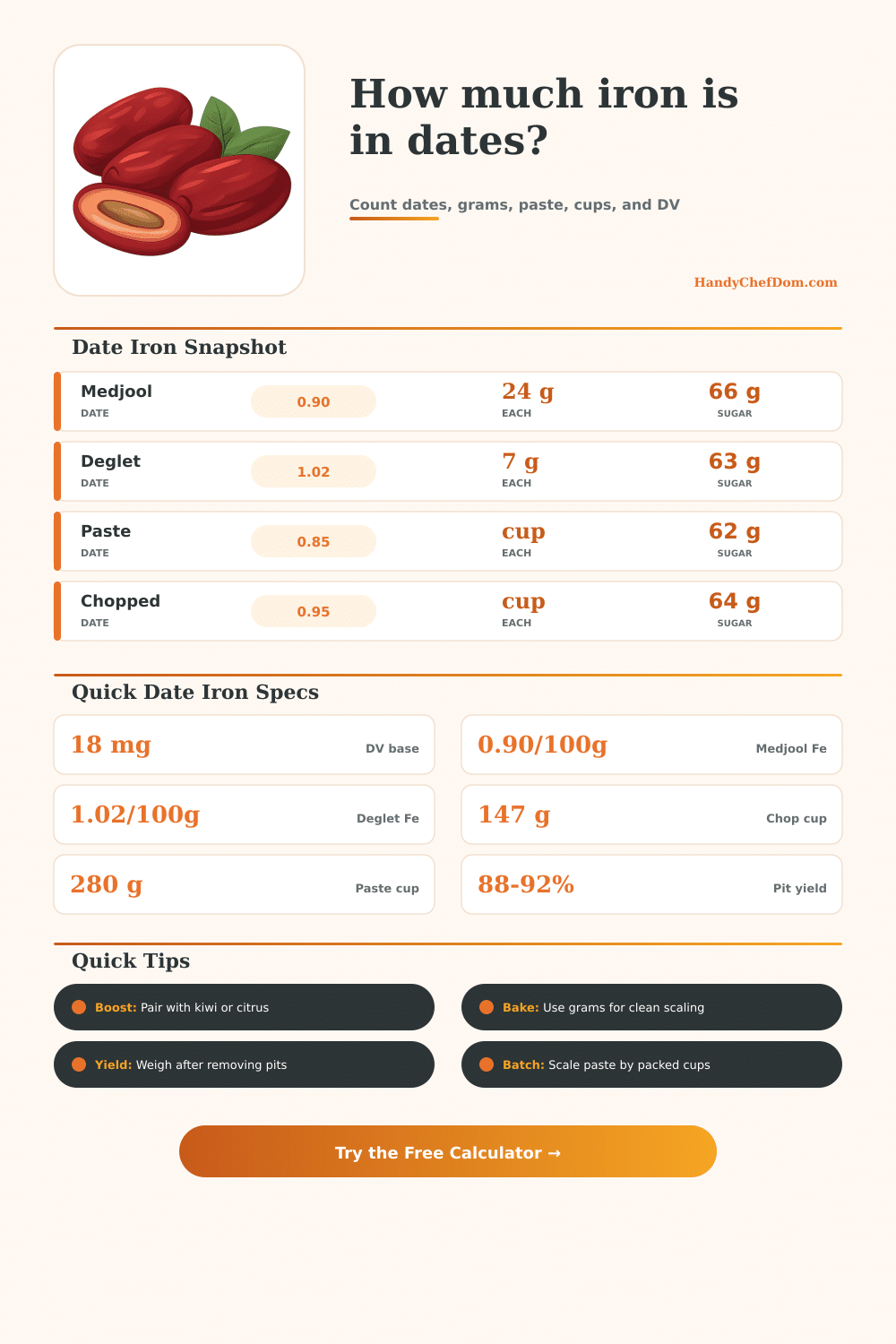
| Medjool pitted whole | 0.90 mg | 24 g each | Snack count, stuffed dates, platters |
| Deglet Noor pitted whole | 1.02 mg | 7.1 g each | Lunchbox packs, trail mix, smaller servings |
| Barhi soft dates | 0.85 mg | 15 g each | Soft snack plates and dessert boards |
| Zahidi semi-dry dates | 1.00 mg | 8 g each | Chopped baking use and pantry batches |
| Ajwa dates | 0.95 mg | 8.5 g each | Small counted portions and sharing plates |
| Blended date paste | 0.85 mg | 280 g per cup | Bars, bites, fillings, and batch scaling |
🥣Chopped cup and paste conversions
| Kitchen measure | Approx grams | Approx ounces | Iron range |
|---|---|---|---|
| 1 cup chopped pitted dates | 147 g | 5.2 oz | 1.25 to 1.50 mg |
| 1/2 cup chopped pitted dates | 74 g | 2.6 oz | 0.63 to 0.75 mg |
| 1 cup packed date paste | 280 g | 9.9 oz | 2.38 to 2.85 mg |
| 1 tablespoon date paste | 18 g | 0.6 oz | 0.15 to 0.18 mg |
| 10 pitted Medjool dates | 240 g | 8.5 oz | 2.16 mg |
| 30 pitted Deglet Noor dates | 213 g | 7.5 oz | 2.17 mg |
🍊Vitamin C pairing context
| Pairing | Typical portion | Calculator note | Best with |
|---|---|---|---|
| Orange slices | 1 medium orange | High vitamin C pairing | Snack plates and lunchboxes |
| Kiwi fruit | 1 kiwi | Compact high vitamin C pairing | Work snack boxes |
| Strawberries | 1/2 cup | Fresh fruit pairing | Breakfast bowls and smoothies |
| Lemon yogurt | 1/2 cup | Bright dairy-style pairing | Date paste bowls and bars |
| Bell pepper plate | 1/2 pepper | Savory vitamin C option | Stuffed dates and grazing boards |
📦Serving and batch scaling table
| Use case | Suggested date portion | Approx iron per serving | Scaling note |
|---|---|---|---|
| Snack plate | 2 to 3 Medjool dates | 0.43 to 0.65 mg | Multiply by people, then add tray buffer |
| Lunchbox Deglet pack | 6 to 8 dates | 0.43 to 0.58 mg | Count small dates before packing |
| Baking batter | 1/4 cup chopped | 0.31 to 0.38 mg | Use grams for repeatable batches |
| Date paste bars | 2 tablespoons paste | 0.30 mg | Scale paste cups with batch multiplier |
| Trail mix | 25 g chopped dates | 0.21 to 0.26 mg | Chop first, then weigh the fruit portion |
🧮Per-serving nutrition grid
💡Practical calculator notes
Besides sugar, dates also contain iron. Not as much as red meat or spinach, admittedly, but still significant if you are using them not merely as an ingredient for sweetness, but as a bona fide food.
The trick is knowing what you’re getting… And how variations in the shape and texture of fruit affect the reading. When we count dates in unweighed pieces, not every item will be the same (and so the nutritional content will vary). That’s why Deglet Noor is smaller and more dense than Medjool dates; they’ll weigh less per piece. Most folks overlook this when trying to account for mineral counts in their raw ingredient.
How to Measure Dates for Better Iron
So instead of guessing if a bunch of smaller dates has the same amount of iron as three larger dates, the converter does it for you. Simply pick the type of date(s) you want to measure, the unit of measurement, and allow the converter to scale the batch and make up for the yield lost by pits. The reason the pits matter: they weigh something but don’t carry nutrient value. If you eat dates that haven’t been de-pitted, or weigh them before removing the stones, your estimates for how much food you’re eating will be off. The converter takes care of this for you, allowing you to get a clearer idea of what’s going into your body.
Dates aren’t easy because they are a relatively dense ingredient, so it’s not a good idea to try to measure them by volume (which is what most recipes ask for). For example, a 1-cup scoop of chopped dates will weigh less than a 1-cup scoop of packed dates. That will change the amount of iron in each serving. When making something like no-bake cookies or energy bars, measuring by weight (grams) rather than by volume means your batches will have identical amounts of minerals, no batch will be slightly higher or lower in iron.” Note: If you’re on a diet or just monitoring nutrient intake, this level of accuracy can matter.
Speaking of absorption: Dates are very sweet! So what’s that mean? Iron isn’t absorbed as easy from plant foods (non-heme) as it is from animals (heme). When you eat your date snack, eating something that has lots of vitamin C can help increase the absorption of that iron greatly. A squeeze of lemon juice, a couple of strawberries, or a slice of orange can be the difference between having iron pass through your body vs. It goes into your blood stream.
You’ll see this on the tool, if you want to make a note of which foods pair well together, since those alter the rate at which you use existing iron. It is a small change, but it increases the nutrient value of your snack.
For meal preparation or making a larger quantity of something (such as for a big group), it’s not really about doubling a recipe; it’s all about scaling up. Sticky things like dates get lighter as they are chopped and handled, so there can be some “friction” in doubling a recipe. To prevent yourself from coming up short with ingredients just before service, I built an adjustment factor into the calculator that lets you account for lost weight without having to recalculate ratios every single time. It frees up brain space and ensures you’re accounting for your ingredient accuratly.
While the mineral content varies slightly between different types of dates, the difference tends to be small compared to the variability caused by moisture content and size. For example, larger, softer Medjool dates are ideal for eating as a snack (either whole fruit or stuffed) versus drier ones like Zahidi which hold their shape well after being chopped into batters used for baking. The type of date you buy will have less impact on your iron intake then how it will feel in your mouth. This allows you to focus on how it tastes instead of the small amount of nutrients that won’t greatly change your total value for the day.
All of this is a way to turn dates… Which are just a sugar hit otherwise, into a part of your nutrition strategy with some structure. With that in hand, you can feel confident when making big batches. You will know how to portion your food and know what stands between you and absorption. And when you go to grab the jar of paste or a box of Medjools, recall: weight beats count every time.
Having clarity on the amount of food you’re getting is something you’ll never get by guessing. You should of checked this earlier if you want exact results.