🍞 Bread Improver Per Cup of Flour Calculator
Scale bread improver from cups or grams of flour, then tune the dose for dough type, whole grain load, hydration, loaf count, rise goal, and flour strength.
Enter your flour amount by cups or grams. The calculator estimates a baker's-percent improver dose, grams per cup, teaspoon measure, water adjustment, rise lift, and dough strength reading.
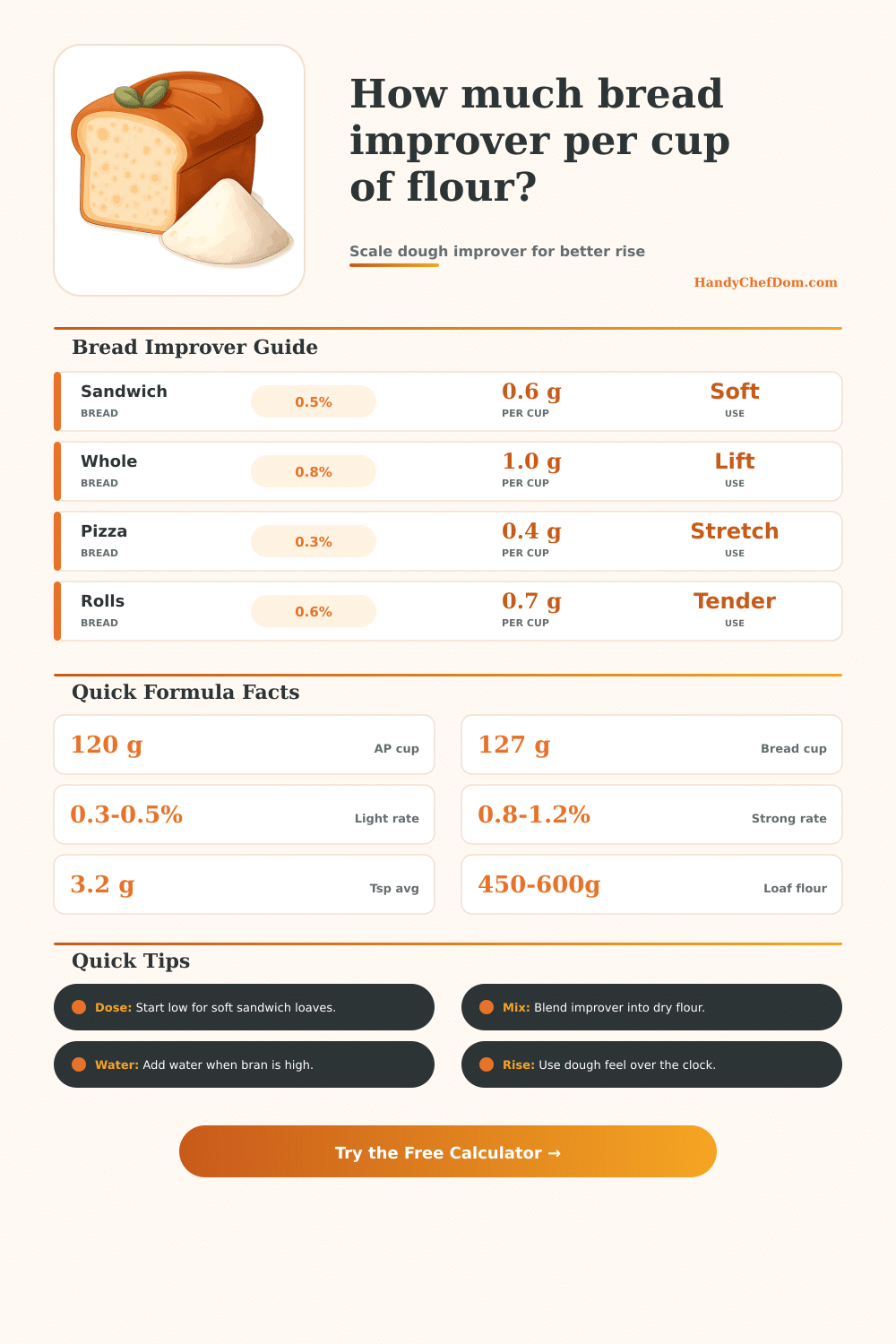
| Bread Style | Typical Improver Rate | Per 120 g Cup | Why Use It |
|---|---|---|---|
| Lean hearth bread | 0.20% to 0.45% | 0.24 g to 0.54 g | Small lift without making crusty dough too tight |
| Soft sandwich bread | 0.40% to 0.70% | 0.48 g to 0.84 g | Better volume, softer slice, and steadier crumb |
| Dinner rolls and buns | 0.50% to 0.85% | 0.60 g to 1.02 g | Supports enriched dough and tender shaping |
| Whole wheat loaf | 0.65% to 1.10% | 0.78 g to 1.32 g | Offsets bran cuts and heavier absorption |
| Pizza dough | 0.20% to 0.50% | 0.24 g to 0.60 g | Improves stretch while avoiding rubbery chew |
| Frozen dough | 0.80% to 1.30% | 0.96 g to 1.56 g | Helps dough recover after freezing and thawing |
| Improver Style | Normal Rate | Average Density | Best Dough Match |
|---|---|---|---|
| Standard bread improver powder | 0.55% | 3.2 g per tsp | Pan breads, rolls, everyday loaves |
| Enzyme and ascorbic blend | 0.35% | 3.0 g per tsp | Lean dough needing volume and strength |
| Pan bread softener blend | 0.65% | 3.4 g per tsp | Sandwich bread and milk bread style dough |
| Whole grain improver blend | 0.85% | 3.5 g per tsp | Whole wheat, seeded, bran-heavy loaves |
| Pizza dough conditioner | 0.30% | 3.1 g per tsp | Extensible dough balls and flatbreads |
| Frozen dough stabilizer | 1.00% | 3.6 g per tsp | Make-ahead dough that will be frozen |
| Ascorbic acid focused improver | 0.12% | 2.8 g per tsp | Very small dose for oxidation and strength |
| Clean-label malt and gluten blend | 0.70% | 3.3 g per tsp | Natural-style lift and color support |
| Flour Measurement | Common Cup Weight | Protein Feel | Calculator Use |
|---|---|---|---|
| Spoon-and-level all-purpose flour | 120 g per cup | Moderate | Default for most home bread formulas |
| Bread flour | 127 g per cup | Stronger | Use when the flour is denser and higher protein |
| Whole wheat flour | 113 g per cup | High protein but bran-heavy | Needs water and handling support despite protein |
| Rye or spelt blend | 105 g to 115 g per cup | Weaker gluten | Choose weak blend for dough strength adjustment |
| Packed flour cup | 135 g to 150 g per cup | Variable | Weigh if possible because improver scales by flour grams |
| Commercial dough batch | Use actual grams | Most accurate | Switch to weight mode for repeatable baker's percent |
| Dough Factor | Rate Move | Hydration Move | Strength Note |
|---|---|---|---|
| Low-protein flour | Add about 15% | No major change | Improver helps but cannot replace gluten entirely |
| Whole grain above 35% | Add 10% to 30% | Add 2% to 5% water | Bran lowers extensibility and volume |
| Sweet or enriched dough | Add 10% to 25% | Add lightly | Fat and sugar slow yeast performance |
| Cold fermentation | Reduce about 10% | No major change | Time builds strength, so avoid over-conditioning |
| High hydration dough | Reduce about 5% | Hold back water | Too much improver can tighten open crumb dough |
| Frozen dough | Add 25% to 45% | Add 1% to 3% water | Use stronger dose for thaw recovery |
Using the correct level of bread improver for any particular flour quantity may seem trivial until your rolls is too dense or your loaves turn out flat. Typically, this means flour isn’t providing enough support, depending on how much whole grain and protein it contains. Once you know how the improver works, you stop asking “how much” and start asking what your dough needs from flour.
The effect of bread improvers is based off the mix: some are more extensible, others adds softness, while others still create structure. Standard powders are generaly about half a percent of the flour weight. Bran cuts right through that gluten network, so whole grain (or enzyme) types will be higher.
How to Use the Bread Improver Calculator
So how do you know what’s best? Enter the flour quantity, then select dough type; the calculator does the rest. Notice how even a slight change in hydration level or whole grain content change the total dose? Why does it matter? Because bran absorbs water and saps strength from the dough. As the whole grain proportion increase, the rate goes up.
But the inputs are reflective of actual bench decisions: Does your base provide lift or do you need to boost? The calculator knows if it is a sweet dough; fat and sugar slows fermentation, so the dough needs a boost. What’s the hydration level? Wetter doughs tolerates a little bit less improver before tightening up. And what’s the rise target? Want noticeably more oven spring then normal? The tool increases the improver to match that goal.
This way, you don’t have to worry about overdoing it by adding yet another quarter teaspoon. When we make a mistake most of us overcorrect. We toss in more improver and then fail to see if our room cooled off, flour changed or maybe we just need to give the dough another fold.
I like that the calculator use the strength score to let me quickly check the balance. How does that show me if my dough is going to be slack or tight? That’s more helpful than remembering numbers. It combines the flour style, improver style, and dough factors into one number. You can use this number as a guide and judge it based off your own experience.
The tool’s handy for scaling recipes too. You can enter the quantity of flour going in (and amount of loaves or dough balls), and it tells you how much improver goes into each one. That ensures your dose stays consistent even if you half/halve/double a recipe.
The water adjust line is similarily useful. Some kinds of improvers will suck up a bit more liquid than others; whole grain does too. Seeing that number avoids the trap of thinking original hydration is written in stone.
That’s where the real benefit comes, with multiple bake. You begin to feel which dough responds to a light hand and which ones rewards a slightly higher rate. With the calculator out of the way, you’re able to concentrate on the feel of the dough in your hands. You don’t need to wonder if you got the math right or wrong.
This move from guesswork to observation makes the difference between an ok loaf of bread and one that you know would of worked out for you.