Pumpkin Seeds Iron Calculator
Estimate iron, Daily Value, portions, and serving breakdowns from pumpkin seed weights, cup measures, or iron targets.
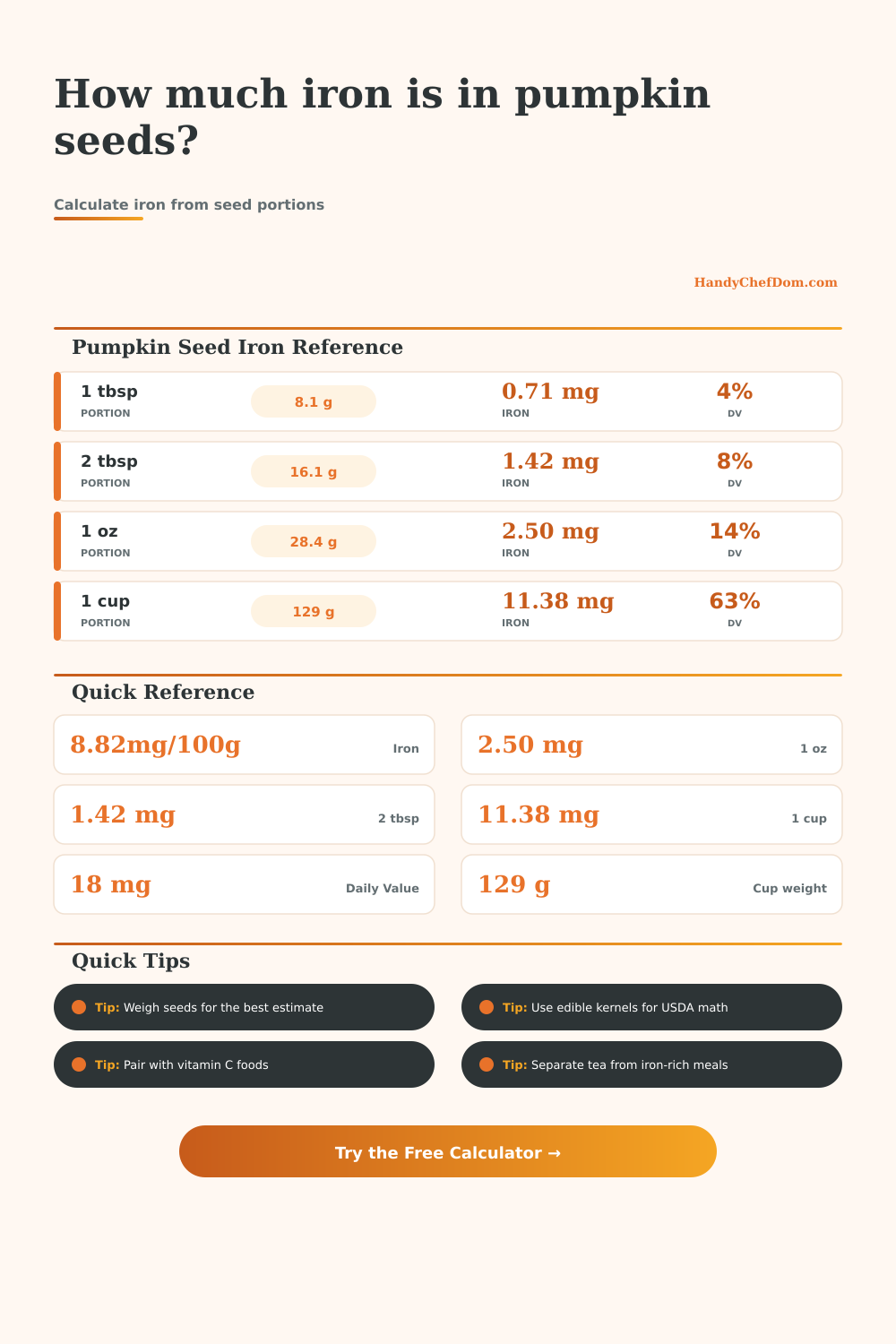
Source basis: USDA FoodData Central, SR Legacy FDC ID 170556, dried pumpkin and squash seed kernels, values per 100 g edible kernels.
| Nutrient | Per 100 g | Per 1 oz | Calculator Use |
|---|---|---|---|
| Iron | 8.82 mg | 2.50 mg | Main iron calculation |
| Energy | 559 kcal | 158 kcal | Portion context |
| Protein | 30.23 g | 8.57 g | Nutrition card |
| Total Fat | 49.05 g | 13.90 g | Nutrition card |
| Carbohydrate | 10.71 g | 3.04 g | Nutrition card |
| Fiber | 6.00 g | 1.70 g | Nutrition card |
| Magnesium | 592 mg | 168 mg | Mineral context |
| Zinc | 7.81 mg | 2.21 mg | Mineral context |
| Portion | Kernel Grams | Iron | % Daily Value |
|---|---|---|---|
| 1 teaspoon | 2.69 g | 0.24 mg | 1% |
| 1 tablespoon | 8.06 g | 0.71 mg | 4% |
| 2 tablespoons | 16.13 g | 1.42 mg | 8% |
| 1 ounce | 28.35 g | 2.50 mg | 14% |
| 1/4 cup | 32.25 g | 2.84 mg | 16% |
| 1/3 cup | 43.00 g | 3.79 mg | 21% |
| 1/2 cup | 64.50 g | 5.69 mg | 32% |
| 1 cup | 129.00 g | 11.38 mg | 63% |
| Profile | Daily Iron | 1 oz Covers | Seeds For 25% |
|---|---|---|---|
| FDA Daily Value, adults and children 4+ | 18 mg | 14% | 51 g |
| Adult men 19+ years | 8 mg | 31% | 23 g |
| Adult women 19-50 years | 18 mg | 14% | 51 g |
| Adults 51+ years | 8 mg | 31% | 23 g |
| Teen boys 14-18 years | 11 mg | 23% | 31 g |
| Teen girls 14-18 years | 15 mg | 17% | 43 g |
| Pregnancy | 27 mg | 9% | 77 g |
| Breastfeeding women | 9 mg | 28% | 26 g |
| Seed Form | Edible Kernel Factor | Cup Basis | Best Input |
|---|---|---|---|
| Hulled pepitas | 100% | 129 g/cup | Weight or cup |
| Raw hulled kernels | 100% | 129 g/cup | Weight |
| Dry roasted pepitas | 100% | 129 g/cup | Weight or cup |
| Roasted salted pepitas | 100% | 129 g/cup | Weight |
| Ground seed meal | 100% | 139 g/cup | Grams |
| Whole shell-on snack | 55% | 92 g/cup | Weight |
| Home-roasted whole seeds | 45% | 84 g/cup | Weight |
And so then: there’s that handful of pepitas in the bag and now you’re wondering whether that makes a difference on blood work. Is it healthy? How can you tell from inside your mouth, without a lab test or scale? Those pumpkin seeds are chock-full of stuff, but when you imagine them, iron doesn’t spring immediately to mind. When you think about getting your iron, you probably imagine either red meat, or maybe spinach, taking top honors.
But those tiny green kernels has an impressively hefty whack for being non-heme plants, which is to say they don’t contain heme, the form of iron found in animals.
How Pumpkin Seeds Help You Get More Iron
The problem is that portion sizes vary wildly in your head. That cup sounds like a lot, until you get down to weighing it. You won’t need to reference the USDA table of densities. There’s a tool (above) that will do the conversions for you. Just enter your best guess of how many seeds there are, and it’ll convert that into a number of milligrams of iron based off average edible kernel weights.
You’re largely just consuming fiber if you eat them with their shells intact. So the tool estimates the amount of edible yield first, and then applies the rate of iron content to that figure. Selecting hulled vs. Raw vs. Choosing hulled, raw, or roasted in the drop-down menu ensures the math accounts for how digestible the food is. That makes a big difference: shell mass dilute the amount of iron in each gram of the overall weight.
You’d think that because seed packets are small, a little goes a long way. But it’s more than most realize. An ounce is tiny when plopped onto a plate, yet it provides around 15% of what men need and 14% of what women need. This is assuming you’re male; you can switch over to female in the calculator to understand impact of one snack on meeting various goals.
The point isn’t just to reach a number, however. Heme (animal) iron from meat absorbs differently in the body different than plant-based iron. In order for it to absorb well, certain conditions must be met. Now consider the pairings. This is where it gets interesting. Combining iron and vitamin C unlocks absorption. In other words, when you eat those seeds alongside foods high in vitamin C (like citrus or bell peppers), your body will scoop up more of the mineral. You can account for food pairings in the calculator to get a realistic sense of how much of what you put into your mouth ends up in your blood stream.
Conversely, coffee and tea contain compounds called tannins, which bind to iron and prevent it from getting inside your cells. So if you eat your morning seed toast with a cup of joe, you’re mostly throwing away your time. Giving yourself even an hour between the two will make a tangible impact on uptake.
The temptation here, with any supplement, or highly nutritious food source; is to assume more is best. You may be tempted to load up on cups of pumpkin seeds all at once because they’re so high in calories, but doing this could spike your energy intake beyond what’s comfortable. By showing you the amount of iron with the calorie load, the tool allows you to tune your intake for fullness while balancing your nutritional needs. In other words, maybe a small portion plus some vitamin C will yield as much absorbed benefit as eating a big old pile of dry seeds. Keep this in mind if you are monitoring how many calories you burn each day.
To provide context for those numbers, the page includes some reference tables that lay out the baseline data (how much iron scales from full cups down to tablespoons). Those can help you sanity check your estimates while offline. If you’re planning a meal and need to remember the number off-screen, a tablespoon will get you a fraction of a percent, which is fine for garnish but won’t do anything to boost your levels. A quarter cup starts making a real difference. Having that sense of what matters helps you plan meals without having to do the math each time.
Fatigue is an early symptom (and sometimes the only one) of iron deficiency, which is not uncommon. One key is taking small amounts regularly instead of large amounts every so often; that’s why seeds can work as a regular source of iron in your diet. Sprinkle them in oatmeal, salads, smoothies (they spread out throughout the day). With the help of the calculator, you can see how that builds over time from various meals. No more wondering if you’re eating enough, just know the exact amount contributed by every bowl.
What’s going on here isn’t living by a spreadsheet; it’s understanding the leverage points in your diet. You don’t need to know how much food to eat; you just need to know which foods are most important; for example, knowing that vitamin C matters more then total volume so that you can make better decisions when shopping. You don’t need to eat shell-on seeds; you can choose hulled ones instead, saving yourself empty weight. You don’t need to eat at any particular time, but if you want your body to get the most benefit from what you eat, you should of drink your coffee right after meals to help your body absorb it. Small tweaks add up over time.
Once you understand the variables, the math behind it becomes simple. The habit of paying attention to them, however, makes all the differance. Your body doesn’t give a damn about the calculator. It gives a damn about what gets across the membrane, and then where it goes from there.