Almonds Calcium Calculator
Estimate calcium, percent daily value, and per-serving minerals from whole almonds, roasted almonds, sliced almonds, almond butter, or almond milk
| Almond Form | Calcium / 100 g | Calories / 100 g | Protein / 100 g |
|---|---|---|---|
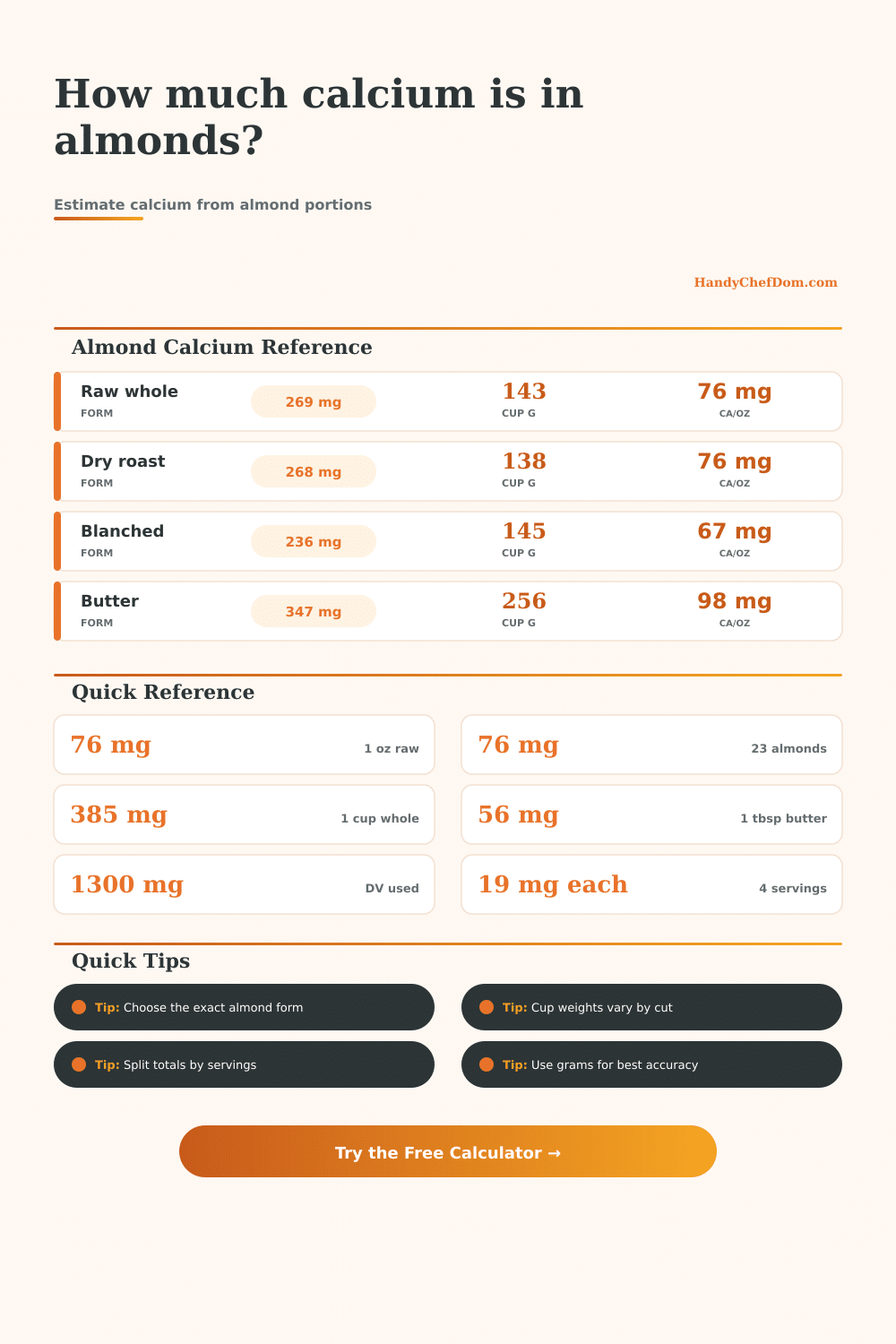
| Raw whole almonds | 269 mg | 579 kcal | 21.15 g |
| Dry roasted almonds | 268 mg | 598 kcal | 20.96 g |
| Blanched almonds | 236 mg | 590 kcal | 21.40 g |
| Sliced almonds | 269 mg | 579 kcal | 21.15 g |
| Slivered almonds | 269 mg | 579 kcal | 21.15 g |
| Ground almonds | 269 mg | 579 kcal | 21.15 g |
| Plain almond butter | 347 mg | 614 kcal | 21.20 g |
| Fortified almond milk | 188 mg | 16 kcal | 0.6 g |
| Measure | Typical Weight | Raw Calcium | Best For |
|---|---|---|---|
| 1 oz whole almonds | 28.35 g | 76 mg | Snack portions |
| 23 whole almonds | 28.35 g | 76 mg | Piece counting |
| 1 cup whole almonds | 143 g | 385 mg | Batch prep |
| 1 cup sliced almonds | 92 g | 247 mg | Salads |
| 1 cup slivered almonds | 108 g | 291 mg | Oatmeal |
| 1 cup ground almonds | 95 g | 256 mg | Baking mixes |
| 1 tbsp almond butter | 16 g | 56 mg | Toast spread |
| 1 cup almond milk | 240 g | 450 mg | Smoothies |
| Plan Target | Target Calcium | Raw Almond Equivalent | Notes |
|---|---|---|---|
| Small snack credit | 50 mg | 0.66 oz | About 15 almonds |
| Standard snack | 76 mg | 1 oz | About 23 almonds |
| 100 mg boost | 100 mg | 1.31 oz | Use grams for accuracy |
| 10% of 1300 mg DV | 130 mg | 1.71 oz | Large snack portion |
| Recipe batch share | 200 mg | 2.62 oz | Split across servings |
| Fortified drink cup | 450 mg | 5.89 oz | Milk varies by label |
| Scenario | Form | Amount | Total Ca | Per Serve | % DV |
|---|
| Form | Calcium | Magnesium | Fiber |
|---|---|---|---|
| Raw whole almonds | 76 mg | 77 mg | 3.5 g |
| Dry roasted almonds | 76 mg | 79 mg | 3.1 g |
| Blanched almonds | 67 mg | 76 mg | 2.8 g |
| Plain almond butter | 98 mg | 79 mg | 2.8 g |
Without thinking about it, you grab a handful of almonds. Sure, you love them; they’re delicious plain or on top of cheese. And you know they’re good for you because, nuts! But you may overlook nutritional details, which include calcium. Nuts aren’t dairy, actualy, yet they serve a similar purpose in several ways.
Once you input your portion size and general form (above), the calculator do the rest. It doesn’t matter whether you memorize conversions, as people typically struggle with coefficients when tracking micronutrients. Keep in mind that not all almonds has the same mineral content. Fortified almond milk, almond butter, and eating raw whole almonds will give you a slightly different calcium profile (as well as other nutrients). Why? Because how it’s processed make a difference.
How to Use the Almond Calculator
Almonds that are blanched don’t have any skin left on them; that impacts weight per cup and texture. Without the skin, there is a shift in the concentration of nutrients, too. This is why the calculator lets you choose which kind of almond you’re including, so you don’t have to remember density of each and every type. All you need to keep in mind is that whole almonds are heavier per cup than sliced almonds. Depending on how they’re cut, a cup of almonds will hold a different amount when measured by volume alone. And that’s where people makes a mistake. They think a cup is always a cup, no matter what shape.
Recipes use cups and other volume measurements, which are handy, but notoriously inaccurate when it comes to nutrition. Doesn’t that “loose” cup of sliced almonds have way less bulk than a heapin’ cup of slivers? To get around this problem, the tool takes all those volumes and converts them into weight, because USDA data is weighted in grams. That’s where this is so important: When you eat or bake with ground almonds, say, a cup of them, the way you measure depends entirely on their density, so using a cup as your measuring device will give you wildly different results when estimating how much calcium you took in. Always weigh ingredient if possible. You’ll remove any variation caused by packing density and have a clean starting point.
The calculator makes this simple, enter measurements in either ounces or grams, whatever you like best. And then there’s the issue of planning, and absorption. Not all calcium gets absorbed at equal rates. Almonds has accompanying minerals, such as magnesium, which support bones. Also, the tool has an option where you can account for yield loss in recipes. When you’re breaking up nuts for baking or using them on a salad, some inevitably get dropped down the drain or stuck to your cutting board. This percentage helps make your tally realistic. It keeps things honest, too. That lost bit of almond you scraped off the cutting board didn’t go into your mouth.
And then there’s another wrinkle: fortified almond milk. While nuts contain a fixed amount of naturally occurring calcium (give or take), fortified liquids can range from brand to brand. To provide some kind of starting point, we’ve plugged in an average for fortified milk; but again, if precision matters, read the label on your carton. Not all brands fortifies with the same amount of calcium carbonate. That’s why the calculator lets you input your own target daily value. Do you aim for a higher intake? For example, say 1300 milligrams? Or maybe something less strict is right for you? Tweak that figure, and you’ll get a picture of how almonds plays against other foods in the larger scheme of things.
Scrolling down to the bottom of the page, I look at the reference tables which present the raw numbers side-by-side. A single almond doesn’t offer the same mineral punch as a tablespoon of almond butter. It’s concentrated. Knowing density will help you select your vehicle if you’re targeting a certain mineral and don’t want to use dairy; you can go for butter if you desire concentration in a tiny space (toast), or milk if you require volume.
So yes, tracking calcium from almonds (or any other food) isn’t about being perfect; it’s about knowing. You should of known that eating enough almonds on a regular basis makes a difference, and that these plant foods matter for your daily requirements. With this tool, there’s no confusion (just the numbers laid out before you). See how many almonds match one serving of something else, and how much butter equals what in a week. When you really know what you’re getting from each serving, it’s harder not to assemble a meal that feels good, and fuels your body just right. The next time you grab that bag of nuts, you’ll know just how much they bring to the table. Far beyond the crunch factor.