Black Tea Caffeine Calculator
Estimate caffeine from black tea type, leaf grams, steep time, water temperature, cup count, re-steeps, body weight, and bedtime timing.
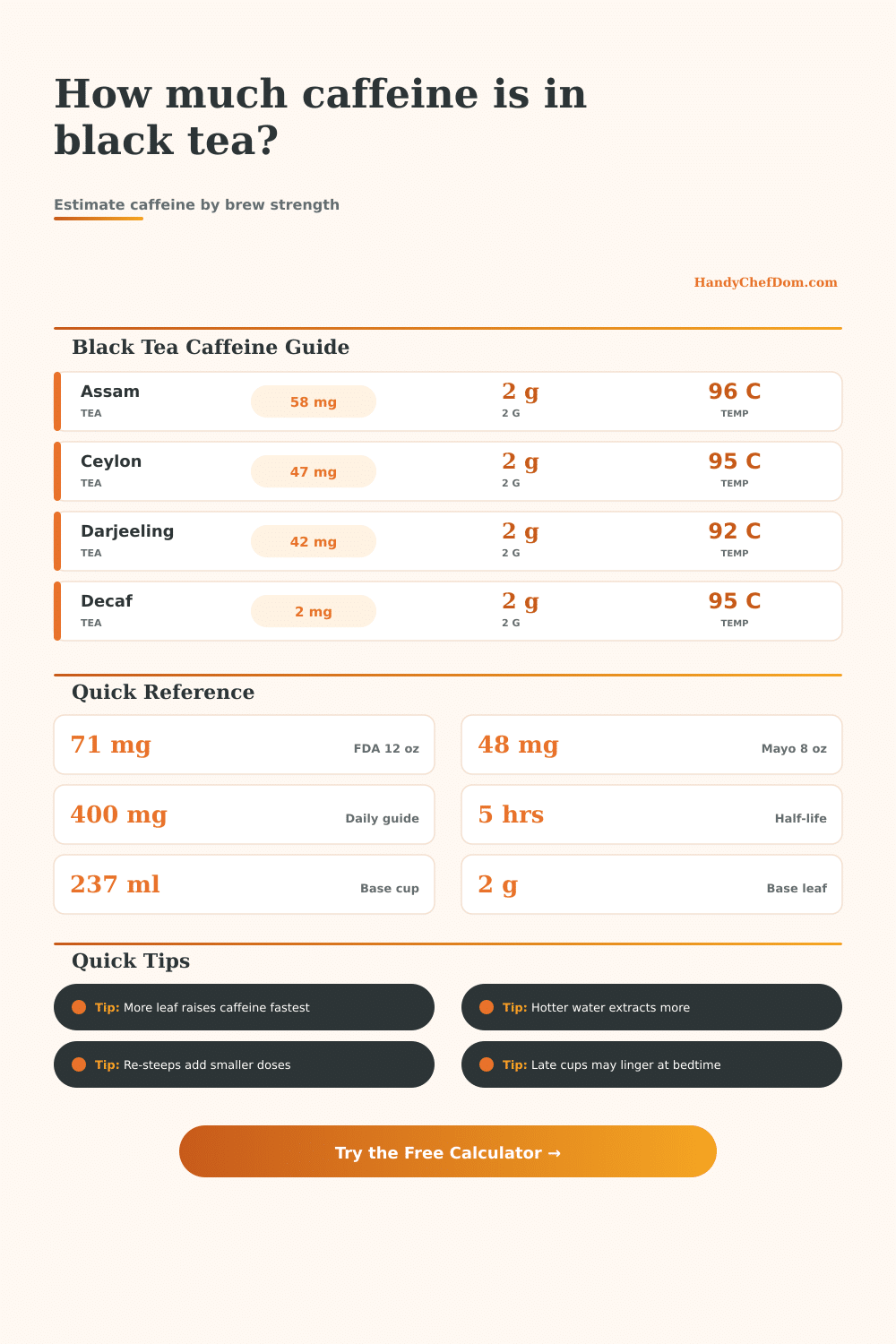
| Black Tea | Base mg | Base Brew | Why It Changes |
|---|---|---|---|
| Assam | 58 | 2 g, 8 oz, 4 min | Bold leaves often brew stronger |
| English Breakfast | 55 | 2 g, 8 oz, 4 min | Blend of strong black teas |
| Earl Grey | 50 | 2 g, 8 oz, 4 min | Black tea base with bergamot |
| Ceylon | 47 | 2 g, 8 oz, 4 min | Close to FDA and Mayo anchors |
| Darjeeling | 42 | 2 g, 8 oz, 3.5 min | Lighter black tea style |
| Decaf Black | 2 | 2 g, 8 oz, 4 min | Mayo lists low residual caffeine |
| Input | Low | Typical | High |
|---|---|---|---|
| Leaf Amount | 1.5 g per cup | 2.0 g per cup | 3.0 g per cup |
| Steep Time | 2 min, lighter | 4 min, baseline | 6 min, stronger |
| Water Temp | 185 F / 85 C | 203 F / 95 C | 212 F / 100 C |
| Leaf Form | Whole leaf slower | Broken leaf baseline | Tea bag faster |
| Steep | Share of First | Example | Use In Calculator |
|---|---|---|---|
| First | 100% | 48 mg | Main cup value |
| Second | 35% | 17 mg | Added if re-steeps = 1 |
| Third | 18% | 9 mg | Added if re-steeps = 2 |
| Fourth+ | 10% then less | 5 mg | Small remaining extraction |
| Reference | Value | Source Anchor | Calculator Use |
|---|---|---|---|
| FDA black tea | 71 mg / 12 oz | Typical drink chart | Equals about 47 mg per 8 oz |
| Mayo black tea | 48 mg / 8 oz | Brewed black tea chart | Main baseline cross-check |
| USDA/FDC item | Black tea, brewed | FoodData Central record | Confirms category and variability |
| Adult daily guide | Up to 400 mg | FDA and Mayo | Percent of guide card |
| Half-life estimate | About 5 hours | Common clinical estimate | Bedtime remaining logic |
Have you ever had some tea later in the afternoon and worried about falling asleep? You’re sipping something warm or caffeinated to focus but it’s going to be hours before you sleep.
Caffeine is considered by most to be a light switch, turn on, then turn off. But realy, it’s more of a slow leak. Once you’ve finished your cup the effects continue long after the last drop leaves your mouth.
How This Caffeine Calculator Works
It also shows you exactly how much caffeine is in your cuppa. Most of us think that all black teas is the same, but some (like an Assam blend) contain almost double the caffeine found in others (like a Darjeeling). It’s due to varying amounts of alkaloids present in each type of leaf. Choose which one you’re using and calculator tells you what it’s going to do to your nervous system.
How hot the water is affect caffeine extraction, too. Caffeine comes off the leaves quicker in hot water different than in luke-warm water. Five minutes at 180°F will extract less caffeine than one minute at 212°F. This means that if you use hot water your tea could be stronger then you expect, and the calculator accounts for it!
How much leaf you use also make a difference. Most guidelines take it that you’re using about 2 grams of tea for an 8 ounce cup of water. If you have more leaves in there, though, then you has greater surface area to pull stuff out of. That’s something many people forget and just worry about how long they steep. Regardless of how brief the steep is, more leaf = more caffeine.
You can check the reference table to see where your habits fall compared to average study subjects. But here’s what happens: Re-steeped tea leaves does not shed their caffeine content completely. While subsequent cups are more diluted than earlier ones, they aren’t free of stimulants. If you’re sensitive to caffeine and especially if you like to re-steep multiple times, each infusion will draw out slightly fewer amounts of the remaining caffeine, but these add up. It might feel like you’re just consuming flavor at this point but you’re still introducing subtle doses of alertness into your body.
Caffeine is a body-wide drug, so it processes based off your body weight. For instance, someone with a 200-pound body will handle a dose different compared to a 150-pound person. To provide you with a standard way to view your intake, the tool calculates in milligrams per kilogram. So it explains why one might get energized from same cup as another feels anxious, dosing is relative to mass.
In healthy adults, the half-life of caffeine is about five hours. Which means that if you have a big ol’ cup at 8 PM, by 1 AM there will still be half left in your system. How does this relate? Well, calculator estimates the rate of decay from your bedtime and lets you know how much caffeine is still lingering when you hit the hay. Depending on the number, you may want to cut back on caffeine or move up to decaf time a bit sooner.
So this isn’t about quitting tea. It’s about knowing what you’re taking in. Don’t let anyone tell you that you should of had a laboratory to manage your energy levels. All you need to do is control the variables of your caffeine intake. Once you’ve got an idea of the amount of caffeine still lingering inside you, you can choose whether or not to have that afternoon cup… Instead of gambling on it.