Chai Tea Latte Caffeine Calculator
Estimate caffeine from concentrate, tea bags, loose chai, milk ratio, cup size, servings, and drinking window
| Reference Item | Serving Basis | Caffeine | Calculator Use |
|---|---|---|---|
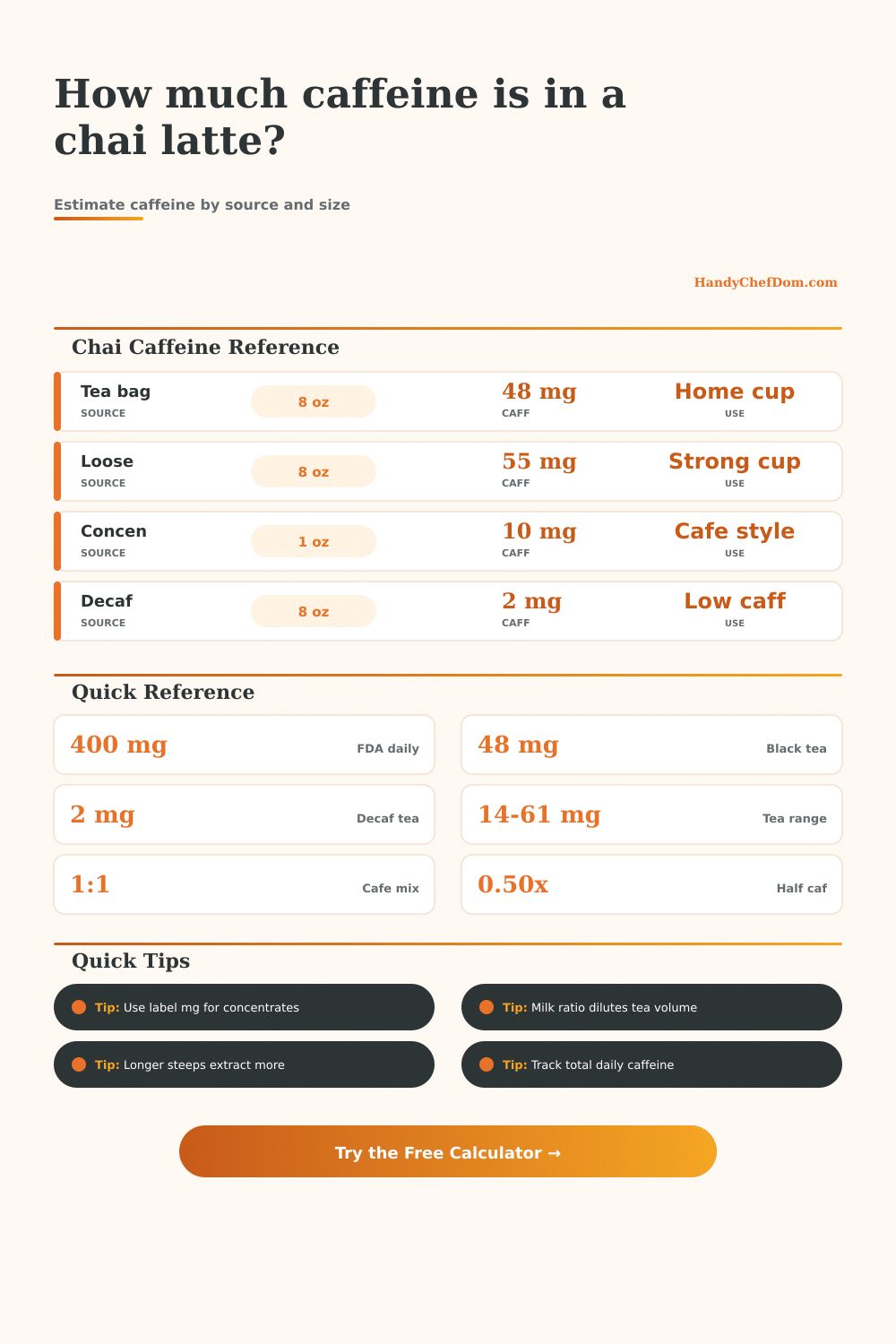
| Brewed black tea | 8 fl oz | 48 mg | Default tea bag chai base |
| Brewed green tea | 8 fl oz | 29 mg | Green chai option |
| Decaf black tea | 8 fl oz | 2 mg | Decaf chai option |
| Brewed tea range | 6 to 8 oz | 14 to 61 mg | Loose tea variability check |
| Latte Style | Milk Ratio | Tea Ratio | Caffeine Effect |
|---|---|---|---|
| Strong chai | 30% | 70% | More tea in cup |
| Balanced cafe | 50% | 50% | Classic concentrate style |
| Milky latte | 65% | 35% | Lower brewed tea volume |
| Light tea flavor | 75% | 25% | Smallest tea portion |
| Source | Control | Low | High |
|---|---|---|---|
| Tea bags | Minutes | 3 min = 0.78x | 7 min = 1.12x |
| Loose chai | Grams | 2 g = 0.75x | 5 g = 1.55x |
| Concentrate | Label mg/oz | 6 mg/oz | 14 mg/oz |
| Powder mix | Label mg/scoop | 20 mg | 60 mg |
| Scenario | Servings | Window | Useful Output |
|---|---|---|---|
| Single mug | 1 | 1 hour | Per serving mg |
| Morning pair | 2 | 3 hours | Mg per hour |
| Family batch | 4 | 4 hours | Total batch mg |
| Pitcher prep | 6 | 8 hours | Spread over time |
There are no hard rules for how much caffeine a chai latte will have, it depends on what you use, how much milk, how it’s prepared, etc. However, most drinkers assume an 8 oz cup has roughly the same kick as a 12 oz mug. That is not true. It’s all about ratio of steamed dairy vs. Actual tea. After that, simply plug in what you’re working with. The calculator will do the rest for you, so you don’t have to make wild guesses about how much longer a double shot concentrated syrup last compared to steeping a single tea bag.
The first step is determining where your liquid are coming from: bottled concentrate? Is it a tea bag? Is it loose leaf? These all behave different when placed into hot water for a period of time. The tea bag is set in its ways, but at least it’s reliable, while loose leaf need room to breathe in the water in order to pull out flavor effectiveley. And concentrates… well, each batch/brand does something different so if you’ve got a label, work off that, as opposed to a random guess.
How to Calculate Caffeine in Chai Latte
But milk does make things different, something that goes unnoticed by most drinker. For example, if you order a 12 oz cafe latte, it’s usually half milk, which means there’s just 6 oz of the brewed chai base in there. And no, the steamed oat milk won’t have any caffeine in it. The tool handle this ratio automatically. Lower the milk percentage and you get more tea into the final glass, giving you a stronger punch. It is just a small mechanical tweak, but when you’re trying to monitor your daily intake every little bit helps.
There’s one other element of control: steeping time. For black chai teas, five minutes are a reasonable midpoint. If you steep it for less time (three minutes), you’ll get less tannin and less caffeine from the leaves. If you steep it longer (seven minutes), your cup will be both stronger and more bitter. That’s why we included a strength factor in our calculator based off steeping time. While this isn’t perfect science, it takes into account what happens when tea is steeped. More time equals more substances pull out of the leaf.
And think about your overall window of intake. Do you drink two lattes during one hour? Or do you sip them over four hours? Caffeine are metabolized by your body at a fairly constant pace. When you dump on yourself at once, you create a spike (perhaps making you jittery). But when you spread it out, it give you a smoother lift. The tool shows you your hourly rate. It also lets you know if you are taking in to much at once. This can help you plan, especially if you have meetings or tasks that need a lot of focus later in the day.
The baseline shifts based off the type of tea used as a base. A standard 8 oz brew of black chai begins at 48 mg and green chai fall nearer to 29 mg. If you use decaf, it isn’t caffeine-free, but the amount is negligible for most, hovering just below 2 mg. Herbal blends like rooibos has no caffeine unless they’re blended with actual tea leaves. Knowing what kind of base you’re drinking will help you manage your energy levels and avoid getting too high. This could of being especially helpful if you’re sensitive to stimulants or cutting back.
Are you using powder or syrup? For these items you’re still stuck with label-reading. The extraction rules used for fresh steeped leaves don’t apply to powders and syrups. A few companies dilutes heavily; some fortify. If uncertain, play it safe on the low side. Better to underdose than crash at 3 p.m.
There’s no magic bullet, no one ideal chai, just the understanding of how tweaking these variables (changing the base, the milk ratio, steep time) shift the needle. When you know that, you won’t be guessing. You’ll be creating. This thoughtful approach make your daily cup of coffee an act of intention; it turns a routine morning practice into something special: just what you needed, and nothing more.