🍗 Marinade per Pound of Chicken Calculator
Estimate marinade volume for chicken by cut, weight, style, oil and acid ratio, container coverage, surface area, soak time, reserve sauce, waste, and servings.
Choose the cut and marinade style, then adjust the container, surface area, soak time, reserve sauce, and waste factor to size the batch.
| Chicken Cut | Typical Marinade Rate | Surface Area | Planning Note |
|---|---|---|---|
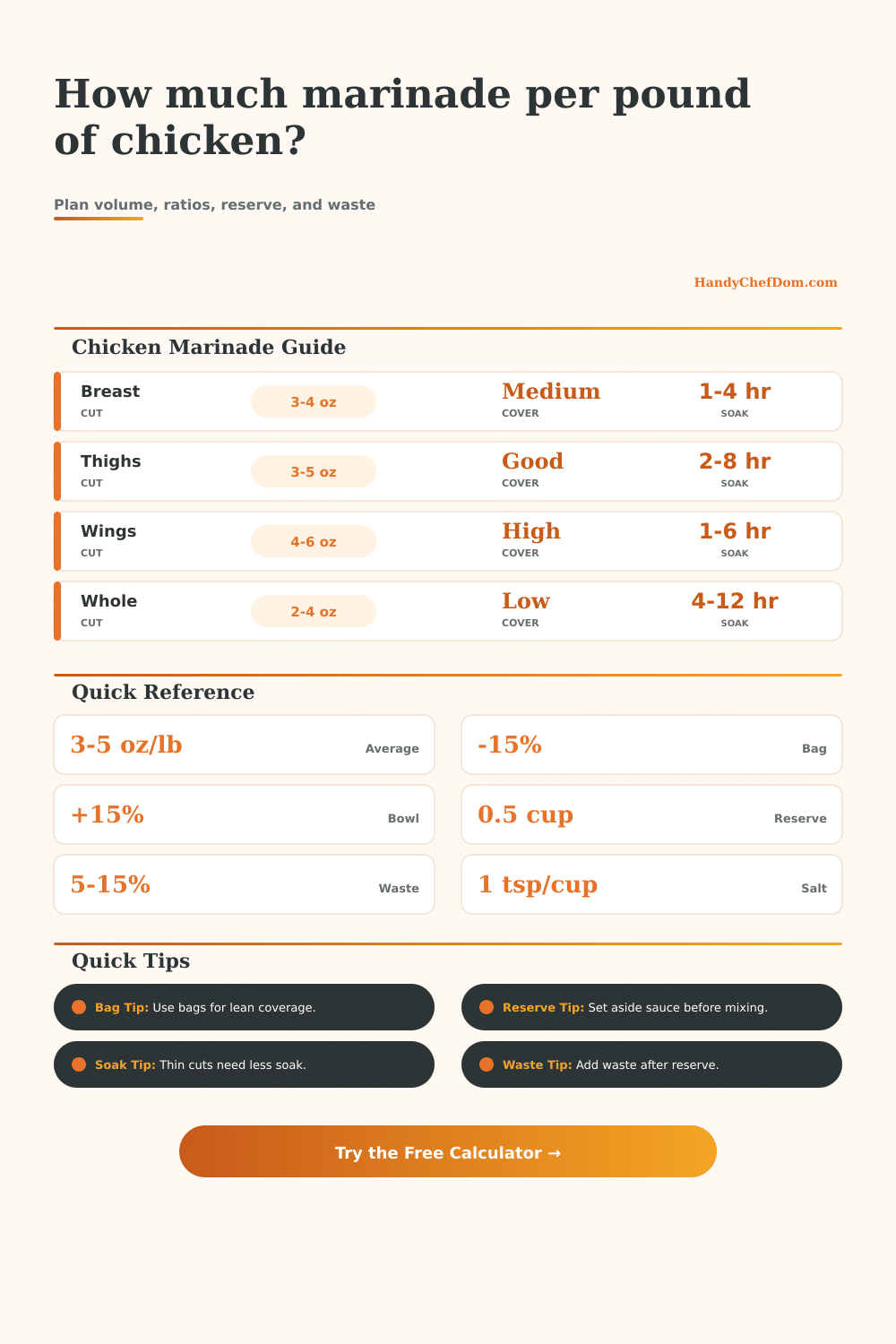
| Boneless chicken breast | 3 to 4 fl oz per lb | Medium | Best in a bag or single-layer dish so lean pieces stay coated. |
| Thin sliced breast | 3.5 to 4.5 fl oz per lb | High | Thin pieces expose more surface, but they do not need deep pooling. |
| Boneless chicken thighs | 3.5 to 5 fl oz per lb | Medium high | Folds and uneven thickness call for extra contact volume. |
| Bone-in thighs | 4 to 5 fl oz per lb | High | Use extra liquid for skin, bone edges, and irregular shapes. |
| Drumsticks | 4 to 5 fl oz per lb | High | A bag or covered pan helps coat rounded surfaces evenly. |
| Chicken wings | 4.5 to 6 fl oz per lb | Very high | Small pieces and joints need more marinade per pound. |
| Whole chicken or halves | 2.5 to 4 fl oz per lb | Low | Large pieces use less per pound but benefit from turning. |
| Marinade Style | Oil Ratio | Acid Ratio | Salt Baseline |
|---|---|---|---|
| Lemon herb vinaigrette | 35% | 30% | 1 tsp per cup |
| Soy ginger | 18% | 18% | 0.6 tsp per cup |
| BBQ mop-style marinade | 12% | 20% | 0.8 tsp per cup |
| Yogurt curry marinade | 10% | 12% | 0.9 tsp per cup |
| Buttermilk soak | 4% | 8% | 0.8 tsp per cup |
| Thick rub-marinade paste | 45% | 10% | 1.2 tsp per cup |
| Teriyaki style | 10% | 12% | 0.5 tsp per cup |
| Container | Coverage Multiplier | Best For | Volume Effect |
|---|---|---|---|
| Zip bag, air pressed out | 0.85x | Breasts, thighs, tenders | Uses less marinade because the bag hugs the chicken. |
| Vacuum bag or tight pouch | 0.75x | Meal prep and uniform pieces | Lowest volume when the pouch removes open space. |
| Shallow dish, single layer | 1.00x | Cutlets, kebabs, large pieces | Good baseline if pieces are turned during the soak. |
| Mixing bowl, turned often | 1.15x | Wings and mixed pieces | Needs more liquid because marinade pools at the bottom. |
| Covered pan or lidded tub | 1.08x | Large batches | Plan a little extra for corners and stacked pieces. |
| Kebab tray or skewer pan | 1.20x | Cubes and skewers | Many exposed edges increase coating demand. |
| Chicken Amount | Bag Marinade | Bowl Marinade | Common Serving Count |
|---|---|---|---|
| 1 lb chicken | About 0.4 cup | About 0.6 cup | 2 servings at 8 oz each |
| 2 lb chicken | About 0.8 cup | About 1.1 cups | 4 servings at 8 oz each |
| 3 lb chicken | About 1.2 cups | About 1.7 cups | 6 servings at 8 oz each |
| 5 lb chicken | About 2 cups | About 2.8 cups | 10 servings at 8 oz each |
| 8 lb chicken | About 3.2 cups | About 4.5 cups | 16 servings at 8 oz each |
| 12 lb chicken | About 4.8 cups | About 6.8 cups | 24 servings at 8 oz each |
There you are, standing in front of the fridge with a half empty bottle of lemon juice and a bag of raw chicken. The recipe on your phone say to marinate. How much sauce should I make? It never gets answered. That’s the issue with many recipes.
You either make too little marinade and end up mixing ingredient in a dry bowl until they taste sad. Or you make too much marinade and waste good olive oil just so you can coat the bottom of a plastic tub.
How to Get the Right Amount of Marinade
Seems intuitive enough, but once you’re not working with two breast anymore. What about a family sized roast?, intuition goes out the window.
When it comes to cooking, you can use this website to do the math for you (just enter weight and number of cuts). It spares you having to convert units or fiddle with the numbers yourself. But knowing how they work is the difference between a good meal and another ordinary one.
What’s the primary variable at play? Surface area-to-weight ratio. A pound of boneless breasts has a nice flat surface area; a pound of wings look like a geometric nightmare of nooks and crannies and joints that requires far more liquid to get the same amount of surface area. Which is why wings require nearly double the marinade per pound compared to a whole bird. It’s not about just wetting some meat; it’s about covering a particular shape.
There’s another aspect to the container: it matters what kind of container. If your marinade is in a zip-top bag, then the sauce is pushed around the meat, creating no dead space with sauce sitting aimlessly doing nothing. If your sauce is in a mixing bowl, then there will be pools of untouched sauce at the bottom that you have to turn over by hand every couple of hours.
This is why the tool adjust depending on which type of container you’re working with. Deep bowl, shallow dish, bag, it takes all that into account. And even though it’s a little thing, it’s one more bit of added-up efficiency if you’re cooking for a larger group at a dinner party. That wasted liquid gets more expensive (and less flavorful) as you scale up.
Squeezing a few drops out of the container gives you free flavor. But there’s also timing: Because short soaking relies on flavor penetrating from the outside inward, you want a stronger hit of flavor on the outside right away. Long soaks give salt and acid more time to penetrate deeper into muscle fibers. The calculator factors this into its suggested volume. Less volume on the surface is good if you’re planning for longer (like an overnight soak), when flavors can be expected to move. More volume are needed if you’re in a rush for a weeknight meal, so each square inch of surface area is coated before it hits the heat.
The other important step overlooked by home cooks is to reserve sauce. Before ever letting that marinade near raw chicken, set aside some for later use. That’s your finishing sauce. You cook down that reserved batch, reduce it into a glaze, and now the flavors of the raw marinade are all there without any food safety risk.
How do you separate the reserve from the contact marinade? Enter the tool. Don’t accidently calculate based off the total batch size and then realize you’ve got no leftover sauce to brush onto the finished chicken. This is a simple workflow fix that elevates the final dish.
Another thing is that salt varies with the base. Different things happen when you use a vinaigrette compared to a yogurt marinade. Oil- and acid-based mixtures carry salt and spices in one way; dairy proteins does another. Here’s where that table of styles on the page comes in: It helps you dial in your saltiness so you’ve got balanced seasoning without an under-seasoned or metallic-tasting chicken. Get it right, and the savory flavors won’t be overwhelmed by the tenderizing effects of the acid.
In the end, that’s what marinating is: control. Physics won’t let you rush-flavor any piece of meat. All you can do is create an optimal environment for it to livig in. You will understand not just when to add water to your container with your specific cut of meat, but also how much to add. The waste goes down. So does the worry. No more guesswork, just cook.