Milk Chocolate Caffeine Calculator
Estimate caffeine from milk chocolate weight, pieces, cocoa level, servings, and the time window when you eat it
| Chocolate Type | Cocoa Range | mg/100 g | mg/1 oz |
|---|---|---|---|
| White chocolate | 0% | 0 | 0.0 |
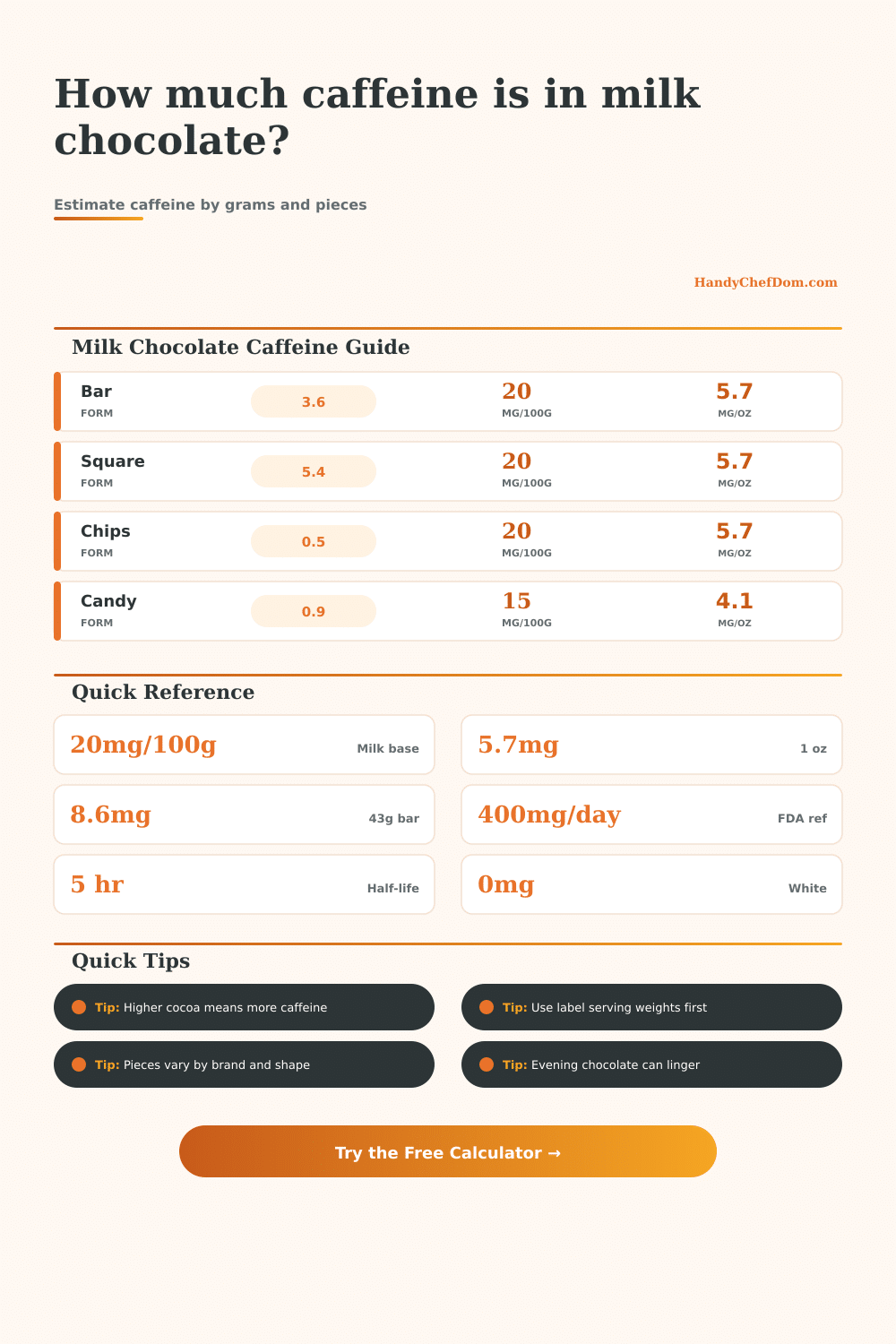
| Classic milk chocolate | 20% to 30% | 20 | 5.7 |
| Dark milk chocolate | 35% to 45% | 28 to 36 | 7.9 to 10.2 |
| Semisweet chocolate | 45% to 59% | 43 | 12.2 |
| Dark chocolate | 70% to 85% | 80 | 22.7 |
| Form | Typical Piece | Serving Weight | Caffeine/Serving |
|---|---|---|---|
| Milk chocolate bar | 3.6 g segment | 43 g | 8.6 mg |
| Break-apart square | 5.4 g square | 32 g | 6.4 mg |
| Milk chocolate chips | 0.5 g chip | 15 g | 3.0 mg |
| Candy coated pieces | 0.91 g piece | 48 g | 7.0 mg |
| Milk chocolate truffle | 12 g piece | 24 g | 3.8 mg |
| Hours Later | Model Remaining | Example From 10 mg | Timing Note |
|---|---|---|---|
| 0 hr | 100% | 10.0 mg | Just eaten |
| 3 hr | 66% | 6.6 mg | Still active |
| 5 hr | 50% | 5.0 mg | One half-life |
| 8 hr | 33% | 3.3 mg | May still matter |
| Item | Typical Amount | Caffeine | Chocolate Match |
|---|---|---|---|
| Milk chocolate | 43 g bar | 8.6 mg | 1 bar |
| Brewed coffee | 8 fl oz | 80 to 100 mg | 9 to 12 bars |
| Black tea | 8 fl oz | 40 to 70 mg | 5 to 8 bars |
| Cola | 12 fl oz | 30 to 40 mg | 3 to 5 bars |
Caffeine is the last thing you’re thinking about when you grab a milk chocolate bar, right? It is comfort food, not fuel. Caffeine exists in milk chocolate in significant quantities. Add those up enough times and you might notice an impact on your sleep schedule. Keep a close eye on your daily caffeine consumption.
The distinction is portion size and cocoa content, two factors that hardly anyone checks the package label for. To get an idea of what’s lurking inside, you can plug your own numbers into the calculator above.
How Caffeine in Milk Chocolate Affects You
On average, most regular milk chocolate have about twenty milligrams of caffeine in every hundred grams. But when you consider that a normal serving may be upwards of forty-three grams… Well, it’s not so little after all: There are almost nine milligrams of caffeine in just one bar, equivalent to a couple of mouthfuls of cola or a very weak cup of tea.
No big deal, right? You might be fine unless you’re on your second or third bar while you binge-watch Netflix and have had a coffee before lunchtime. Those numbers adds up fast, especially for people who are more sensitive.
The biggest lever you have here is the percentage of cocoa in the chocolate itself. Most milk chocolate will be somewhere in the range of twenty to thirty percent cocoa solids. High-cocoa milk chocolates, or bars close to true dark chocolate, will see the caffeine density increase a lot. There is simply more bean matter involved, and more bean matter means more of the naturally occurring stimulant compounds are present.
It’s not all about how bitter it tastes; it’s also about how concentrated those stimulants are. Even though a 50-percent bar might not be noticeably different from a 25-percent bar to someone with untrained tastebuds, it has far more caffeine per ounce. This can make all the difference when you’re trying to limit how much you eat while still enjoying the treat.
This also depends a lot on timing. In most adults, the half life for caffeine is around five hours. That is to say that if I eat a chocolate bar today, five hours later (around my bedtime), there will still be about half of that chocolate bar’s worth of caffeine in me. Eating something sweet three hours before bed won’t be entirely out of your system, though it’ll be waning.
It also accounts for why some people are able to eat sweets before bed without issue, while others toss and turn despite what seems like very little. Everyone’s body processes things differently, but the rough rule applies generaly well enough to be informative when planning accordingly.
White chocolate is an interesting exception to the rule. As it turns out, white chocolate contains none of the above; instead it’s just made from cocoa butter (which obviously contains no caffeine), milk, and sugar. It doesn’t even contain the other mild stimulant called theobromine that’s present in cacao beans, which raises your heart rate a bit and keeps you awake.
So if you’re ultra-serious about staying away from anything that might give you a jolt, white chocolate may be theoretically safe from that angle. But don’t fool yourself into thinking that “no-caffeine” means “healthy.” It’s just a different kind of treat, packed with both fat and sugar.
Most folks greatly overestimate how much caffeine there is in milk chocolate and assume it’s similar to coffee or dark chocolate. Here’s a fact, there are eighty to one hundred milligrams of caffeine in a normal cup of brewed coffee. It would take you eating ten big bars of milk chocolate to equal a single cup of coffee.
This puts it into perspective but also shows where the actual danger lies. Acute toxicity from the chocolate isn’t often the culprit, it’s usually the additive cumulative effects in combination with other caffeinated products such as pre-workout supplements, energy drinks, and sodas. Folks tend to forget what they’ve had throughout the day.
The page also includes comparison charts for various types of chocolates (e.g. 1 square vs 1 cup; 1 chip vs 1 candy-covered piece). This will affect how many you get in that “handful” and thus the amount of caffeine taken in. Depending on the type of chocolate, things like chips, squares, and candy-coated pieces all have different weights per unit, which changes how much caffeine you’re actualy getting.
The best thing to do: read the nutrition label’s serving weight rather than eyeballing it. Your eyes are awful at estimating mass.
So, enjoy your milk chocolate! Don’t be afraid of it; don’t avoid it completely; just know yourself. What are you consuming? How much cacao content is there? When do you eat it (in relation to before bed)? If you’re looking for numbers to help guide your choices that align with your life, they’ll tell you all of this. And then you can sleep soundly and enjoy your treat anyway.