🍞 Chicken Broth per Stuffing Calculator
Estimate the broth your stuffing needs from bread cubes, bread weight, bread dryness, add-ins, moisture target, dish depth, eggs, butter, servings, and reserved liquid.
Use cup mode for measured bread cubes or weight mode when you have a bag, loaf, or tray of cubed bread. Egg and butter are counted as moisture credits so the final broth recommendation stays practical.
| Bread Type | Approx Weight per Cup | Absorption | Best Moisture Target |
|---|---|---|---|
| White sandwich bread | 1.35 oz / 38 g | Medium | Moist but not wet |
| Sourdough cubes | 1.55 oz / 44 g | Medium-high | Firm or classic |
| Cornbread cubes | 1.65 oz / 47 g | High crumble | Soft spoonable |
| Brioche or challah | 1.25 oz / 35 g | Medium-low | Classic moist |
| Whole wheat bread | 1.45 oz / 41 g | Medium-high | Classic moist |
| Baguette cubes | 1.70 oz / 48 g | High crust | Extra tender |
| Rye bread | 1.50 oz / 43 g | Medium | Firm and sliceable |
| Gluten-free bread | 1.40 oz / 40 g | Variable | Moist but not wet |
| Stuffing Style | Starting Broth per Cup Bread | Texture Goal | Adjustment Note |
|---|---|---|---|
| Bread-forward dressing | 0.34 cup / 80 mL | Loose cubes | Keeps edges distinct |
| Sliceable casserole | 0.36 cup / 85 mL | Set slices | Eggs help bind |
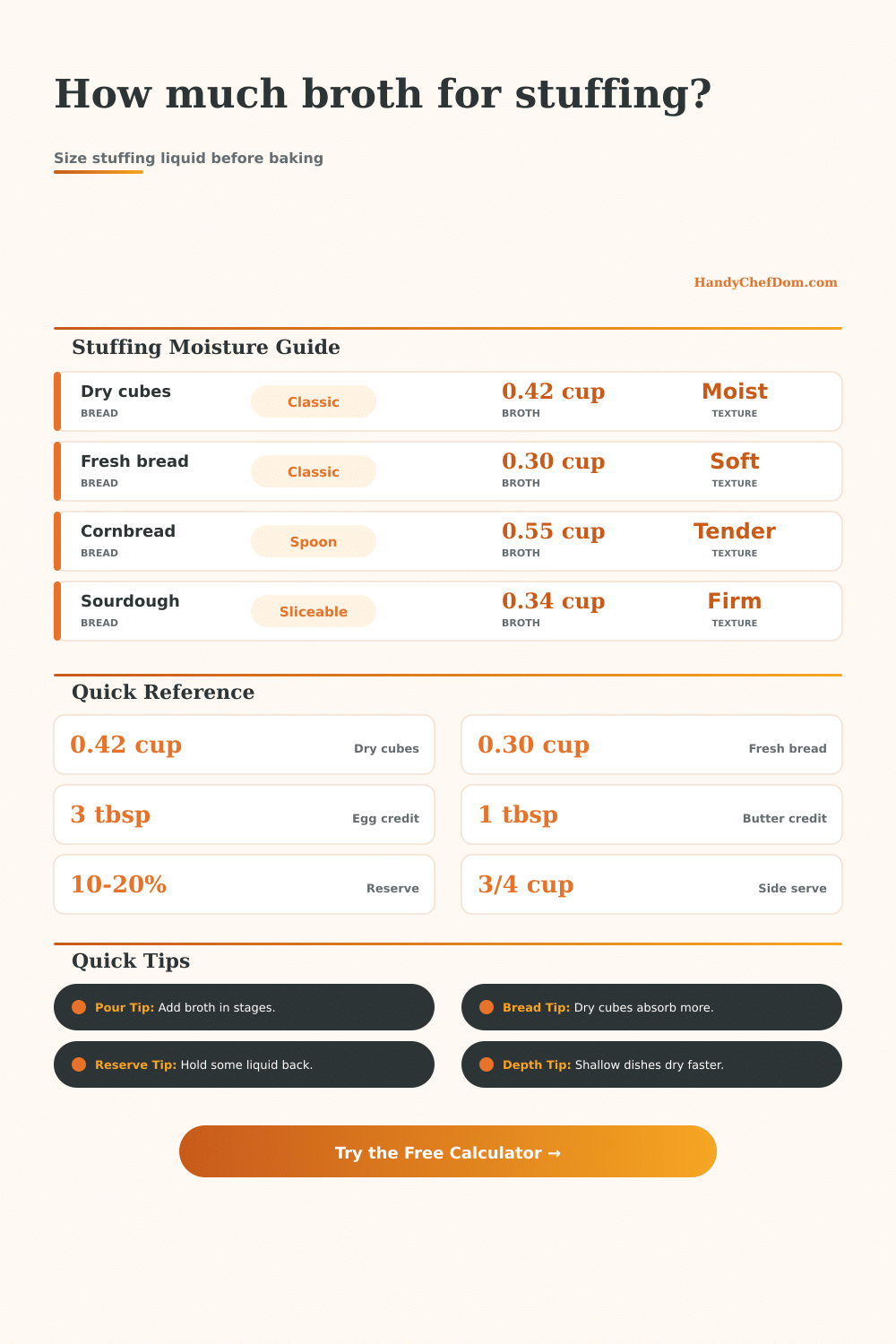
| Classic moist stuffing | 0.42 cup / 99 mL | Moist center | Most all-purpose |
| Sausage-heavy stuffing | 0.38 cup / 90 mL | Rich and cohesive | Cooked meat adds weight |
| Cornbread dressing | 0.48 cup / 114 mL | Tender crumbs | Hold a larger reserve |
| Spoonable soft stuffing | 0.55 cup / 130 mL | Soft scoop | Add liquid slowly |
| Servings | Bread Cubes | Classic Broth Range | Finished Side Portions |
|---|---|---|---|
| 4 servings | 6 cups | 2.1 to 2.7 cups | About 3/4 cup each |
| 6 servings | 9 cups | 3.2 to 4.0 cups | About 3/4 cup each |
| 8 servings | 12 cups | 4.2 to 5.4 cups | About 3/4 cup each |
| 12 servings | 18 cups | 6.3 to 8.1 cups | About 3/4 cup each |
| 16 servings | 24 cups | 8.4 to 10.8 cups | About 3/4 cup each |
| 25 servings | 38 cups | 13.3 to 17.1 cups | Buffet side tray |
| Add-in Mix | Liquid Effect | Use in Calculator | Broth Handling |
|---|---|---|---|
| Onion and celery | Adds gentle moisture | Sauteed vegetable add-ins | Small broth increase |
| Cooked sausage | Adds fat and density | Cooked sausage | Slight broth reduction |
| Dried fruit and nuts | Absorbs liquid | Dried fruit and nuts | Increase reserve |
| Mushrooms and herbs | Adds moisture | Mushrooms and herbs | Reduce broth a little |
| Mostly bread | No extra cushion | Mostly bread | Follow bread baseline |
| Rice or grain blend | Absorbs after mixing | Rice or grain blend | Keep reserve ready |
The calculator lets you figure out how much liquid is needed for the right consistency. Simply plug-in what kind of bread you’re using and what sort of stuffing texture you want, no guesswork required.
Different breads take on liquids at different rates. Fresh bread is already wet, meaning it’ll soak up fewer broth. Conversely, dry bread cubes aggressively soak up broth, requiring higher liquid levels. Feed them both an equal amount of broth and you’ll wreck the fresh bread. Because of this, you can choose whether your bread is dried-out or fresh. That little detail make a big difference to the overall liquid requirements.
How to Use the Calculator
The math gets complicated by add-ins. Moisture cooks out off things like sautéed celery and onion. All that additional cooking moisten the mix. Nuts and dried fruit soak up water. Then the bread’s left high and dry. Eggs and melted butter count as extra liquid to the calculator. An egg bring about three tablespoons of liquid structure. Melted butter has a little liquid, but it is mostly for fat. Understanding where this stuff comes from will keep you from overcompensating with broth.
Maybe it seems like the mix isn’t wet enough before baking time. Often what’s happening is that there’s no soup you can see. But no soup doesn’t equal no needed moisture. The depth of a dish is much more important than you think. In a shallow dish, the steam rises faster which dries out the edges while the center bake. In a deeper one, such as a casserole, the steam are trapped inside. It’s a gentler, moister environment that doesn’t need so much liquid in the first place.
Start by adding a little bit less broth if you’re baking in a deeper dish. Add some more after a few minutes. That’s why the reserve liquid feature is handy. By reserving 15-20% of the broth called for in the calculation, you can test the texture of the mix. Pour most of the liquid into the pan, and let stand for a moment. Let the bread soak up the liquid for a moment. Then poke at it. It should be moist, like when you wring out a sponge. Dripping isn’t right. Too wet? Hold off. It is too dry. Add from the reserve pool. You have control here in a way you’d never of had by dumping all the liquid at once.
Use the reference tables to identify your bread. Different breads soak up the liquid at different rates. Crumble cornbread (higher % binding liquid); sourdough (denser; holds up to firmer textures). Know what the bread will be like. Use that to determine the finished texture. Do you want a sliceable, firm casserole? Or soft enough to be spooned into mouths? It is a textural decision. Not a measurement. Essentially, it’s a bit like designing how the finished product feels in your mouth.
Also, it’s not just you; it matters what time of year it is. Drier winter air can extract moisture from an uncovered loaf. Humid summer air may preserve a loaf’s softness for longer. Environmental conditions like these are why I recommend checking visually, as opposed to strictly following a cup measure.
The calculator provides a solid starting point. It is based off the variables you do have control over. Your hands and eyes will give you the confirmation. Let the math put you in the ballpark. Then let your senses land you on target.
Balance A good stuffing needs to have its own flavor but stay together. You need ingredients to have flavor on their own, yet still work as one cohesive unit when sliced or scooped up. The broth is what holds the bread, the herbs, and the add-ins all together. It’s the glue. Meld the flavors by getting the amount right. Mess it up and the dish will fall apart.
Get an estimate. Have a reserve nearby. Add in small amounts. That last careful pour can make the difference between a centerpiece and a forgettable side dish.