Espresso Beans Caffeine Calculator
Estimate caffeine from whole espresso beans by bean type, coating, count or grams, servings, time window, and body weight
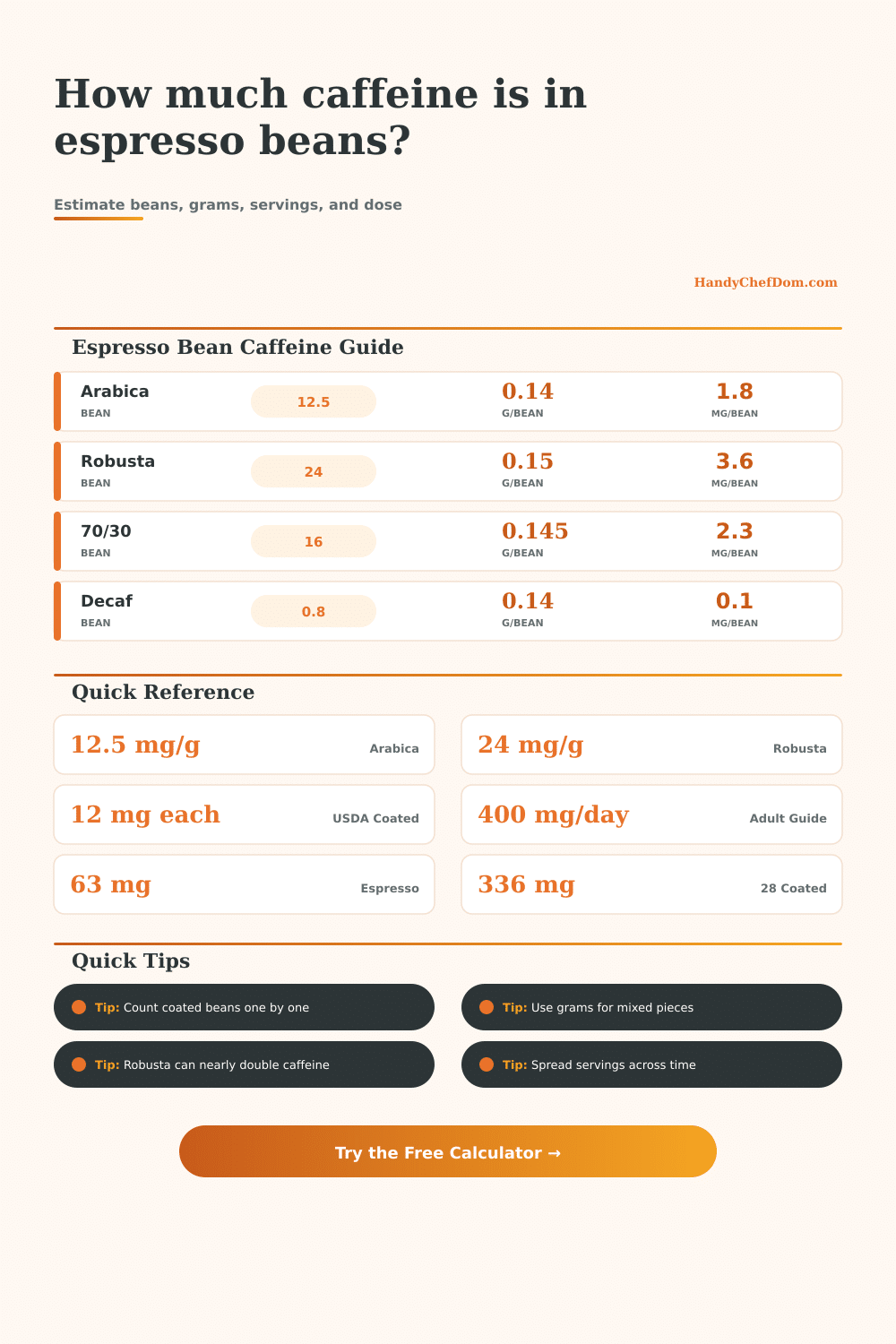
| Bean Type | Caffeine Basis | Avg Bean Weight | Estimated mg/Bean |
|---|---|---|---|
| Arabica espresso roast | 12.5 mg/g | 0.14 g | 1.8 mg |
| Robusta espresso roast | 24 mg/g | 0.15 g | 3.6 mg |
| 70/30 arabica robusta blend | 16 mg/g | 0.145 g | 2.3 mg |
| 50/50 espresso blend | 18.5 mg/g | 0.145 g | 2.7 mg |
| Decaf espresso bean | 0.8 mg/g | 0.14 g | 0.1 mg |
| Coating | Added Weight | Caffeine Logic | Use Case |
|---|---|---|---|
| No chocolate | 0.00 g/bean | Coffee bean only | Plain roasted beans |
| Light dark chocolate | 0.22 g/bean | 0.85 mg/g chocolate | Thin shell pieces |
| Standard dark chocolate | 0.36 g/bean | 0.85 mg/g chocolate | Typical coated beans |
| Milk chocolate | 0.38 g/bean | 0.20 mg/g chocolate | Sweeter snack pieces |
| Dark coated reference | Product value | 12 mg per piece | USDA 28 piece entry |
| Benchmark | Caffeine | Calculator Use | Reference |
|---|---|---|---|
| Adult daily guide | 400 mg/day | Daily percent card | FDA and Mayo |
| Espresso shot | 63 mg per 1 oz | Espresso equivalent card | Mayo Clinic |
| Dark coated beans | 336 mg per 28 pieces | USDA coating option | USDA caffeine list |
| Dark chocolate | 24 mg per oz | Dark coating add-on | USDA caffeine list |
| Body Weight | 100 mg | 200 mg | 400 mg |
|---|---|---|---|
| 120 lb / 54 kg | 1.8 mg/kg | 3.7 mg/kg | 7.3 mg/kg |
| 150 lb / 68 kg | 1.5 mg/kg | 2.9 mg/kg | 5.9 mg/kg |
| 180 lb / 82 kg | 1.2 mg/kg | 2.4 mg/kg | 4.9 mg/kg |
| 220 lb / 100 kg | 1.0 mg/kg | 2.0 mg/kg | 4.0 mg/kg |
| Scenario | Beans | Estimated Caffeine | Espresso Equivalent |
|---|---|---|---|
| 6 plain arabica beans | 6 | 11 mg | 0.2 shot |
| 12 standard dark arabica | 12 | 25 mg | 0.4 shot |
| 12 robusta coated beans | 12 | 47 mg | 0.7 shot |
| 28 USDA dark coated beans | 28 | 336 mg | 5.3 shots |
While chocolate-covered espresso beans is a quick pick-me-up for afternoons, they tend to be more candy-like then coffee-like. Although it starts with a surge from added sugar, this can hide gradual rise of caffeine over time. Since you can think of them as a mini-snack item, you might think you are having a small snack when you have effectively downed three shots of espresso without even realizin it. Because this fall somewhere between the “stimulant” and “dessert” category, it’s simple to get tripped up on your dosage.
Because each bean variety has its own coffee chemistry, the calculator estimated how much caffeine was in each candy based off how many beans went into it, and what kind of coating they had. Arabica beans generaly contain about 12.5 milligrams of caffeine per gram, while robusta varieties can nearly double that amount. Depending on whether you’re eating all robusta or half arabica/half robusta, this mean there’s likely quite a bit more caffeine going into each candy than you’d expect.
How to Track Your Caffeine Intake
The calculator helps: It lets you choose between different types of beans (robusta vs. It also takes into consideration the thickness of the chocolate covering. That thickness add weight to each candy, as well as more theobromine and extra caffeine, which builds up fast when you have a big piece. The interface feels like something you can trust.
If you weigh coffee in grams but choose “bean count” instead of “gram weight,” it will calculate number of beans based on an assumed average density. It also compensates for extra weight of the chocolate. That matter with shelled beans, which have added bulk without additional coffee strength. You’re measuring not just caffeine, but also sugar and fat. How many calories did that serve contain? And how many per serving you should be eating? Of course, remember to take your body size into account as well.
Everyone respond differently to caffeine, for example, bigger bodies tend to distribute and process caffeine just a little quicker. By dividing the amount of caffeine consumed by one’s kilogram (or kg) body weight, the calculator give you a view you can’t get from raw milligrams alone. It allows you to judge how intense something is in relation to your own body. For instance, a 100-milligram dose will feel stronger on a 120-pound person compared to 200-pound person. So personalized information is better then generic recommendations.
The table on the page presents a clear set of benchmarks: compare your twenty-eight bean serving size against your daily allowances. For most healthy adults, the FDA recommend an upper limit of about 400 milligrams per day. (That’s not too helpful if you’re having them all in one shot.) You might spread your dose out over a few hours, which will flatten how it enters your system and help keep you from getting the jitters from taking them to fast. It’s more about managing the peak effect than the total dose.
But another false assumption is that the darker roasted beans are stronger because, well, they’re strong tasting, right? Turns out that while light roasts tend to pack a little more of a punch, it’s actualy dark roasts that lose a bit of their caffeine during process of being roasted (the heat breaks down some of the compounds). So your intuition will tell you one thing, but your data will give you something different. And if you play around with presets; like office robusta boost, or maybe after dinner dark arabica; then you could of gotten an idea for how subtle shifts in roast profile and bean source affect resulting number. It makes it not only about consuming more coffee, but understanding what coffee you are consuming.
Don’t forget about other sources of caffeine throughout your day either. Dark chocolate? Energy drink? A cup (or two) of tea? All that adds up. That latte plus a couple cups of coffee could be enough to get you past your max with those espresso beans.
We’re not advocating for removing caffeine from your life, just for awareness so you can control how much you consume. For some, a hundred milligrams are too many; for others, they does great on double that amount. When you know where you sit, you can prevent yourself from feeling restless at night or crashing in the afternoon. Treating espresso beans as a snack requires a bit more awareness than sipping a cup of joe.
Espresso? That’s another story. You’re drinking highly concentrated coffee, with no clear indication of whether or not it will provide a burst of energy. What kind of bean? Is there any coating? These questions transform guessing into planning. Knowing precisely what’s powering your morning help ensure you can enjoy the flavor… Without fearing the after-effects.