🐏 Slow Roast Leg of Lamb Cooking Time Calculator
Set weight, cut style, oven heat, and finish level to map a slow roast leg of lamb timeline with rest, yield, and serving counts.
Pick the cut, heat, and doneness that match your roast. The calculator converts everything internally, then applies rest, cover, pan, and altitude adjustments.
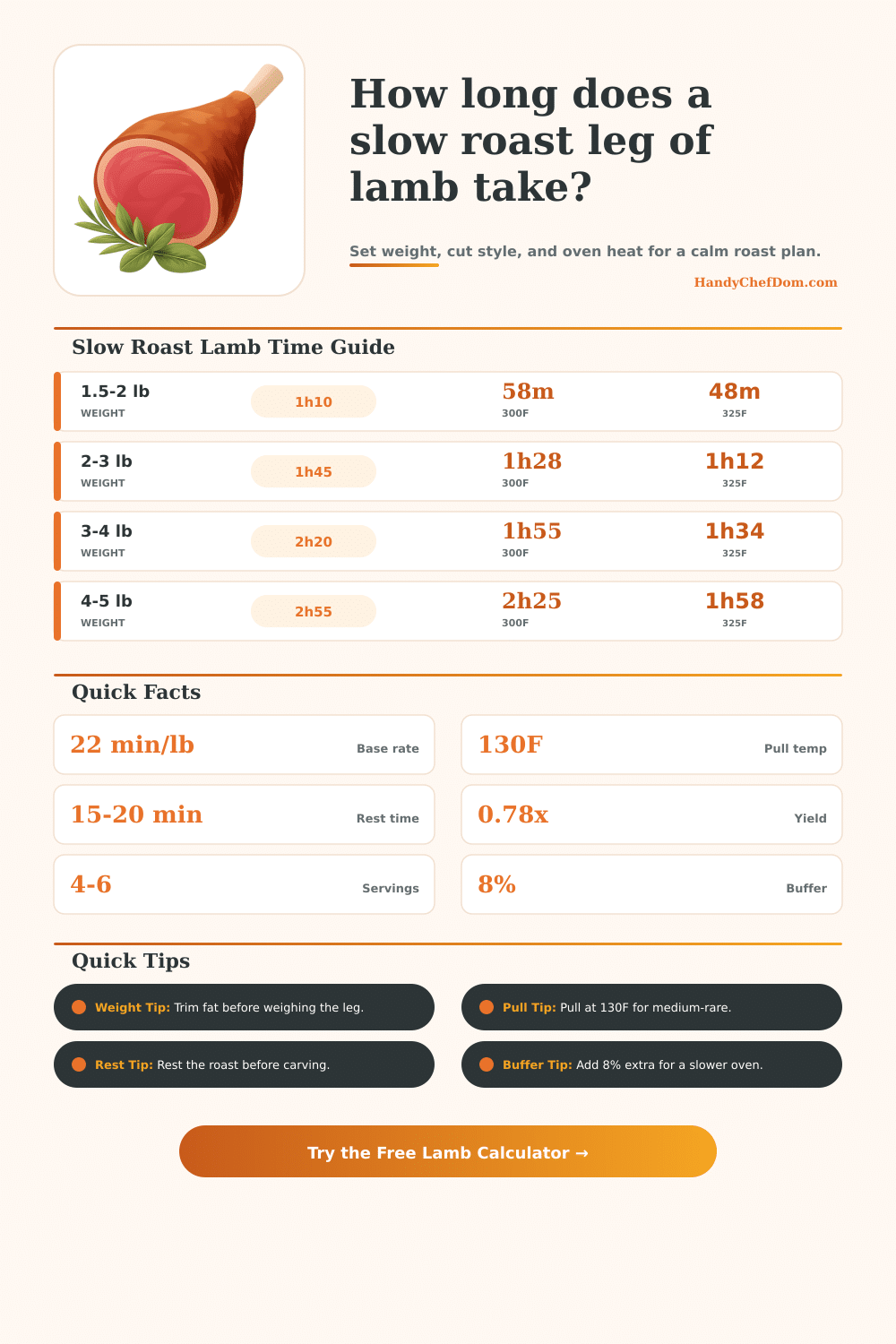
| Temp | Base | Pull | Note |
|---|---|---|---|
| 250F | 26 min/lb | 128F | Very slow |
| 275F | 24 min/lb | 130F | Low roast |
| 300F | 22 min/lb | 130F | Classic |
| 325F | 20 min/lb | 135F | Faster |
| Weight | Bone-in | Boneless | Note |
|---|---|---|---|
| 1.5-2 lb | 32-44m | 28-40m | Small leg |
| 2-3 lb | 44-66m | 38-60m | Mid roast |
| 3-4 lb | 66-88m | 57-80m | Family size |
| 4-5 lb | 88-110m | 76-95m | Large roast |
| Cut | Factor | Yield | Note |
|---|---|---|---|
| Bone-in | 1.00x | 78% | Steady |
| Boneless | 0.92x | 82% | Faster |
| Butterflied | 0.78x | 80% | Flat |
| Rolled | 0.95x | 79% | Tighter |
| Finish | Pull | Rise | Note |
|---|---|---|---|
| Rare | 125F | 6F | Pink core |
| Medium rare | 130F | 5F | Juicy |
| Medium | 140F | 5F | Balanced |
| Medium well | 150F | 4F | Firmer |
Use this slow roast leg of lamb calculator to balance weight, cut style, oven temperature, and rest time, so you can plan a tender roast without guessing the timing.
Slow roasting a leg of lamb require an understanding of time and temperature because the time and temperature for roasting will determine teh texture of the leg of lamb when it is cooked. If a person roasts a leg of lamb at too highly a temperature or for too many long a time, the leg of lamb will become tough and dry. However, if a person cooks a leg of lamb slow at a low temperature, the connective tissues in the leg of lamb will transform into gelatin during the cooking process, which will make the leg of lamb tender when it is roasted.
The temperature of the oven in which a person roasts a leg of lamb is a primary factor in the slow roasting process. A person can set the oven temperature between 275 and 325 degrees Fahrenheit when roasting a leg of lamb. If a person sets the oven temperature to 250 degrees Fahrenheit, the cooking process will take place very slow.
How to Slow Roast a Leg of Lamb
Additionally, the low temperature provide more forgiveness in case the temperature within the oven isnt consistent. However, if a person sets the oven temperature to 325 degrees Fahrenheit, the roasting process will take place at a faster rate. Additionally, the more higher the oven temperature will allow for more carryover cooking.
Carryover cooking is when the temperature of the leg of lamb continues to rise after the person removes the leg of lamb from the oven. Therefore, if a person sets the oven temperature to 325 degrees Fahrenheit, they will have to remove the leg of lamb from the oven before it reach the desired temperature. Another factor that will influence the time required to roast a leg of lamb is the cut of leg of lamb that is to be roasted.
If the leg of lamb is a bone-in leg of lamb, it will require longer roasting time than a boneless leg of lamb. Additionally, a butterflied leg of lamb will cook more even than a leg of lamb that is not butterflied. Additionally, a butterflied leg of lamb will require less time to roast per pound of leg of lamb than a leg of lamb that is not butterflied.
Lastly, the amount of shrinkage that the leg of lamb will experience while roasting will depend on whether it is a rolled leg of lamb. A rolled leg of lamb will shrink more during the cooking process than a bone-in leg of lamb. The starting temperature of the leg of lamb will also affect the time that it take to roast the leg of lamb.
If the leg of lamb starts at a colder temperature than a leg of lamb that is at room temperature, it will take longer to roast the leg of lamb to the desired temperature. Additionally, a person can use a foil tent to roast the leg of lamb so that the steam will help to soften the leg of lamb. A meat thermometer can be used to determine the internal temperature of the leg of lamb that is being roasted.
For a leg of lamb that is roasted to a medium-rare doneness, the cook should remove the leg of lamb from the oven when it reaches 130 degrees Fahrenheit. After the person removes the leg of lamb from the oven, it should be allowed to rest for fifteen to twenty minutes. Allowing the leg of lamb to rest allows the juices to redistribute within the leg of lamb so that it is even in temperature.
If the leg of lamb is carved while it is still hot, the juices will exit the leg of lamb and the leg of lamb will be dry. Finally, another factor in determining the cooking time for a leg of lamb is the yield of the leg of lamb. During the cooking process of a leg of lamb, the leg of lamb will lose some of its weight due to the loss of moisture and fat.
Approximately 78 percent of the raw weight of the leg of lamb will remain after it is trimmed and roasted. If each person is to eat one-half pound of leg of lamb, the number of servings can be calculated. However, if cooking for a large group of people, more than one-half pound of leg of lamb may be require per person.