Tea Caffeine Calculator
Estimate caffeine from tea category, leaf grams, bag count, steep time, temperature, infusions, cups, body weight, and drinking window
| Tea Type | Typical 8 oz | Standard Leaf | Standard Steep | Standard Temp |
|---|---|---|---|---|
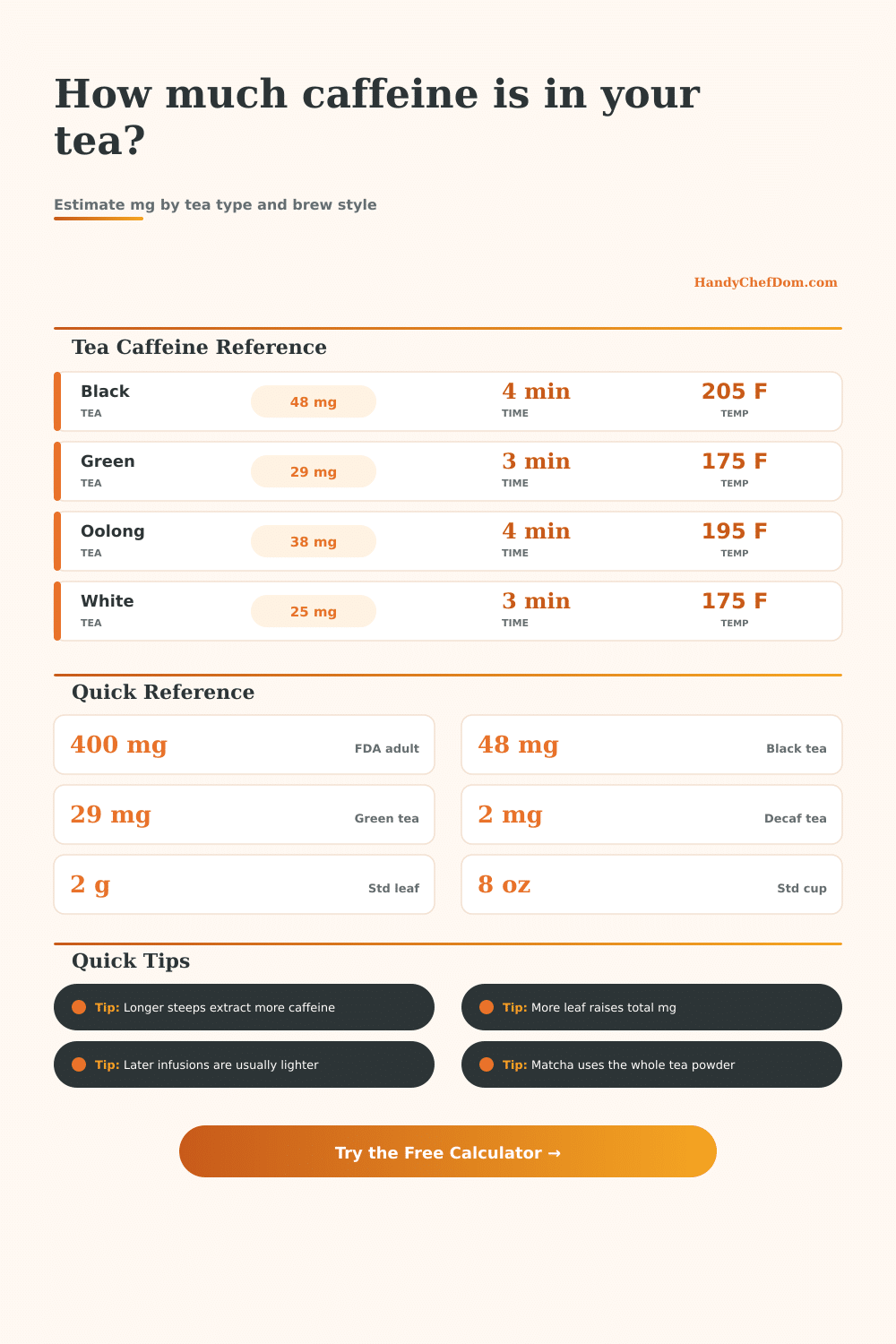
| Black tea | 48 mg | 2.0 g | 4 min | 205°F / 96°C |
| Green tea | 29 mg | 2.0 g | 3 min | 175°F / 79°C |
| Oolong tea | 38 mg | 2.5 g | 4 min | 195°F / 91°C |
| White tea | 25 mg | 2.0 g | 3 min | 175°F / 79°C |
| Pu-erh tea | 45 mg | 2.5 g | 4 min | 205°F / 96°C |
| Matcha powder | 64 mg | 2.0 g | Whisked | 175°F / 79°C |
| Yerba mate | 78 mg | 3.0 g | 5 min | 170°F / 77°C |
| Decaf black tea | 2 mg | 2.0 g | 4 min | 205°F / 96°C |
| Brew Change | Lower End | Standard | Higher End | Calculator Effect |
|---|---|---|---|---|
| Steep time | 1-2 min | 3-5 min | 6+ min | Scales extraction |
| Water temp | 160-175°F | 175-205°F | Boiling | Scales extraction |
| Leaf amount | 1 g | 2-3 g | 5+ g | Scales total mg |
| Batch volume | Small cup | 8 oz cup | Large pot | Dilutes per cup |
| Infusion | Approx Share | Best Fit | Effect | Example |
|---|---|---|---|---|
| First | 100% | Any tea | Main extraction | 48 mg black |
| Second | 55% | Oolong, pu-erh | Moderate carryover | 26 mg black |
| Third | 30% | Gongfu tea | Lighter cup | 14 mg black |
| Fourth+ | 18% then less | Session tea | Small add-on | 9 mg black |
| Reference | Amount | Use In Calculator | Notes |
|---|---|---|---|
| FDA adult reference | 400 mg/day | Daily percent | General healthy adult guide |
| Mayo black tea | 48 mg/8 oz | Black tea baseline | Brewed tea guide value |
| Mayo green tea | 29 mg/8 oz | Green tea baseline | Brewed tea guide value |
| Mayo decaf tea | 2 mg/8 oz | Decaf baseline | Decaf is not zero |
| USDA FoodData Central | Tea nutrient data | Reference check | Use label data first |
| Tea research ranges | Wide variation | Category estimates | Time and temp matter |
We all know that there’s a lot of caffeine in coffee, and we tend to think that tea is mellow by comparison. And guess what? That’s not always true. Brew up a pot of strong black tea. Assuming you have enough leaf or left it steeping too long, you’ll find yourself with a caffeinated beverage similar to a shot of espresso.
The problem is that most folks lump everything called “tea” together. Regardless of whether it’s ceremonial grade powder, loose leaves or a bag, they think it’s all the same. That is not the case anymore. This calculator eliminates guesswork and lets you see precisely what’s in your cup… depending on how you make it.
How to Control Your Caffeine Intake
First comes the raw material: Green tea has roughly twenty-nine milligrams of caffeine per eight-ounce serving; black tea clocks in at around forty-eight. These are baseline figures under normal circumstances. Alter any variable and things get dicey fast. The most important factor here is steeping time. Hot water does an excellent job of extracting the alkaloid (that’s the fancy name for caffeine) from the leaves. A two-minute soak draws a lot less out of the leaf then a six-minute steep.
Water temperature also affects things… But not as much as many believe. Yes, very hot water can extracts more quickly, but let something sit in lukewarm water long enough and it’ll start pulling out some caffeine, too. The tool takes those extraction curves into account. You won’t be guessing whether that cuppa last night had twice as much kick as this one did.
Another thing: volume vs. Concentration. That’s what trips up most home brewers. Putting a single tea bag in a big ol’ travel mug does not result in more caffeine than putting that same tea bag in a little bit of water in a small cup. It’s just diluted different. The per-cup figure goes down; the total dosage into your system stays the same. Knowing that can help you make sense of things when you’re attempting to control how much you drink each day. Maybe you want to avoid exceeding some random guideline, such as the four-hundred milligram reference point frequently mentioned for adults, or maybe you have your own limit and you don’t know how to stick to it. Because yeah, that big ol’ travel mug may taste weak, but your body doesn’t care; you take in same quantity of stimulant, regardless.
Matcha throws everything for a loop. It’s not just a portion of the leaf; it’s the entire leaf as a powder. You do not steep it or discard it. That means that there’s generally a higher dose of caffeine per serving compared to brewed leaves. Similarly, multiple infusions throw a wrench into things. Many people think the initial cup contains all the caffeine, but subsequent steeps is packed with plenty too. A quality pu-erh or oolong tea can be brewed three or four times over. Each one adds another to your overall daily tally. If you’re sensitive or looking to keep below a certain number of cups, tracking the additional ones becomes important.
But body weight matter too. What energizes one may leave another feeling jittery. When it’s dosed by weight, it normalizes your output so you get a better idea of how it’s impacting your body. And it offers more than an abstract number. It helps explain why someone could be drinking the same brand of tea as you, yet they respond very different to it. They’re getting a higher relative dose per kilogram of body weight.
With the tool, there are also some reference tables that set basic baselines for various types of teas. It helps you calibrate your expectations. How much caffeine does decaf have? It has a little bit. How does white tea compare to black tea? These are just useful benchmarks that will help you spot any outlier in your routine. Looking at the breakdown will tell you if it’s the number of infusions, the steep time, or the leaf type that’s driving the total up.
At its heart, this is a tool for control. A lot of us has no idea what we’re drinking when we make a cup of tea, but making tea is all about precision and ritual. The tool turns that guesswork into data by letting you plug in your own personal preferences: How much leaf? What temp’s your water? How long do you steep?
When you begin tracking these details, you realize that caffeine isn’t simply contained within the tea. Caffeine levels depends on how you prepare your tea. With that knowledge, you can adjust your brew so that you’ll get as jacked up as you’d like, without going too far into anxious territory. Your cup o’ joe becomes a calculated decision (instead of a mystery). You should of known that!