Onion Carb Calculator
Estimate total carbs, net carbs, fiber, edible yield, cooked yield, chopped cups, and per-serving onion carbs for raw, sauteed, and caramelized onions.
Onion Carb Results
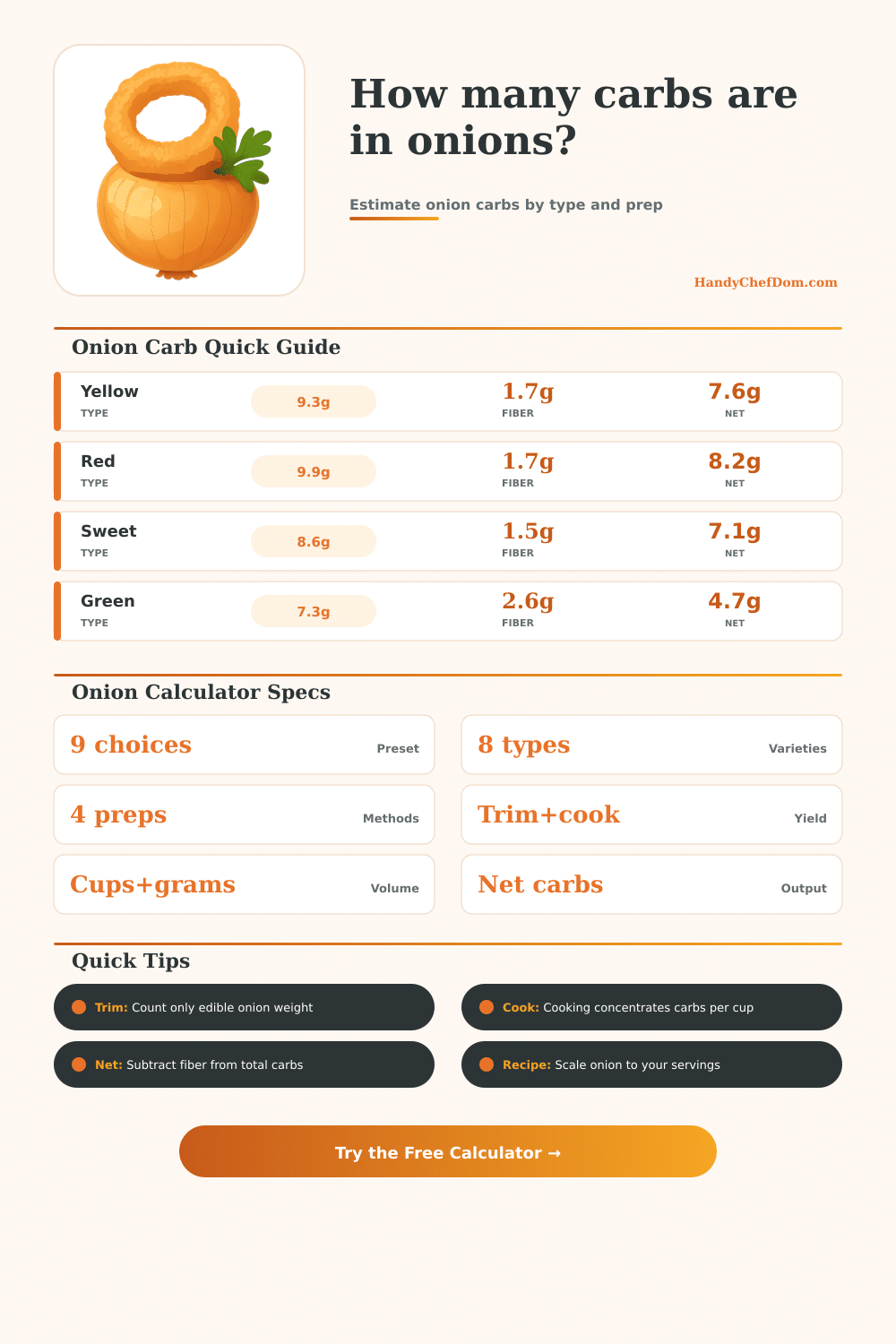
| Onion variety | Total carbs per 100 g | Fiber per 100 g | Net carbs per 100 g | Best calculator use |
|---|---|---|---|---|
| Yellow onion | 9.3 g | 1.7 g | 7.6 g | Balanced all-purpose recipes |
| Red onion | 9.9 g | 1.7 g | 8.2 g | Raw salads, tacos, bowls |
| White onion | 9.6 g | 1.7 g | 7.9 g | Salsa, burgers, quick cooking |
| Sweet onion | 8.6 g | 1.5 g | 7.1 g | Large slices and onion-forward sides |
| Shallot | 16.8 g | 3.2 g | 13.6 g | Small but carb-dense aromatics |
| Green onion | 7.3 g | 2.6 g | 4.7 g | Lower-carb garnish portions |
| Pearl onion | 9.6 g | 1.7 g | 7.9 g | Stews and roasted mixes |
| Leek | 14.2 g | 1.8 g | 12.4 g | Soup bases with higher carb density |
| Kitchen measure | Approx raw edible grams | Approx ounces | Chopped cup equivalent | Net carbs, yellow onion |
|---|---|---|---|---|
| 1 small onion | 70 g | 2.5 oz | 0.44 cup | 5.3 g |
| 1 medium onion | 110 g | 3.9 oz | 0.69 cup | 8.4 g |
| 1 large onion | 150 g | 5.3 oz | 0.94 cup | 11.4 g |
| 1 cup chopped onion | 160 g | 5.6 oz | 1.00 cup | 12.2 g |
| 1 cup sliced onion | 115 g | 4.1 oz | 0.72 cup | 8.7 g |
| 1 tablespoon minced onion | 11 g | 0.4 oz | 0.07 cup | 0.8 g |
| Prep method | Yield from edible raw weight | Cup density used | Carb effect | Calculator note |
|---|---|---|---|---|
| Raw chopped or sliced | 100% | 160 g chopped cup | Total carbs unchanged | Best for salads and toppings |
| Sweated recipe base | 78% | 185 g cooked cup | More carbs per cup | Good for soups and sauces |
| Sauteed onions | 70% | 200 g cooked cup | Water loss concentrates cups | Use for pans and skillets |
| Caramelized onions | 38% | 240 g cooked cup | Dense, high flavor spoonfuls | Small portions carry more net carbs |
| Recipe situation | Common onion amount | Typical servings | Net carbs per serving | Adjustment idea |
|---|---|---|---|---|
| Raw taco topping | 0.5 cup diced red onion | 4 servings | About 1.6 g | Use green onion to lower carbs |
| Soup base | 1 medium yellow onion | 6 servings | About 1.4 g | Half base keeps flavor lighter |
| Fajita skillet | 2 large sliced onions | 6 servings | About 3.8 g | Cooked cups shrink noticeably |
| Caramelized topping | 3 large sweet onions | 10 servings | About 3.2 g | Weigh the final batch for portions |
| Stuffing or casserole base | 2 medium yellow onions | 12 servings | About 1.4 g | Recipe base factor scales quickly |
What kind of onion? Most recipes don’t say. But if you’re cooking to avoid carbs or counting them preciseley, that doesn’t matter. Standard nutrient databases assumes the little yellow thing in your crisper and the giant sweet one in bulk bags are nutritionally the same. Which they aren’t. Not even close.
Measuring the right portion size or adjusting a recipe can be confusing and annoying. The calculator above do the work so you don’t have to guess if that caramelized topping put you over your carb goal for today. Vague “add 1 onion” wording turns into exact numbers. That’s the easy part. You just need to determine what kind of onion it is and in what quantity.
How to Measure Onions for Carbs
We usually eyeball it; assuming a medium onion is roughly consistent in size. But as every home cook knows, that isn’t even remotely close; it range wildly based off supplier and the time of year. With this tool, you can enter whole counts (with size adjustments) or go with raw weight if you’re feeling precise. Weight doesn’t lie when it comes to measuring out quantity, so it take all guesswork out of equation.
If you want to measure by cups, however, say, if you’ve got chopped or sliced or minced onions, the calculator will take into consideration texture, since a cup of slices won’t weigh as much than a cup of diced. The calculator accounts for how chopped, sliced, or minced textures changes the density of that volume. And that directly affects amount of carbs you’re going to get.
Water is lost, but carbohydrates stay behind when you cook them. Caramelizing or sauteing onions doesn’t just concentrate their flavor: it concentrates their nutrients as well. A two-hundred-gram bulb of onion become a pile of something no bigger than a hundred and fifty grams after sweating off all the water. There’s still the exact same amount of carbohydrate present, only now it’s packed into much smaller package.
A lot of folks fail to make this distinction; if a cooked onion take up less space in the pan than a raw onion slice does, they assume there must be less carbohydrate present. There isn’t. And the calculator accounts for these yield losses so you know you’re eating more carb weight in a spoonful of caramelized onions than you are with a spoonful of raw ones.
Onions: You might think all varieties of onion is created equal, and that cooking one will result in exactly the same nutrition as another, but they aren’t. A white or yellow onion is a workhorse with moderate levels of carbs, but it has fewer sugars and fibers per volume than a shallot or leek. Shallots and leeks has dense bodies packed with much more of both.
Try using them for garnishing. Try green onions. They’re low-carb since it’s mostly the fiber-packed stem that you’re eating (not the sugary bulb part). And choosing the right type for the job will help make sure the amounts you use matches the ingredients you’ve actualy chopped up. You are using red onions instead of yellow to make a batch of salsa? The extra carbs from the switch add up on big-batch day. A little thing, but when you want accurate, every little bit counts.
There’s also a quiet variable in any equation: trimmed loss. When you buy an onion, for example, and peel away layers, cut off a root end, or remove a bit of bruise or a peel…well, those won’t get eaten. But most nutrition calculations uses the entire veggie weight (with its root end, peels and all) without accounting for your actual trimming.
Using the tool, you can choose to have a moderate amount of trim loss, heavy peeling, or other common ways people trim food at home. In the case of buying onions by the bag, pre-peeled, you’d choose zero trim loss, since every gram of that onion will be part of what you eat. Failing to account for this could of result in overestimating carbs, which isn’t what you ate after all.
Knowing those factors help you use onions as a part of your food instead of a wildcard ingredient that messes up your dinner plan. Need an onion to add some crunch to a salad? How about one to form the basis for a soup? Knowing how much it’s really going to affect everything else on your plate gives you the confidence to plan the rest of your meal to match. No more guessing and fretting over hidden carbohydrates, just get to enjoy the taste!