Saturated Fat Content Calculator
Estimate saturated fat by USDA-style food data, serving weight, cooking fat, draining, daily limit, and recipe batch portions.
| Food | Reference Amount | Calories | Total Fat | Saturated Fat | Protein |
|---|---|---|---|---|---|
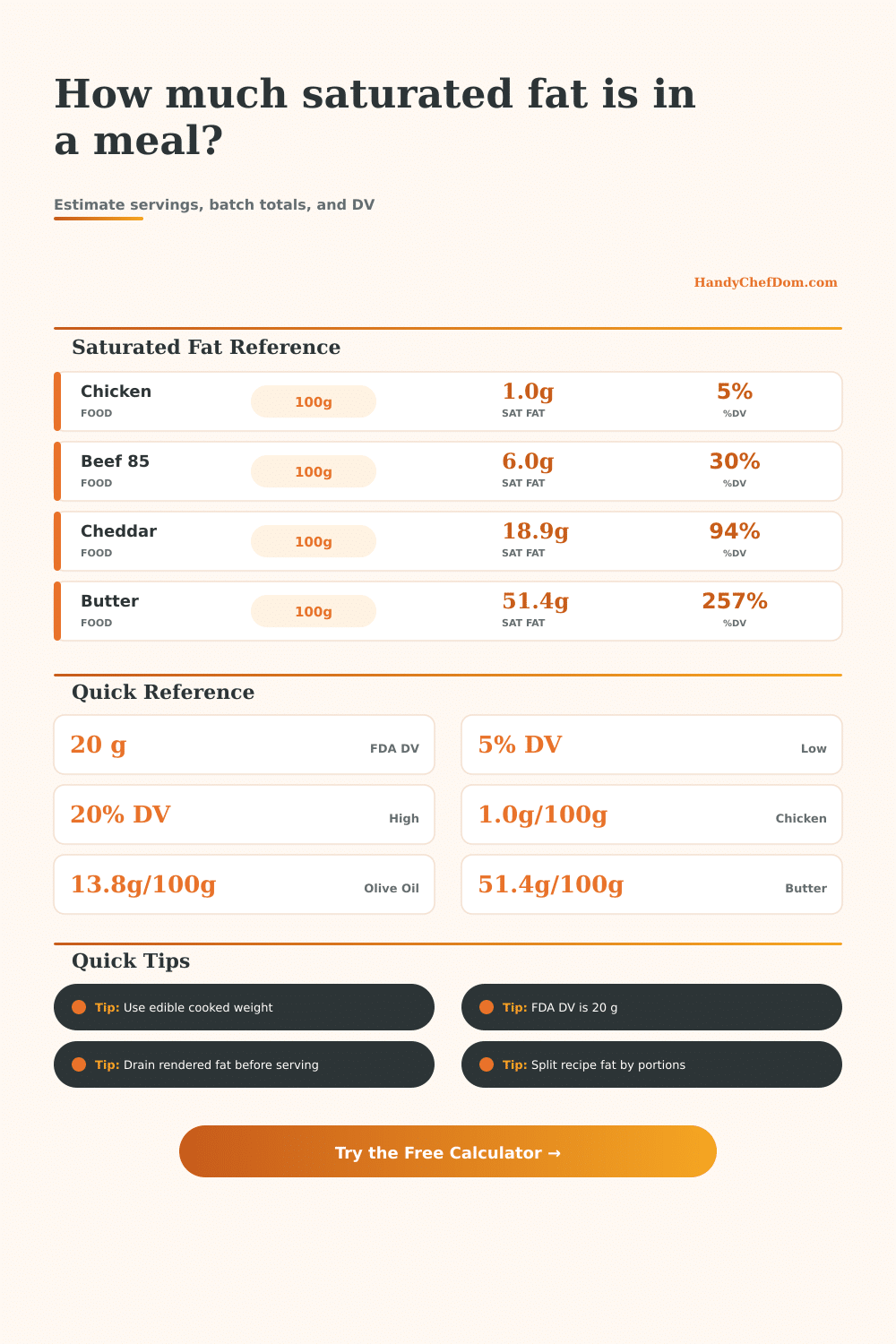
| Chicken breast, meat only, cooked, roasted | 100 g | 165 kcal | 3.57 g | 1.01 g | 31.02 g |
| Ground beef, 85% lean, cooked estimate | 100 g | 250 kcal | 15.40 g | 6.00 g | 25.90 g |
| Atlantic salmon, cooked dry heat | 100 g | 206 kcal | 13.40 g | 3.05 g | 22.10 g |
| Pork chop, broiled edible portion | 100 g | 231 kcal | 12.60 g | 4.40 g | 25.70 g |
| Cheddar cheese | 100 g | 403 kcal | 33.31 g | 18.87 g | 22.87 g |
| Whole milk, 3.25% fat | 100 g | 61 kcal | 3.25 g | 1.86 g | 3.15 g |
| Egg, whole, cooked | 100 g | 155 kcal | 10.61 g | 3.27 g | 12.58 g |
| Firm tofu, prepared with calcium sulfate | 100 g | 76 kcal | 4.78 g | 0.69 g | 8.08 g |
| Cooking Fat | Common Measure | Saturated Fat | Total Fat | Best Calculator Use |
|---|---|---|---|---|
| No added fat | 1 tbsp | 0.0 g | 0.0 g | Dry heat or steamed foods |
| Butter | 1 tbsp | 7.3 g | 11.5 g | Baking, finishing, sauteing |
| Ghee | 1 tbsp | 9.0 g | 13.0 g | High-fat butter substitute |
| Lard | 1 tbsp | 5.0 g | 12.8 g | Frying and pastry estimates |
| Coconut oil | 1 tbsp | 11.2 g | 13.5 g | High saturated fat oil |
| Olive oil | 1 tbsp | 1.9 g | 13.5 g | Lower saturated fat sauteing |
| Avocado oil | 1 tbsp | 1.6 g | 14.0 g | Lower saturated fat roasting |
| Serving Size | Weight | Food Sat Fat | With Cooking Fat | % of 20 g DV | Interpretation |
|---|
| Per Serving Saturated Fat | % of 20 g DV | Label Reading | Calculator Note |
|---|---|---|---|
| 1 g | 5% | Low | FDA guidance treats 5% DV or less as low. |
| 2 g | 10% | Moderate | Often useful for mixed meals with multiple foods. |
| 4 g | 20% | High | FDA guidance treats 20% DV or more as high. |
| 10 g | 50% | Large Share | Half of the default daily limit in one portion. |
| 20 g | 100% | Full DV | The default FDA Daily Value used by this calculator. |
| Food | Common Portion | Approx Weight | Sat Fat | % of 20 g DV |
|---|---|---|---|---|
| Chicken breast, roasted | 4 oz cooked | 113 g | 1.1 g | 6% |
| Ground beef, 85% lean, cooked | 4 oz cooked | 113 g | 6.8 g | 34% |
| Atlantic salmon, cooked | 4 oz cooked | 113 g | 3.5 g | 17% |
| Pork chop, broiled | 4 oz cooked | 113 g | 5.0 g | 25% |
| Cheddar cheese | 1 oz slice | 28 g | 5.3 g | 26% |
| Whole milk | 1 cup | 244 g | 4.5 g | 23% |
| Whole egg, cooked | 1 large | 50 g | 1.6 g | 8% |
| Firm tofu | 100 g | 100 g | 0.7 g | 3% |
You are likely aware of the advice to limit saturated fat. It comes out of your doctor’s office. It shows up on a nutrition label. But knowing something isn’t the same as measuring it as you cook. It’s one thing to have an idea; it’s another to hold yourself accountable.
Most people fall into that gap between knowledge and action because they make assumptions, sure, chicken is lean! They don’t realize the butter they use to sear it counts. Or that the oil in their pan doesn’t magically evaporate -, fat is fat until wiped off or eaten. Which is why tools beat advice.
Why You Need a Fat Calculator
To help you avoid doing any of these calculations yourself, I made a calculator (above) which does all the work for you after you input amounts and types of food you intend to eat. There’s no need to convert grams into percentages of your day (the calculator does it for you).
Food comes in abstractions: “a slice” or “a serving.” But a slice of what? A person’s definition of what a slice means depends on who cut it! Weight doesn’t have ambiguity; most foods can be weighed to remove all guesswork. What you put in your mouth is something you weigh, the part with the saturated fat inside of it. And when you want to eat some grilled chicken, weight of the bone plus the gristle is not going to have any saturated fat. By asking you how much you plan to eat once it has been cooked, the calculator accounts for this. It’s a subtle difference, but one that stops you from unknowingly overeating.
But they also take into account how what we eat gets cooked. Sure, one hundred grams of lean ground beef have lower saturated fats compared to other cuts. But when you cook it in two tablespoons of butter then serve it along with the entire pan sauce, suddenly you’re way past the line. While meat may be healthy, that extra fat contains a lot of saturated fat, quickly making it unhealthy.
The calculator separates out the base of the food you’re eating from the additional fat you add through cooking. It lets you know what kind of butter or oil you used (which matters!). It also shows how much you used and lets you set an amount you drained away. This part matters. Pour grease into the trash? Doesn’t count. Let it congeal in the pan? Does. It is beautiful to force you to make that decision clear instead of letting you assume that you ate all of what was on the pan.
It’s also important to know where you’re putting in these calories. That’s why we’ve included daily limits. As a general guideline, the FDA recommends no more than twenty grams of saturated fat per day (for an average 2,000-calorie diet). While some people may exceed this threshold depending on their activity level, others have certain heart-related risks and should consume less.
To keep things in perspective, you can change your daily limit right here in the calculator. Your value doesn’t necessarily need to be the default twenty grams. If you want a little extra wiggle room or you know you have high-activity days, feel free to reduce or increase accordingly. Then you’ll get a clear picture of just how many grams you’ve spent so far, and how many are left for the remainder of the day.
To get a sense of what these percentages mean, here’s how they’re classified: Low is five percent of DV, and High is twenty percent or more. These terms are intended to allow you to balance your plate. For example, if you’ve got saturated fats accounting for sixty percent of your allotment at lunchtime, the rest of the day should be easy on red meat and heavy on veg or tofu. Tofu contains virtually no saturated fat, so it’s a great anchor around which to balance out a slightly more luxurius previous meal. Why? Variety spreads the load among different nutrient profiles rather than front-loading just one component.
These kinds of thing are hidden in recipes, which list out their ingredients without telling you what they will become as a final product. For example, “half a cup” of butter is an ingredient in many batch cookie recipes. If you divide that across all twelve cookies, you’ll have an idea of how much it’s per serving, assuming you cook all twelve and eat all of them entirely yourself.
To handle this, the calculator allows you to calculate batches. Enter total amount of cooked fat and the number of servings. This gives you a precise representation of your own consumption from one meal prep or family dinner. It converts vague recipe directions into exact nutrition information.
Reading labels is still an art form. It’s not all about glancing at words. Low saturated fat…yay! But what does low mean? Why low? Did food companies make it that way just to strip out nutrition and call it “low?” Labels can’t tell you that. Real food provides context that labels alone cannot supply. Chicken breast stays low because of biology; it doesn’t need to be manufactured to be low. Cheese is high because of dairy: milk fat is high in saturated chains. That’s not added, those are inherent qualities of real food.
You know this, which allows for smarter food swaps… No deprivation necessary.
That doesn’t mean you have to be perfect every single day, just make small adjustments toward reducing the biggest sources of saturated fat in your diet. Small changes add up faster than drastic cuts, which don’t help as much. Don’t count every single thing you eat; that’s a huge mistake. Instead, make informed choices knowing what you give up. That turns vague worry into clear decisions. And that’s how you manage bad habits using measured action.