Chicken in Slow Cooker Cooking Time Calculator
Estimate slow cooker chicken time by cut, raw weight, low or high setting, fresh or frozen start, liquid depth, cooker fill percent, bone-in style, and slice or shred target.
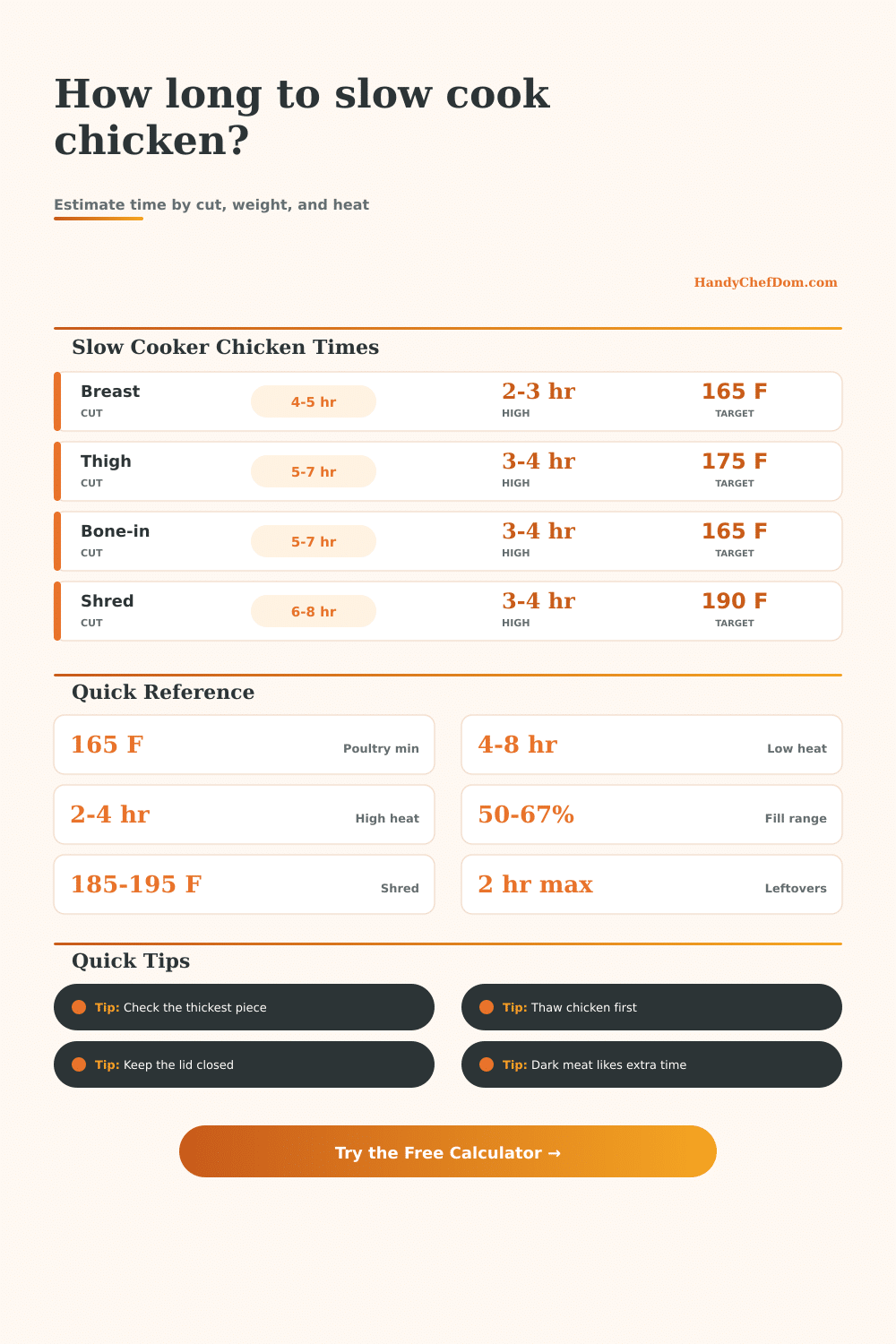
| Chicken Cut | Typical Weight | Low Setting | High Setting | Target |
|---|---|---|---|---|
| Boneless chicken breast | 1.5 to 3 lb / 0.7 to 1.4 kg | 4 to 5 hours | 2 to 3 hours | 165°F / 74°C |
| Chicken thighs | 2 to 4 lb / 0.9 to 1.8 kg | 5 to 7 hours | 3 to 4 hours | 175°F / 79°C for tenderness |
| Drumsticks | 2 to 4 lb / 0.9 to 1.8 kg | 5 to 6.5 hours | 2.5 to 4 hours | 175°F / 79°C for tenderness |
| Mixed pieces | 3 to 5 lb / 1.4 to 2.3 kg | 5.5 to 7.5 hours | 3 to 4.5 hours | Check every large piece |
| Small whole chicken | 3 to 4.5 lb / 1.4 to 2 kg | 6 to 8 hours | 4 to 5 hours | Breast and thigh checks |
| Chicken tenders | 1 to 2 lb / 0.5 to 0.9 kg | 2.5 to 3.5 hours | 1.5 to 2.25 hours | 165°F / 74°C |
| Factor | Range | Time Effect | Calculator Use |
|---|---|---|---|
| Cooker fill | 50 to 67 percent | Baseline | Best general slow cooker loading range |
| Cooker fill | Over 75 percent | Adds time | More food mass heats more slowly |
| Liquid depth | 0.25 to 1 inch | Baseline | Moist heat without full submersion |
| Liquid depth | Over 1.5 inches | Slightly faster | More heat transfer from broth or sauce |
| Bone-in style | Bone-in pieces | Adds time | Dense pieces need a wider check window |
| Frozen state | Frozen or partly frozen | Safety flag | Thaw first, then use normal timing |
| Target Texture | Temperature Basis | Best Cuts | Yield Note |
|---|---|---|---|
| Slice or dice | 165°F / 74°C | Breast, tenders, mixed pieces | About 74 to 78 percent cooked yield |
| Tender dark meat | 175°F / 79°C | Thighs, drumsticks, wings | Dark meat stays tender with extra time |
| Shred | 185 to 195°F | Breast or thighs in sauce | Longer time for pull-apart fibers |
| Whole small chicken | 165°F / 74°C minimum | Small thawed birds only | Check breast and thigh separately |
| Reference Point | Value | Applies To | Calculator Meaning |
|---|---|---|---|
| All poultry minimum | 165°F / 74°C | Chicken pieces and whole poultry | Default safe internal target |
| Thermometer placement | Thickest part | Breast, thigh, drumstick, mixed pieces | Do not rely on time alone |
| Slow cooker fill | Half to two-thirds full | Most slow cooker meals | Baseline fill percentage |
| Frozen poultry | Thaw first | Raw chicken before slow cooking | Frozen state is a warning flag |
| Leftover cooling | Within 2 hours | Cooked chicken after serving | Refrigerate promptly |
A slow cooker makes an easy dinner, right? Unfortunately, if you’re not prepared, you’ll end up with rubbery, dry results. “Put the chicken in,” you say. “Press Start.” Walk away and do something else. Let it cook on its own, like magic. Well, no, there’s no magic here.
There’s also only one thing happening: heat transfer. That means volume of cooker plus depth of liquid plus density of bones equals whatever comes out. Unless you know what those three things mean, you’re gambling with your meal. Setting a timer isn’t enough; there is a science (physics) of moist heat. Once you fill in those details, the calculator (above) do the math for you.
The Science of Cooking Chicken in a Slow Cooker
You don’t have to guess which conversions works; you don’t have to try to calculate coefficients. Chicken isn’t all chicken: A boneless breast doesn’t behave like a frozen drumstick with its thick piece of dark meat, or a couple of thighs. Dark meat contains more connective tissue (collagen), which has to melt into gelatin; white meat will dry out long before that happens. For that reason, the tool want to know what texture you’re trying to get.
If it’s clean slices destined for a salad, you reach 165 degrees Fahrenheit. But if you’re after shredded meat for tacos, you’ll keep going, raising the internal temp closer to 190 degrees. It’s not just about flavor; its also about structure.
Finally, there’s water volume. Some recipes say to cover the meat. Others don’t. Slow cookers aren’t just pots of simmering liquid. They are also containers for circulating steam. If you put too much liquid in, the chicken will be steamed rather than simmered; this can result in a bland dish. If you use too little liquid, however, you risk burning the bottom of the cooker. To get it right, there has to be enough liquid so that contents are moist but not so much that the flavors gets diluted. In general, 1/2 inch of sauce or broth is usually plenty to create a moist environment while concentrating flavors. This variable is built into the calculator because depth affect the rate of penetration by heat and consequently alters total cooking time.
You should also note fill percentage. Undercooking food… Especially when it spends too long in the danger zone, is a hazard of overloaded slow cookers. As a rule of thumb, experts say don’t fill your pot past halfway to two thirds; the pot will heat up more quickly. You might cram four pounds of chicken into a three-quart insert. The inner part of food remains cold while the outside overcooks. Mass matters: Because the tool factors your estimate around the cooker’s fill level, a heavier load require a longer period of time to reach the same temperature, and if you neglect that delay, you risk ruining texture before the food has been safely cooked.
Meat on the bone is more complicated. Because it’s an insulator, it takes longer for the outside of meat to cook through, bone-in thighs will take longer than boneless cuts, for example. But because of that extra time, there’s less moisture lost from them cooking slowly, so they stay moister throughout. So if you’re combining cuts, you’ll want to account for the one that cooks slowest finishing last. When you have bone in the mix, the calculator factors this in by extending the estimated time.
In this case, uniformity is key. Don’t rely on the sauce color; use your thermometer to check thickest part of meat (not touching any fat or bone). Where home cooks fall down is with frozen chicken. Placing a rock-solid chunk of bird into your slow cooker means exterior stays at dangerous temperatures that allow bacteria to grow for multiple hours while the interior gradually melts. This is not only unsanitary, but it also look bad.
By flagging frozen ingredients, the tool prompts you to defrost beforehand, an important step that’s frequently forgotten when cooking under pressure during rush hour. A pre-thawed piece of chicken in the fridge overnight removes any doubt about its starting point, so you know meat starts getting cooked the moment you turn up the heat.
So at the end of the day, slow cooking is about precision (and patience). It is not about neglecting anything. The windows listed above are estimates (they’re where you start from). No two batches of chicken will be identical; no two pieces will be quite the same thickness or quality. And each of our models cooks just a little bit differently. Trust your thermometer, use what came out as a guideline, but take into account all those factors. Then slow cooker won’t feel like a game of chance any more, instead it’ll be another kitchen standby, one that’s earned its place there because you respect what it can do.
Most times, the distinction between success and failure is simply in knowing when to plan on cooking something, before opening the freezer door. You should of known the texture would depend on mass. It was actually more difficult than I thought. Making sure everything is cook perfectly is hard.