🌿 Dried To Fresh Thyme Converter
Convert whole, rubbed, crushed, or powdered dried thyme into fresh leaves and sprigs for soups, poultry, braises, sauces, stuffing, and long-simmered pots.
Start with the dried thyme in your recipe. The calculator normalizes it to dried teaspoon strength, then converts to fresh stripped thyme leaves and estimated sprigs using your chosen leaf yield.
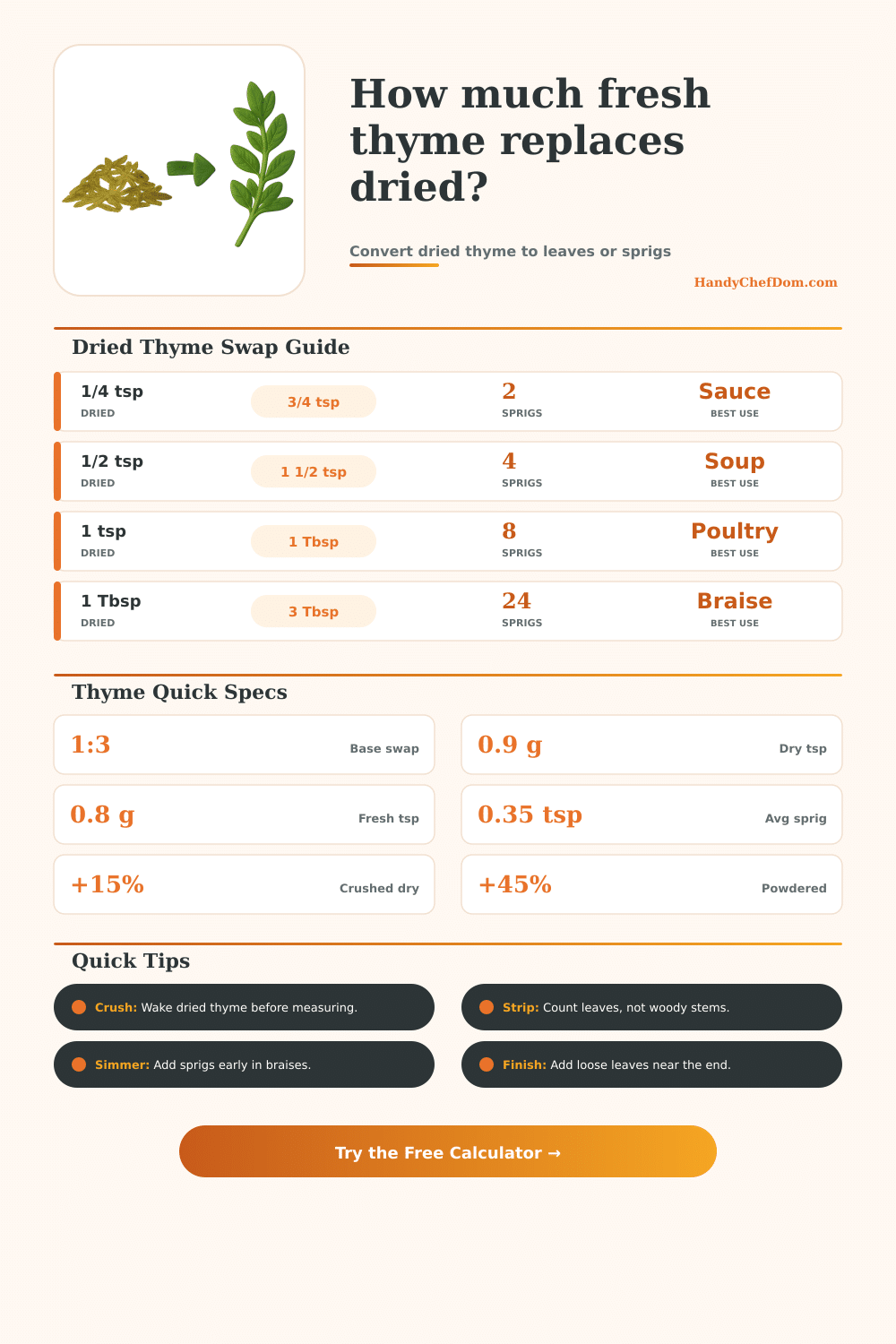
| Dried Thyme | Fresh Leaves | Fresh Sprigs | Good For |
|---|---|---|---|
| 1/8 tsp dried thyme | 3/8 tsp stripped leaves | 1 small sprig | Single sauce serving |
| 1/4 tsp dried thyme | 3/4 tsp stripped leaves | 2 to 3 sprigs | Pan gravy or vegetables |
| 1/2 tsp dried thyme | 1 1/2 tsp stripped leaves | 4 to 5 sprigs | Small soup or poultry pan |
| 1 tsp dried thyme | 1 Tbsp stripped leaves | 8 to 10 sprigs | Family soup, roast chicken |
| 2 tsp dried thyme | 2 Tbsp stripped leaves | 16 to 20 sprigs | Large stew or stuffing |
| 1 Tbsp dried thyme | 3 Tbsp stripped leaves | 24 to 30 sprigs | Big braise or stock batch |
| Fresh Sprig Type | Leaves Per Sprig | When To Use | Calculator Setting |
|---|---|---|---|
| Small delicate sprig | 1/4 tsp leaves | Thin stems with small leaves | small sprigs |
| Average grocery sprig | 1/3 tsp leaves | Most clamshell thyme bunches | average sprigs |
| Leafy garden sprig | 1/2 tsp leaves | Soft new growth with many leaves | leafy sprigs |
| Woody sparse sprig | 1/5 tsp leaves | Older bunch with hard stems | woody bunch |
| Measured bunch | custom tsp leaves | Strip 5 sprigs and average them | custom yield |
| Dried Form | Strength Factor | Fresh Match | Use Note |
|---|---|---|---|
| Whole dried thyme leaves | 1.00x | standard 3-to-1 fresh | Best for balanced soups |
| Rubbed dried thyme | 1.08x | slightly more fresh leaves | Good for poultry and stuffing |
| Lightly crushed thyme | 1.15x | add a small pinch fresh | Blooms quickly in warm fat |
| Finely crushed thyme | 1.25x | round fresh amount upward | Strong in marinades |
| Powdered dried thyme | 1.45x | needs the most fresh leaves | Use carefully in sauces |
| Dish Type | Fresh Adjustment | Best Fresh Form | Add Window |
|---|---|---|---|
| Soup or stock pot | 1.05x | sprigs or stripped leaves | early simmer |
| Poultry roast | 1.10x | chopped leaves | rub before roasting |
| Beef or lamb braise | 1.20x | tied sprigs | early, then remove |
| Beans or lentils | 1.15x | loose leaves | middle simmer |
| Stuffing | 1.08x | finely chopped leaves | mix before baking |
| Cream sauce or gravy | 0.85x | minced fresh leaves | finish gently |
The recipe says it needs A TEASPOON of dried thyme, but you only have that limp, slightly-faded bunch hiding in the vegetable crisper. According to the web, the conversion rate should be three to one, easy-peasy…until it isn’t, when you notice that not all dried thyme look (or behaves) alike. While some is rubbed or even finely-crushed into an unrecognizable powder that compacts very tightly in a measuring spoon, other varieties remains as intact leaflets that don’t collapse at all. That alters what quantity of plant material you’re actualy putting into the pot. And though a one-to-three ratio may sound reasonable, it’s far off by more than a smidgen.
Once you enter the type of dry item you have and how many tablespoons of fresh you want, the calculator do the number crunching for you, so no need to spend time wondering exactly how many sprigs are equivalent, or fiddle with the “strength coefficient. For example, you’ll see that one factor to take into account is the type of dry herb you’re using. Finely crushed thyme is much denser than a spoonful of whole, dried leaves which have air pockets between the bits. If you substitute powdered thyme without considering this difference, you’ll probably end up with a dish that tastes unpleasantly medicinal different than bright and herbal. By default, tool recognizes the change in density when you select powdered or crushed ingredients. It then increases the number of fresh leaves needed to match the flavor strength the recipe was originally aiming for. Again, it’s a subtle tweak, but it eliminates the all-too-common problem of overconcentrating a subtle sauce with too much potent dried herb.
Simple Tips for Using Thyme in Cooking
And what about stripping leaves, versus buying them by the sprig? At the market, most home cooks purchase thyme in bunches held together by rubber bands. Depending on how long they spend at the grocery store, there will be widely different amounts of leaf per stem. An old woody bunch of thyme that’s been sitting around for a while will contain far less green matter than a leafy young sprig from the garden. Instead of guessing how many tiny chopped leaves is enough and measuring as you cook, use the converter. You can input how leafy your sprig actualy is, so it can estimate how many whole ones you’ll need. This is much more practical. If you prefer, just strip off the leaves or add entire stems (depending on whether you like your thyme chopped, or not).
The other big factor is timing. Some herbs, like thyme… Is pretty hearty (and even prefer hot weather), but don’t want to be boiled for days. For something like a long-simmered beef braise, tossing in a few sprigs at the start lets the herbs cook slowly, releasing their slightly earthy flavors into the liquid and fat as they go. But for a quick pan sauce for chicken, you want the herbs in at the end so that their brighter tones has time to shine, and won’t get cooked away if tossed in too soon. Based off what you’re cooking, the calculator factors its recommendations accordingly: More fresh herbs for longer cooking methods when some of their strength is bound to be lost to breakdown and evaporation.
If you’re using herbs as an ingredient in a recipe (think roasted vegetables or stuffing), however, you’re looking for something closer to the flavor of freshly chopped herbs than what you can get from dried. Rehydrating dried herbs doesn’t capture the punch of fresh herb. Their lively scent still clings to fresh herb leaves when they’re tossed into the pot at the last moment before serving, retaining that hint of citrusy zest that you can’t get back with dried ones. And so that’s where making this switch from dried-to-fresh is so important: It isn’t only a matter of quantity, but of flavor preservation. You’re giving up some safety here for a better sense of the ingredient itself. The tool gives you a way to find that sweet spot in any given dish.
So all things considered, what’s the best way to cook with thyme? It’s not so much about following a recipe to the letter as it is learning its character under varied conditions, about how timing, texture, and form will affect the strength of your dish. Whether fresh and aromatic off the twig or from a jar that has been sitting in the fridge for most of the past year, familiarity with these variables help you to cook confidently. Not fearfully. The next time you mess up a pot of something, you’ll know which factors are at play and thus could of relied on your taste buds just a little more. And when you do so, even the tiniest of herbs (with a little attention) becomes the main part of a well-balanced meal: proof positive that even the smallest herb is worth paying some mind prior to the heat.