🦃 Turkey Brining Time Calculator
Estimate wet or dry turkey brine time, salt weight, salt volume, water volume, refrigerator safety, and sodium-sensitive adjustments.
Wet brine salt is calculated as salt weight divided by water weight. Dry brine salt is calculated from turkey weight, with the selected salt percentage adjusted for sodium sensitivity and brine duration.
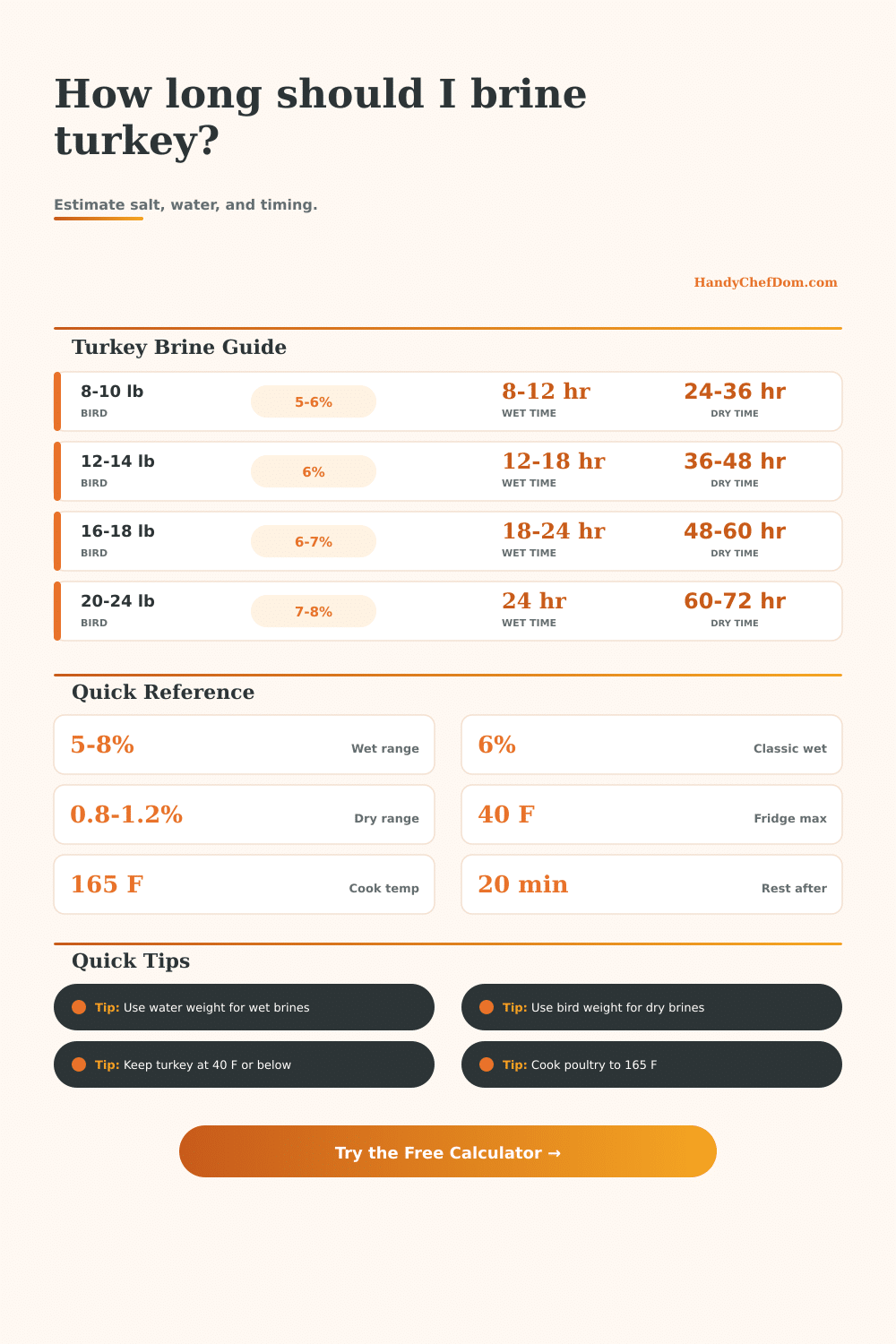
| Turkey Size | Wet Brine Strength | Wet Brine Time | Dry Brine Time |
|---|---|---|---|
| 8 to 10 lb | 5 to 6% water weight | 8 to 12 hours | 24 to 36 hours |
| 12 to 14 lb | About 6% water weight | 12 to 18 hours | 36 to 48 hours |
| 16 to 18 lb | 6 to 7% water weight | 18 to 24 hours | 48 to 60 hours |
| 20 to 24 lb | 7 to 8% water weight | 20 to 24 hours | 60 to 72 hours |
| Water Volume | Water Weight | 6% Salt Weight | Diamond Crystal Volume |
|---|---|---|---|
| 1 gallon | 3,785 g | 227 g | 1.67 cups |
| 2 gallons | 7,571 g | 454 g | 3.34 cups |
| 3 gallons | 11,356 g | 681 g | 5.01 cups |
| 8 liters | 8,000 g | 480 g | 3.53 cups |
| Salt Type | Approx Grams Per Cup | Why It Matters | Calculator Use |
|---|---|---|---|
| Diamond Crystal kosher | 136 g per cup | Large flakes, lighter cup | Best measured by weight |
| Morton kosher | 230 g per cup | Denser flakes | Needs less volume |
| Table salt | 288 g per cup | Fine and dense | Use lower volume |
| Fine sea salt | 288 g per cup | Similar density to table salt | Measure carefully |
| Coarse sea salt | 240 g per cup | Crystal size varies | Weight is safest |
| Safety Item | Target | Calculator Flag | Practical Meaning |
|---|---|---|---|
| Refrigerator brining | 40°F or below | Warns above 40°F | Keep turkey cold while brining |
| Whole poultry doneness | 165°F minimum | Always displayed | Verify with food thermometer |
| Enhanced turkey | Reduce salt | Large salt reduction | Avoid overly salty results |
| Wet brine strength | 5 to 8% | Flags outside range | Use water weight, not cups first |
| Scenario | Best Brine | Salt Basis | Timing Range | Strength Range | Watch Item |
|---|---|---|---|---|---|
| Classic holiday turkey | Dry brine | Bird weight | 36 to 60 hours | 0.9 to 1.1% | Even salt coverage |
| Very lean breast meat | Wet brine | Water weight | 8 to 16 hours | 5 to 6% | Full submersion |
| Large 20 lb bird | Dry or wet | Bird or water | 24 to 72 hours | 6 to 8% wet | Fridge space |
| Low sodium meal | Dry brine | Bird weight | 24 to 48 hours | 0.6 to 0.8% | Enhanced labels |
| Partly thawed turkey | Dry brine | Bird weight | 24 to 48 hours | 0.8 to 1.0% | Thaw the cavity |
| Overnight only | Wet brine | Water weight | 8 to 12 hours | 5 to 6% | Do not overbrine |
Raw Turkey: Every November, you might stare into your refrigerator and realize it is already packed with leftovers, yet you have a raw bird that needs to go somewhere cold for the next thirty-six hours. Planning ahead becomes crucial. Room in the fridge is tight, so how do you manage? The solution is to use brine for extra taste.
This poses its own problem: the physical puzzle of timing and proportions. Too little time, or too high a concentration, will mean a potentially salty (or even dry) turkey. Enter your turkey weight and cooking technique, and let the calculator do the rest. No more guesswork about whether or not your pot will hold the bird.
How to Brine Your Turkey Perfectly
Displacement is something most people ignore when wet-brining turkeys; that fourteen-pounder isn’t going to fit into two gallons of liquid without causing an overflow. Enter weight of the bird and the volume of your container, and the tool calculates how much salt needs to be used based off amount of water in contact with the meat. It’s the difference between a successful attempt and a disaster on Thanksgiving dinner night.
It is also helpful to know how percentages relate to brine types: Osmosis pushes water into the muscle fiber in wet brines. That’s why your solution has to be higher in salt to compensate for the moisture being pushed into the meat. A 6 percent solution may sound strong but results in a well seasoned bird.
In dry brines, you’re actualy rubbing salt onto the meat, which pulls moisture from the flesh, dissolves, then absorbs back with the seasoning. Because the salt never leaves the ecosystem of the bird, you can use less of it by weight. One percent of the turkey’s own bodyweight typically suffice. Confusion over these proportions can result in an under- or over-salted bird.
Safety trumps flavor when considering the temperature of your fridge. While brine slows down bacteria, it doesn’t eliminate it entirely. Your refrigerator MUST maintain a temperature of 40 degrees F or cooler. That’s why there’s a safety check in the calculator: it will alert you to any setups in which the temperature could creep up into the danger zone within the brine window.
Shorten the brine to match if your fridge leans towards warmth. Even if math says you should of go for an extra-long soak, don’t do it, food safety isn’t negotiable in the name of juicier meat.
The other thing about salt is that there is all kinds of varieties, and none are created equal when it comes to volume measures. Because salt has different densities, a cup of flaky kosher salt won’t weigh as much as the same cup of fine table salt… Almost twice as little, actualy! This means you could easily double your seasoning without realizing it, unless you use the incorrect conversion factor.
By weighing your ingredients, you eliminate this guesswork and create something steady where there was once something that changes. On the page, I’ve broken down the densities into reference tables so that you can make adjustments if all you have is measuring cups. A kitchen scale are an investment worth making during the first holiday season.
The variables aren’t corrected by the oven. Controlling them before they go into the oven is the idea behind brining. When heat reaches the protein, it speed up moisture loss. Dehydration can’t be reversed with basting. What happens before you turn on the oven makes all the difference.
Plan for fridge space, check your salt weight, observe the time. Prepping like this make a moist roast. Doing the math ahead of time ensures a moist roast.