🍞 Yeast to Baking Powder Converter
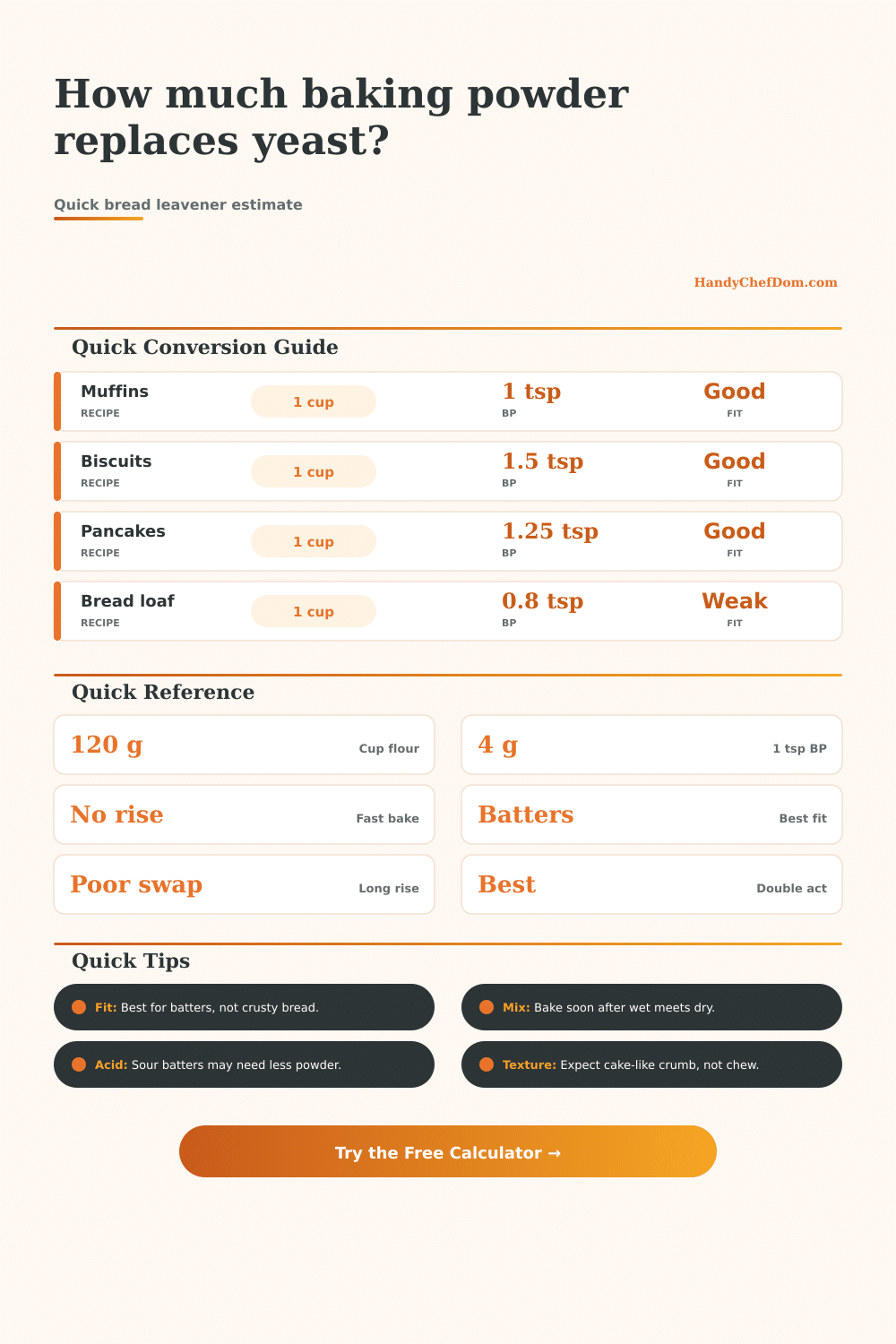
Approximate a yeast-leavened formula as a quick bread, batter, biscuit, pancake, or spoonable loaf by flour amount, recipe style, rise time removed, hydration, acidity, egg support, and batch size.
This converter estimates baking powder for quick breads and batters. It does not create the gluten development, fermentation flavor, crust, or open crumb of artisan bread.
| Quick Recipe Target | Typical Baking Powder | Hydration Fit | Conversion Note |
|---|---|---|---|
| Quick loaf or banana bread | 1 to 1.25 tsp per cup flour | 75% to 105% | Good for tender sliceable loaves with fruit, milk, oil, or eggs. |
| Muffins or scoopable batter | 1 to 1.4 tsp per cup flour | 80% to 115% | Good lift if mixed briefly and baked after portioning. |
| Biscuits or scones | 1.25 to 1.75 tsp per cup flour | 45% to 75% | Works when fat is cut in and the dough is handled lightly. |
| Pancakes or griddle cakes | 1 to 1.5 tsp per cup flour | 100% to 150% | Best for loose batters that cook immediately after a short rest. |
| Waffles | 1.2 to 1.6 tsp per cup flour | 95% to 145% | Extra steam and eggs help the chemical leavening set. |
| Quick flatbread or pizza base | 0.6 to 1 tsp per cup flour | 55% to 80% | Expect a biscuit-like or cracker-like base, not yeasted chew. |
| Flour Amount | Light Lift | Standard Lift | High Lift | Metric Powder |
|---|---|---|---|---|
| 1 cup flour / 120 g | 3/4 to 1 tsp | 1 to 1 1/4 tsp | 1 1/4 to 1 1/2 tsp | 3 to 6 g |
| 2 cups flour / 240 g | 1 1/2 to 2 tsp | 2 to 2 1/2 tsp | 2 1/2 to 3 tsp | 6 to 12 g |
| 3 cups flour / 360 g | 2 1/4 to 3 tsp | 3 to 3 3/4 tsp | 3 3/4 to 4 1/2 tsp | 9 to 18 g |
| 4 cups flour / 480 g | 3 to 4 tsp | 4 to 5 tsp | 5 to 6 tsp | 12 to 24 g |
| 6 cups flour / 720 g | 4 1/2 to 6 tsp | 6 to 7 1/2 tsp | 7 1/2 to 9 tsp | 18 to 36 g |
| 8 cups flour / 960 g | 6 to 8 tsp | 8 to 10 tsp | 10 to 12 tsp | 24 to 48 g |
| Original Formula Signal | What Yeast Was Doing | Quick-Bread Fit | Method Adjustment |
|---|---|---|---|
| Short 30 to 60 minute rise | Mostly quick gas production | Fair to good | Use standard powder ratio and bake promptly. |
| One to two hour rise | Gas plus moderate dough conditioning | Fair | Increase egg or starch support and expect a softer crumb. |
| Overnight or cold ferment | Flavor, acidity, gluten change, and gas | Weak | Keep this as a new quick loaf, not the same bread. |
| Sourdough starter base | Acidity, flavor, wild yeast, and flour contribution | Weak to fair | Account for starter liquid and use a batter-style method. |
| High yeast sandwich dough | Fast rise and dough expansion | Fair if enriched | Use a pan and add structure; do not expect chewy slices. |
| Pizza, baguette, or ciabatta | Gluten extensibility and oven spring | Poor | Convert only if a quick flatbread texture is acceptable. |
| Step | Yeast Recipe Habit | Baking Powder Version | Reason |
|---|---|---|---|
| Mixing | Knead or fold to build gluten | Mix only until no dry flour remains | Overmixing can toughen quick breads. |
| Resting | Rise until expanded | Rest briefly only if batter needs hydration | Gas production starts as soon as powder is wet. |
| Shaping | Degas, proof, and score | Scoop, pour, pat, or pan gently | Chemical leavening cannot rebuild lost gas. |
| Baking | Often high heat for oven spring | Moderate heat until center sets | Quick breads need structure to set around bubbles. |
| Flavor | Fermentation creates aroma | Add acid, dairy, fruit, malt, herbs, or spices | Flavor must come from ingredients, not fermentation time. |
| Cooling | Cool to finish crumb setting | Cool before slicing tender loaves | Fast-leavened crumbs can seem gummy while hot. |
There’s no time. You have a packet of yeast and three cups of flour. Great! But the yeast has to wake up for an hour, then sit and rise for another couple of hours. And then…you have to bake your bread. If life isn’t going to give you that kind of luxurius, there really is only one option: switch to baking powder.
But don’t think that you can simply swap the leaveners out willy nilly. Baking powder and yeast aren’t interchangeable. Yeast is a living thing that eats time and sugar. Baking powder are a chemical reaction initiated by heat and moisture.
How to Use Baking Powder Instead of Yeast
That’s why I created this calculator, it takes care of the math for you. It inputs things like recipe type, acidity, and hydration, and spits out a specific number of teaspoons. No guessing required.
People make mistake of believing that baking powder can be used as a substitute for fermenting dough. It cannot. Slow fermentation with yeast build complexity in flavor and structures gluten. Baking powder just blows the air into the mixture.
If you take a thick sandwich loaf formula and attempt to convert it immediately, you’ll probably get something that tastes metallic. It won’t have any depth of flavor. The texture will lack depth too.
The way the tool works around that is that it looks at what you want to bake. Pancakes and muffins are a good fit. That batter is built for chemical lift. Baguettes and bread is a bad fit. The bread do not hold its shape well enough. This understanding saves you from disappointment at dinnertime.
Surprisingly enough, acidity also has a big part to play here. In order for baking powder to work properly, it needs an acid-rich environment. So if your initial yeast-based recipe called for milk and water alone, you’ll need additional baking powder to achieve the same lightness. However, if there’s any sour fruit, yogurt or buttermilk involved, then the batter will be naturaly acidic. To take this into account, the converter lowers the amount of powder depending on how high you set the acidity level. That way, you avoid having a bitter taste caused by too much baking powder. It is a tiny bit of chemistry, but it makes all the difference in the overall taste. We are looking for lift without a chalky aftertaste.
Another variable that alters the behavior of gas is hydration. While a wet batter such as waffle mix contains gas, it reacts different than a dry dough like a biscuit. Because high moisture batters let the bubbles expand easier, you may require less powder with the same volume. This is why the calculator is calculating the percentages and providing a balance ratio. It even takes into account the content of eggs. Eggs add structure to maintain those bubble. If you have no eggs and low hydration, then your batter is weak. And the converter lets you know that the outcome is going to be fair at best. It’s better to know that before you mix all the ingredients.
The last hurdle of baking bread fast is timing. If you are using yeast, you can let it rest for an hour and it will still work. If you’re using baking powder, it begins its countdown as soon as the liquid touch the dry ingredients. The double-acting kind provides a small buffer zone: it releases a bit upon being moistened and more upon being cooked. But you don’t have hours (and hours). The solution the tool proposes involve changes in method: mix fast, bake now. Letting it linger wastes the leavening power. It requires you to reorient your work flow from a leisurely fermentation routine into a dash to the finish line.
At the end of the day, there’s no substitute for using yeast instead of baking powder; it’s simply learning to make bread that’s going to be different. You should of chose tenderness over chew. Choose speed over complexity. Choose rise time over instant gratification.
The page provides reference tables showing the typical ratio to start with. Knowing when to use such things is truly where the mastery lies. Don’t try to force a chemical leavener to do the job of a living one. Embrace the speed: mix, pour, bake, eat. It is not the same but it is still delicious in itself.