🧈 Salt in Salted Butter Calculator
Estimate salt already inside butter by brand style, salted versus unsalted choice, tablespoons, sticks, grams, recipe substitution, sodium label, and batch scale.
Choose the butter amount, butter brand style, and substitution direction. The calculator can use typical salt percentage data or convert your package sodium label into actual salt using the standard sodium-to-salt factor.
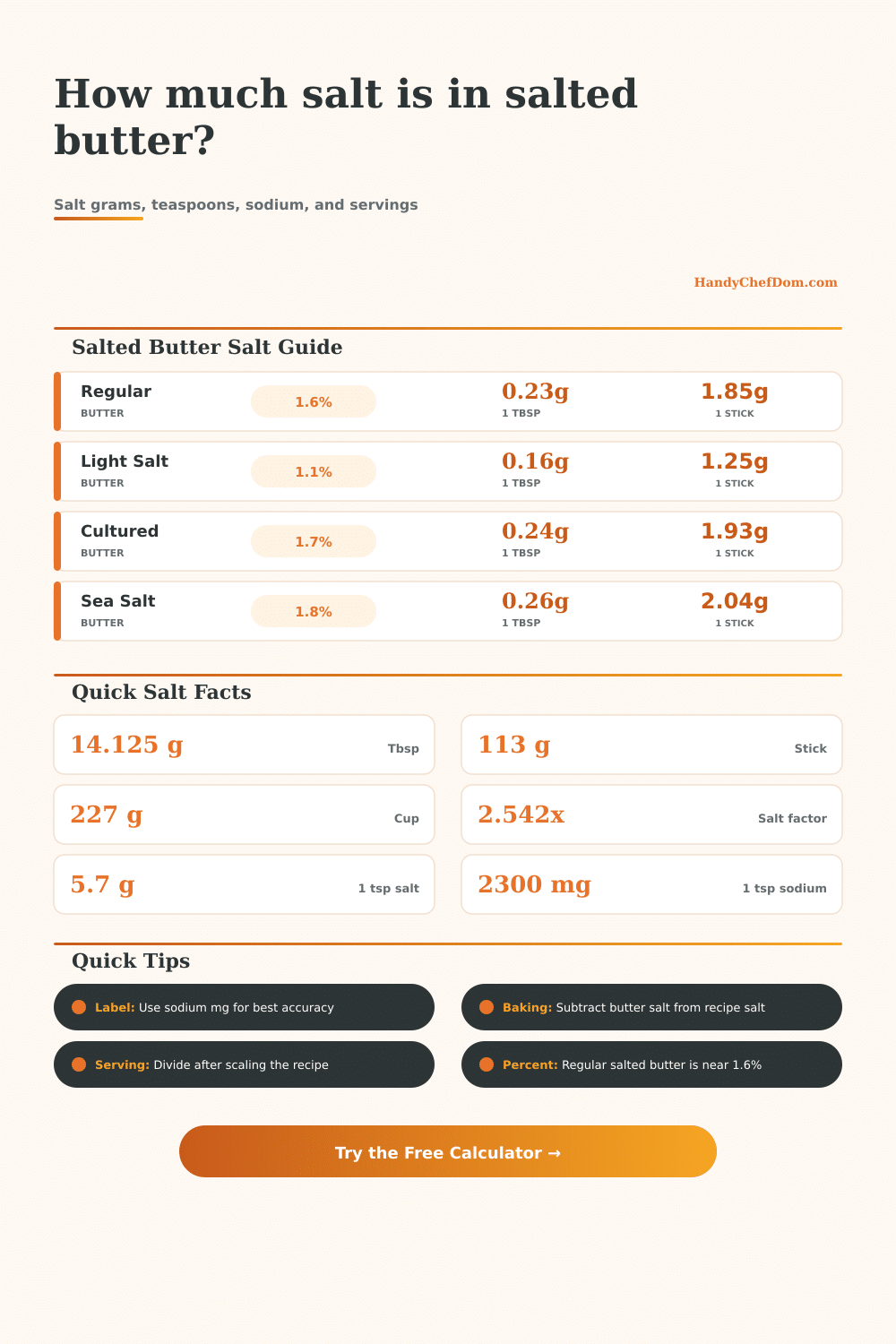
Regular salted butter is commonly estimated near 1.6% salt by weight, close to 91 mg sodium per tablespoon.
| Butter brand/style | Salt by weight | Salt per tablespoon | Salt per stick | Calculator note |
|---|---|---|---|---|
| Regular salted butter | 1.63% | 0.23 g | 1.85 g | Closest to a common 91 mg sodium per tablespoon label. |
| Lightly salted butter | 1.10% | 0.16 g | 1.25 g | Useful when the label says reduced or lightly salted. |
| Cultured salted butter | 1.70% | 0.24 g | 1.93 g | Often a little saltier by weight for finishing use. |
| European-style salted butter | 1.50% | 0.21 g | 1.70 g | Higher butterfat can slightly change tablespoon weight. |
| Sea salt butter | 1.80% | 0.26 g | 2.04 g | Use label sodium if crystals or flakes are uneven. |
| Spreadable salted butter | 1.40% | 0.20 g | 1.59 g | Blended spreads vary, so package labels matter. |
| Whipped salted butter | 0.80% | 0.11 g | 0.91 g | Spoon volume includes air, so salt per spoon is lower. |
| Unsalted butter | 0.03% | 0.004 g | 0.04 g | Trace sodium only; useful for substitution comparison. |
| Custom salt percent | User value | Calculated | Calculated | Use when a recipe or supplier gives salt percentage. |
| Butter measure | Tablespoons | Sticks | Butter weight | Salt at 1.63% |
|---|---|---|---|---|
| 1 teaspoon | 0.33 tbsp | 0.04 stick | 4.7 g | 0.08 g |
| 1 tablespoon | 1 tbsp | 0.13 stick | 14.125 g | 0.23 g |
| 2 tablespoons | 2 tbsp | 0.25 stick | 28.25 g | 0.46 g |
| Half stick | 4 tbsp | 0.5 stick | 56.5 g | 0.92 g |
| 1 stick | 8 tbsp | 1 stick | 113 g | 1.84 g |
| 1 cup | 16 tbsp | 2 sticks | 227 g | 3.70 g |
| Kitchen amount | Approx salt weight | Approx sodium | Regular salted butter match | How to read it |
|---|---|---|---|---|
| Pinch salt | 0.30 g | 118 mg | 1.3 tbsp butter | Small seasoning amount. |
| 1/8 tsp salt | 0.71 g | 279 mg | 3.1 tbsp butter | About a scant quarter stick. |
| 1/4 tsp salt | 1.43 g | 562 mg | 6.2 tbsp butter | Close to three quarters of a stick. |
| 1/3 tsp salt | 1.90 g | 748 mg | 1.0 stick butter | Near the salt in one salted stick. |
| 1/2 tsp salt | 2.85 g | 1121 mg | 1.5 sticks butter | Common recipe salt line. |
| 1 tsp salt | 5.70 g | 2242 mg | 3.1 sticks butter | Use serving math before comparing. |
| Scenario | Butter amount | Salt basis | Servings | Salt per serving |
|---|---|---|---|---|
| Toast for two | 2 tbsp | Regular salted | 2 | 0.23 g |
| Half stick baking | 4 tbsp | Regular salted | 8 | 0.12 g |
| Cookie batch | 1 stick | Regular salted | 24 | 0.08 g |
| Roll spread bowl | 6 tbsp | Lightly salted | 12 | 0.08 g |
| Cultured finish | 4 tbsp | Cultured salted | 8 | 0.12 g |
| Metric block bake | 250 g | Regular salted | 16 | 0.25 g |
| Recipe swap | Butter amount | Salt difference | Sodium difference | Adjustment |
|---|---|---|---|---|
| Salted for unsalted | 1 stick | About 1.80 g | About 710 mg | Reduce added salt by about 1/3 tsp. |
| Unsalted for salted | 1 stick | About 1.80 g | About 710 mg | Add about 1/3 tsp salt if flavor requires it. |
| Salted for unsalted | 1/2 cup | About 1.84 g | About 724 mg | Reduce added salt by about 0.32 tsp. |
| Unsalted for salted | 1 cup | About 3.63 g | About 1428 mg | Add about 0.64 tsp salt for similar salinity. |
| Light salted for regular | 1 stick | About 0.60 g less | About 236 mg less | Add a small pinch only if needed. |
| Sea salt for regular | 1 stick | About 0.19 g more | About 75 mg more | Reduce added salt slightly in delicate baking. |
For most home cooks, salted butter is one variable. Grab a stick, measure it out, and assume recipe has already accounted for everything. But butter isn’t simply fat; it’s a vehicle that delivers a hidden load of sodium. Sodium content vary widely depending on the kind of butter you purchase. You might buy a tub of whipped spread, a generic brand, or a European cultured block.
That hidden salt can make for a too-salty batch if you’re baking something delicate such as shortbread or macarons. The contents of your butter matter far more then many recipe cards indicate. And all of this calculation happens behind-the-scenes: You don’t need to remember any brands or label names at all. Instead, the calculator takes whatever quantity of butter you enter, then converts it into equivalent measurements of sodium, teaspoons of seasoning, and grams of salt.
Why Salt in Butter Matters for Cooking
Why? Because most recipes includes extra salt on top of what the butter already contains. Using salted butter instead of unsalted in a recipe intended for the latter will accidental double your seasoning. Enter your desired portion size. The tool can then calculates if your batch of cookies exceeds your daily sodium allowance more than you thought.
Generally, regular salted butter is around one point six percent salt (by weight). It doesn’t sound like much but a stick has almost two grams of salt. That’s roughly one-third of a teaspoon of straight up salt lurking in your pastry crust for comparison. Lighter salts come in nearer to one percent; some artisanal sea salt butters goes to as high as two percent and beyond.
It makes a noticeable difference in the overall flavor profile. Switching types of butter without adapting the rest of the ingredients is a roll of dice on the finished result. Here is exactly how much sodium each style of butter contribute in both stick and tablespoon form:
And what happens if you’re out of unsalted butter? A typical solution is to reduce the salt elsewhere in the recipe. But reducing “a pinch” or some such imprecise measurement from another part of the ingredients list isn’t obvious. The substitute feature in the tool will make that calculation concrete. Simply enter the quantity of salted butter you have, and you’ll get the exact number of teaspoons of salt you’d need to reduce for the same taste level.
For example, if you’ve only got half a cup of salted butter instead of unsalted, then expect to reduce your added salt by approximately half a teaspoon. This way, you don’t go too far with your salt and still achieve the right taste intensity. It transforms a guessing game into a calculated tweak.
This also raises another textural issue that not many folks think about: air. The whipped butter has incorporated air into it so it affects its weight to volume ratio. For example, a cup of solid stick butter will weigh much more than a cup of whipped butter. Even though both fit into a measuring cup, one is much lighter then the other.
The salt concentration per tablespoon change as well. Depending on whether you are weighing your ingredients, or relying solely on volume measurements, you can either under- or overestimate the amount of salt you’re putting in there. When you start baking precisely, you need mass (not volume) for this very reason.
Even reading nutritional information on packaging carefully isn’t safe: The serving sizes for some foods is listed per-serving, not per-stick (or whatever unit you’re measuring). A serving might actualy be only fifteen grams, but the standard slice is more like twenty-eight; that’s going to skew your mental math pretty fast. To convert those milligrams of sodium back into grams of salt, you use a multiplier that is roughly two point five times the sodium value.
It’s hard to get right in your head when you’re trying cook. It is better to let an app take care of the unit conversions. This helps you know what you are comparing and whether it fits your dietary goals.
It all boils down to knowledge: You have no say over what amount of salt your manufacturer added to your butter, but you do have a say over accounting for it in your own home cooking. Knowing its starting point means you’re able to adjust accordingly with confidence; whether you’re baking a layer cake or dinner rolls. It turns a possible mistake into something easier to handle.
Next time you pick up that butter wrapper, give it just a moment to check out the nutrition facts. Just a couple of seconds will not only spare you from an overly salty snack, but help your recipe shine like it’s supposed to.