Blackstrap Molasses Iron Calculator
Estimate iron from tablespoons, grams, cups, or recipe servings using blackstrap and standard molasses reference values
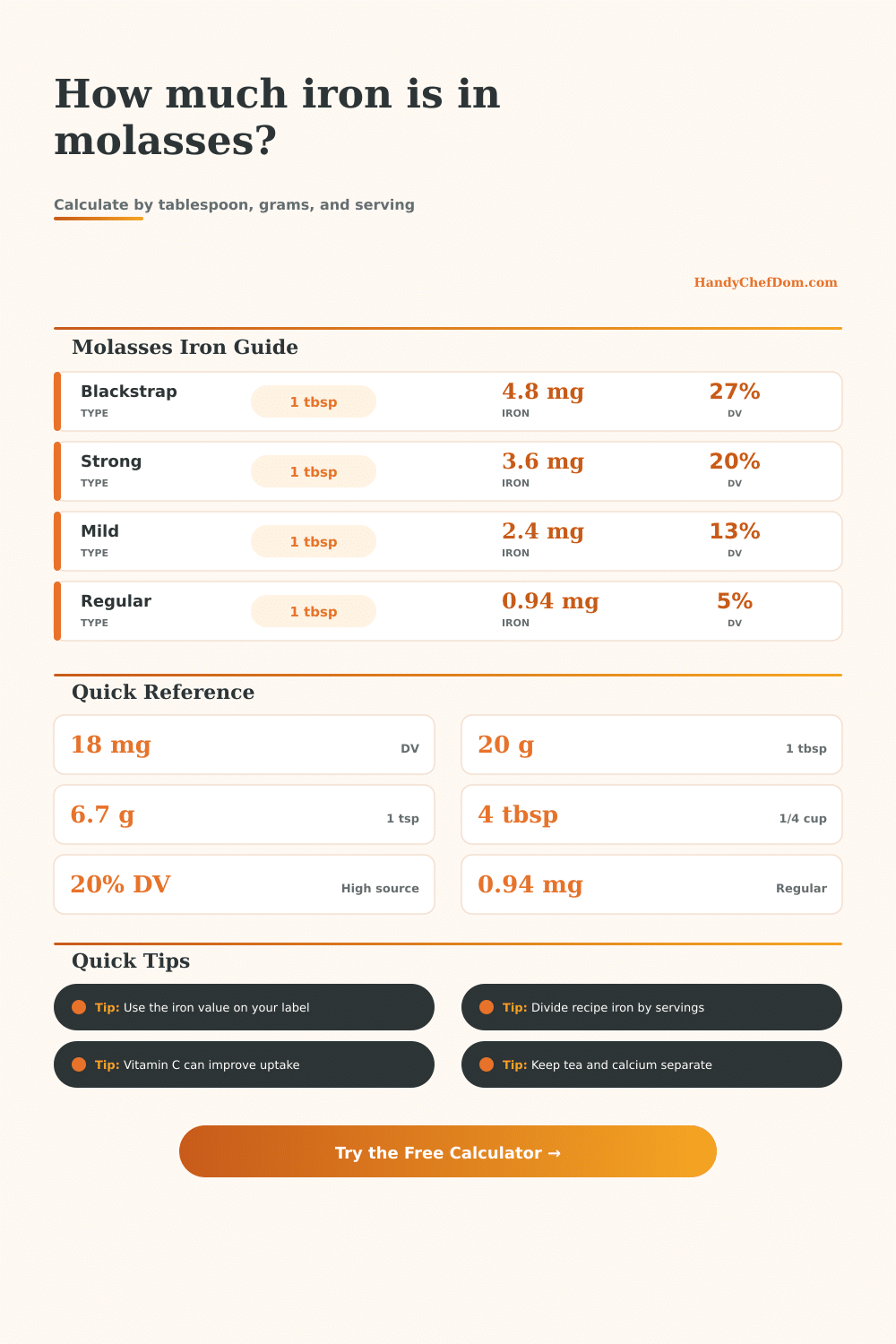
| Molasses Type | Iron / Tbsp | Iron / 100 g | Default Basis | Best Use |
|---|---|---|---|---|
| Blackstrap Label Average | 4.8 mg | 24.0 mg | Blackstrap nutrition label | Jar label estimate |
| Strong Blackstrap | 3.6 mg | 18.0 mg | Common high-iron labels | Conservative blackstrap |
| Mild Blackstrap | 2.4 mg | 12.0 mg | Lower label range | Light label estimate |
| Regular Molasses USDA | 0.94 mg | 4.72 mg | Standard molasses data | Non-blackstrap swap |
| Custom Label Value | User entry | Calculated | Your jar label | Most accurate |
| Kitchen Measure | Tbsp | Approx Grams | Blackstrap Iron | Regular Iron |
|---|---|---|---|---|
| 1 teaspoon | 0.33 | 6.7 g | 1.6 mg | 0.31 mg |
| 1 tablespoon | 1 | 20 g | 4.8 mg | 0.94 mg |
| 2 tablespoons | 2 | 40 g | 9.6 mg | 1.9 mg |
| 1/4 cup | 4 | 80 g | 19.2 mg | 3.8 mg |
| 1/3 cup | 5.33 | 107 g | 25.6 mg | 5.0 mg |
| 1/2 cup | 8 | 160 g | 38.4 mg | 7.6 mg |
| 1 cup | 16 | 320 g | 76.8 mg | 15.1 mg |
| Group | Target | Blackstrap Tbsp | Regular Tbsp | Calculator Setting |
|---|---|---|---|---|
| Adults 4+ Daily Value | 18 mg | 3.75 tbsp | 19.1 tbsp | DV Adults 4+ |
| Adult Men 19-50 | 8 mg | 1.67 tbsp | 8.5 tbsp | Adult Men / 51+ |
| Women 19-50 | 18 mg | 3.75 tbsp | 19.1 tbsp | Women 19-50 |
| Pregnancy | 27 mg | 5.63 tbsp | 28.7 tbsp | Pregnancy |
| Children 4-8 | 10 mg | 2.08 tbsp | 10.6 tbsp | Children 4-8 |
| Teen Girls 14-18 | 15 mg | 3.13 tbsp | 16.0 tbsp | Teen Girls |
| Use Case | Molasses | Servings | Iron / Batch | Iron / Serving |
|---|---|---|---|---|
| Oatmeal drizzle | 1 tsp | 1 | 1.6 mg | 1.6 mg |
| Smoothie boost | 1 tbsp | 1 | 4.8 mg | 4.8 mg |
| Gingerbread loaf | 1/4 cup | 10 | 19.2 mg | 1.9 mg |
| BBQ marinade | 2 tbsp | 6 | 9.6 mg | 1.6 mg |
| Bran muffins | 1/3 cup | 12 | 25.6 mg | 2.1 mg |
| Large bake batch | 1/2 cup | 16 | 38.4 mg | 2.4 mg |
| Scenario | Tbsp | Grams | Iron mg | % DV | Servings | Iron / Serving |
|---|
Blackstrap molasses gets a reputation for its healthfulness, so do you know why? You probably already know that blackstrap molasses are supposed to be good for you (and that’s partly because it’s got some iron in there). But what else give it this reputation? It certainly adds deep flavor to gingerbread, for starters. The dark color doesn’t tell the whole story.
Most people keep a bottle of iron on their counter, not because they particulary want it in their food but because it is one of the few supplements worth taking as something tasty, rather than something that tastes like a supplement at all. Knowing what kind of molasses you’re getting will help show whether you get any iron from it, as will understanding how your body process it.
Why Blackstrap Molasses Is Good For You
The calculator up top does the math for you so you can find out if your oatmeal-drizzle qualifies as part of your day’s requirements, or just a sweet afterthought. People often mistakenly believe all molasses is created equal, but they aren’t! Blackstrap is result of boiling down sugarcane juice three times: it removes almost all of the sugar, leaving only the mineral-rich residue (hence the iron).
Regular or mild molasses, on the other hand, still contains significant amounts of sugar and thus delivers very small amount of iron in return. A single tablespoon of Blackstrap will provide you with almost as much iron as 19 tablespoons of regular molasses. Huge difference! Make sure to look at the label before you assume your molasses is the powerhouse variety.
So: once you’re sure you’re consuming the real thing, what about absorption? Because the iron we get from plants (aka non-heme iron) doesn’t absorb as well into our bloodstreams than the iron in meat, there are things that assist our bodies’ ability to pull it in. That is why dietitians care about pairings so much; they matter more then most people think.
If you consume your molasses alongside something rich in vitamin C; such as a handful of berries or a squeeze of lemon; you’ll greatly increase your iron uptake. On the other hand, if you drink tea or coffee during said meal, you can block absorption almost entirely. You can account for those kinds of scenarios in the tool, which will adjust its results accordingly, and provide you with an estimate of how much of whatever you’ve swallowed is actualy being absorbed by your body.
The second complication is recipe scaling. One tablespoon doesn’t sound like much, until it’s one-half cup of marinade for the meat you’re braising or a batch of cookies to bake. Before you know it, you’ve gone way beyond what the recommendation allow, and there was no thought made for total volume. That’s where the batch serving size table on the page comes in. It explains how many servings in a batch, relative to each person, dilutes the per-person dose.
This gives you a chance to determine whether the iron is worth considering based off the needs of your diet. It converts abstract nutrition into concrete quantities you believe in. The need for iron vary dramatically from person to person. Adult males have very different targets than pregnant women; kids are something in-between. Using a one-size-fits-all daily value could confuse you.
You might think you is getting enough when you are actually falling short, or you might think you are falling short when you are actualy getting enough. Personalize the target in the calculator so it reflects the percentage values of what’s right for you. That means no more chasing after arbitrary numbers that don’t translate to your life stage.
And then one last thing: Remember that molasses is still sugar. Yes, there are minerals too. But even large amounts of minerals don’t cancel out the importance of moderation when it comes to carbohydrate. You’re going to get carbs and calories with all that mineral goodness. Adding energy density doesn’t take away the nutrition so be sure to watch your balance. Add a little iron without thinking it’s replacing everything else you eat.
And know that this isn’t necessarily your only source of iron; it’s just a good way to add some extra measure. Know how to use the mighty spoon in your cupboard, and know just what’s in it; and how to make it work for you. A single spoonful has much more power than many realize if used correctly.