🥤 Soft Drink Calculator for Party
Plan party soft drinks by guest count, event length, age mix, package size, flavor split, ice, cooler space, and leftover buffer.
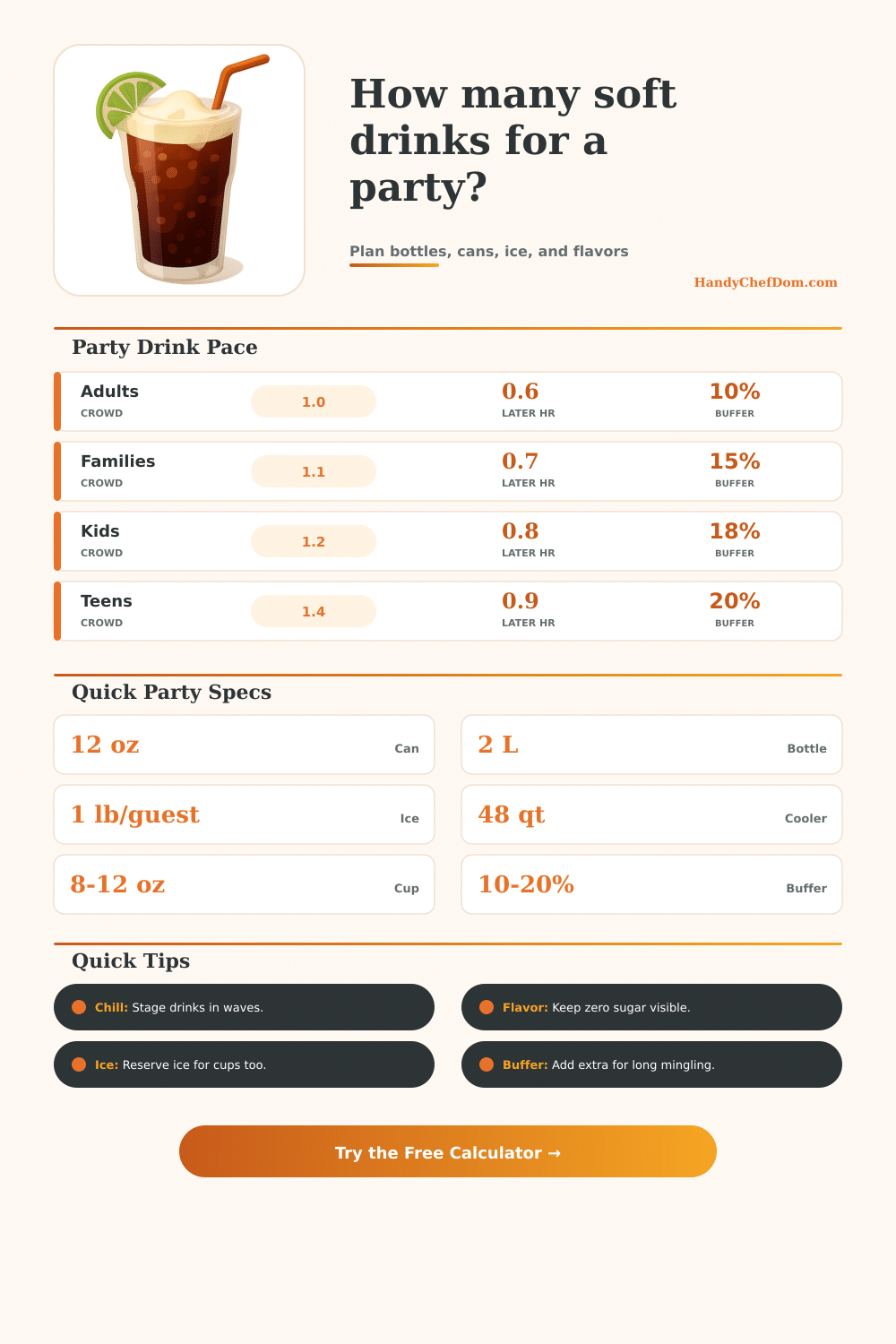
Use a serving pace that matches the party style. The calculator converts drink volume into containers, cold storage space, ice needs, and a flavor-by-flavor pull list.
| Party Style | Suggested Pace | Buffer | Planning Note |
|---|---|---|---|
| Short cake-and-gifts party | 0.45 to 0.65 servings/hr | 10% | Guests drink less when food time is brief. |
| Backyard meal or barbecue | 0.70 to 0.95 servings/hr | 15% | Warm air and salty food lift drink demand. |
| Kid-heavy birthday | 0.80 to 1.10 servings/hr | 18% | Small cups reduce waste while keeping refills easy. |
| Teen gaming or movie night | 0.90 to 1.20 servings/hr | 20% | Long snack windows usually need extra cola and citrus. |
| Open house reception | 0.50 to 0.75 servings/hr | 15% | Guests arrive in waves, so chill drinks in batches. |
| Mocktail-forward gathering | 0.85 to 1.15 servings/hr | 20% | Mixers and sparkling options move faster than plain soda. |
| Container | Fluid Ounces | Best For | Cooler Note |
|---|---|---|---|
| 7.5 oz mini can | 7.5 oz | Kids, dessert tables | More pieces, less leftover per guest. |
| 12 oz can | 12 oz | Casual meals | Stacks neatly in small coolers. |
| 16.9 oz bottle | 16.9 oz | Outdoor events | Resealable, but bulkier than cans. |
| 20 oz bottle | 20 oz | Long events | Good for individual grab-and-go service. |
| 1 liter bottle | 33.8 oz | Small table service | Needs cups and a visible pour station. |
| 2 liter bottle | 67.6 oz | Buffets, big groups | Efficient volume, more cup planning. |
| 1 gallon jug | 128 oz | Dispensers | Works best with labeled drink stations. |
| Flavor Plan | Cola | Citrus/Fruit | Zero/Sparkling |
|---|---|---|---|
| Classic cola-citrus-zero | 35% | 30% | 35% |
| Kid-bright fruity mix | 20% | 50% | 30% |
| Zero-sugar friendly | 25% | 20% | 55% |
| Mocktail mixer heavy | 15% | 25% | 60% |
| Caffeine-free family | 10% | 45% | 45% |
| Sparkling water plus soda | 20% | 20% | 60% |
| Cooler Size | Drink Fit | Ice Fit | Best Use |
|---|---|---|---|
| 24 qt tote cooler | About 24 cans | 8 to 10 lb | Small dessert table or backup drinks. |
| 48 qt rolling cooler | About 50 cans | 15 to 20 lb | Most family parties and cookouts. |
| 70 qt chest cooler | About 75 cans | 25 to 30 lb | Outdoor events with longer service. |
| 100 qt event cooler | About 110 cans | 35 to 45 lb | Large receptions or two drink zones. |
Drinks planning requires you to calculate the amount of liquid that you will need and the amount of ice that will be necesary for your guest drinks. You must consider many different factor in your planning because many different factors may affect how many drinks your guests will consume during your event. Some of those factor include the number of guests that will attend, the length of the event, the age of the guests, and the temperature of the environment in which the event will take place.
If you do not plan for these factors, you may either find that you do not have enough drinks to provide for all of your guests, or that you will have too many drink. The number of guests that will attend your event is one of the primary factor that you must consider in your planning for drinks. The length of the event is also a primary factor in drink planning.
How to Plan Drinks and Ice for an Event
It is common for guests to consume more drinks during the first two hours of an event than they do during the later hour of that event. The age of the guests can also impact the rate at which they consume the drinks. For instance, children may consume smaller amount of liquid than adults.
However, they may consume their drinks at a much higher rate. You can account for these factors in a calculator that you utilize in your planning for the event. Another factor to consider is the size of the drink packages.
For instance, twelve-ounce cans of drinks are common because they are easy to store and they chill quick. Two liter bottles contain more liquid than twelve ounce cans, however you must provide cups for the guests to fill with the drinks. Mini cans of drinks is useful in that they create less waste, but provide less liquid than other types of drink packages.
These factors can also be accounted for in the calculator. Another factor to consider is the amount of ice that is required for the drinks. The amount of ice that is required will depend upon the number of guest and the length of the event.
If the event is to occur in an outdoor area in a hot environment, more ice will be required for the drinks than if the event was to occur indoors in a cooler environment. Additionally, you must decide whether you will chill the packages in advance with ice or provide the ice for the guests to add to their drinks. The calculator will provide you with the total weight of the ice that will be required for the number of guests and the length of the event.
Another factor to consider for your event is the flavor of the drinks. You may offer packages with various flavors, such as cola, citrus flavors, or zero sugar drinks. Each flavor should be offered in amounts that will satisfy each guest and their preference for flavor.
If you offer too much of one flavor and not enough of another, some guests may not find a flavor that they enjoy. A calculator will determine how many containers of each flavor that you should purchase to account for the preferences of your guests. Another factor to consider is the cooler space that you have available for the drinks.
Even if you calculate the number of drinks that you require, you may not have enough cooler space to provide the drinks to your guests. You can calculate the number of guests that can be satisfied by the coolers that you have, and you can determine the percentage of the coolers that you would like to fill with ice. If you do not have enough cooler space for your guests drinks, you will have to rotate the drinks between the coolers in “waves.” This means that you will have some drinks that will be stored in a separate area, and that you will only fill the coolers with those drinks when the coolers have enough space for the drinks.
Events sometimes change once they have begun. Thus, you should plan for a buffer for your drinks. This provides for the fact that some guests may arrive later than you have estimated, or that there may be more guest than you estimated.
The weather for the event may also change, which may lead guests wanting to drink more liquid. A buffer for the drinks allows for these types of change to your event to be accounted for without having to guess how many drinks you will need in excess of the calculated amount. Providing for a buffer for the guests ensures that you have enough drinks for all of your guests, and that you have some extra drink left over for the next day.
The style of the event is another factor that can influence the rate at which the guests will consume the drinks. For instance, if the event will be short and may include gift presentations, guests will likely consume their drinks at a lower rate than guests who is attending a longer event that includes meals. You can account for the length of the event in tables that provide examples of the rate of consumption of different types of guests at events of varying lengths.
If your guests will drink more than the average group of guests, you should provide for this in your calculations. In summary, factors to consider when planning drinks for an event include the number of guests that will attend, the length of the event, the flavor of the drinks, the amount of ice that will be required for the drinks, the space in which the drinks will be stored in the coolers, and any buffers for the guests. Each of these factors can be accounted for in a calculator.
If you plan for these factors, you will find that you can provide enough drink to each guest throughout the entire event.