Chicken Pressure Cooker Time Calculator
Estimate pressure cooker chicken time by cut, weight, fresh or frozen start, bone-in style, pressure level, liquid depth, release method, and slice or shred target.
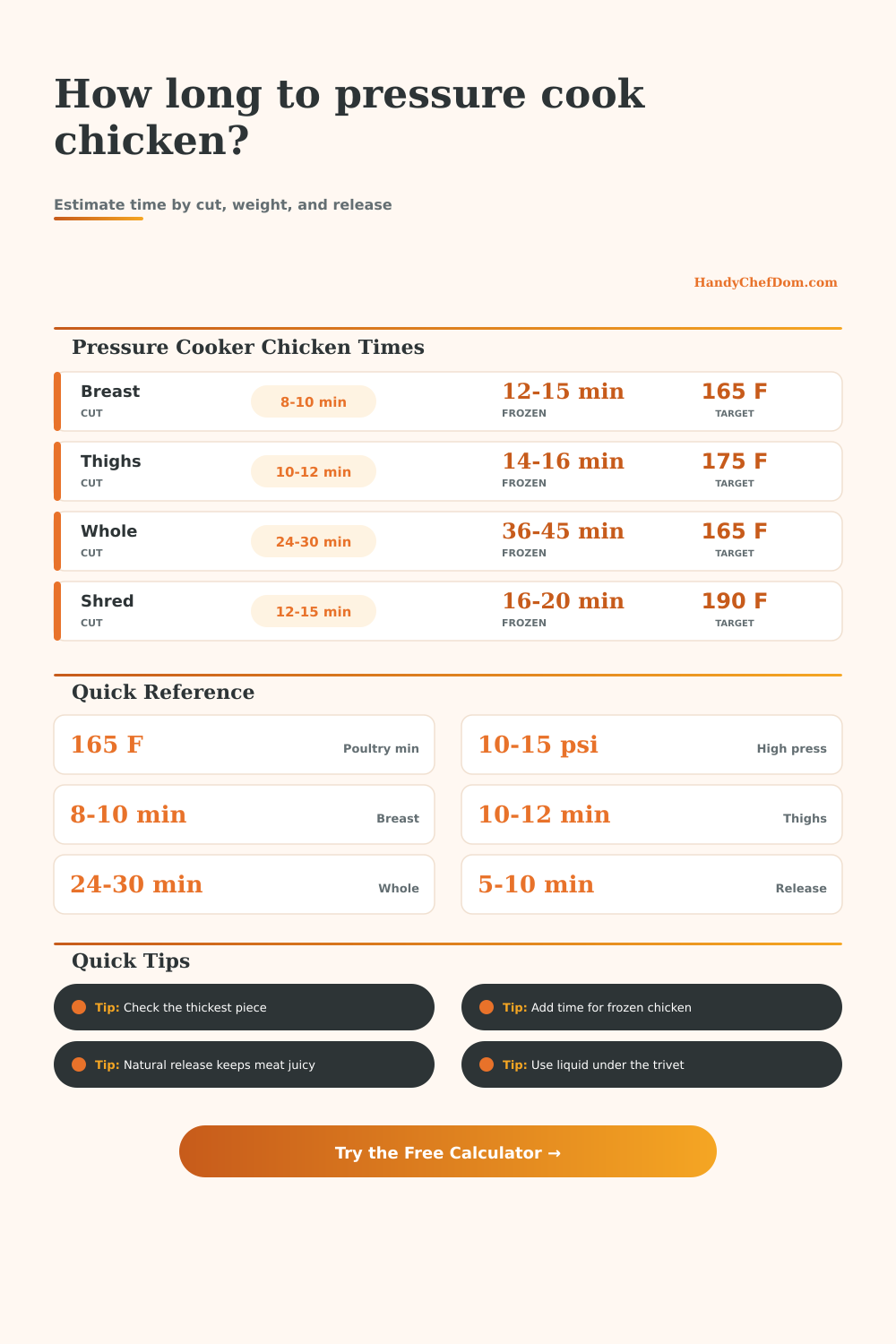
| Chicken Cut | Typical Weight | Fresh High Pressure | Frozen High Pressure | Best Release |
|---|---|---|---|---|
| Boneless chicken breast | 1 to 3 lb / 0.5 to 1.4 kg | 8 to 10 minutes | 12 to 15 minutes | 5 minute natural, then quick |
| Boneless chicken thighs | 1.5 to 4 lb / 0.7 to 1.8 kg | 10 to 12 minutes | 14 to 16 minutes | 5 to 10 minute natural |
| Bone-in thighs | 2 to 5 lb / 0.9 to 2.3 kg | 12 to 15 minutes | 16 to 20 minutes | 10 minute natural |
| Drumsticks | 2 to 4 lb / 0.9 to 1.8 kg | 10 to 14 minutes | 15 to 18 minutes | 5 to 10 minute natural |
| Mixed chicken pieces | 3 to 5 lb / 1.4 to 2.3 kg | 12 to 16 minutes | 18 to 22 minutes | 10 minute natural |
| Whole chicken | 3 to 5 lb / 1.4 to 2.3 kg | 24 to 35 minutes | 36 to 50 minutes | 10 minute natural or full natural |
| Input | Setting | Time Effect | Calculator Meaning |
|---|---|---|---|
| Starting state | Fresh or thawed | Baseline | Use normal cut timing |
| Starting state | Frozen single layer | Add 35 to 45 percent | Pieces are separate, not a solid block |
| Starting state | Frozen block | Add 60 to 80 percent | Use wider window and check carefully |
| Pressure level | Low pressure | Add about 25 percent | Gentler cooking but slower timing |
| Pressure level | Stovetop high | Reduce about 5 percent | Often reaches slightly higher pressure |
| Release method | Full natural release | Carryover cooking | Shortens pressure time slightly |
| Factor | Typical Range | Timing Effect | Yield Note |
|---|---|---|---|
| Liquid depth | 0.25 to 0.75 in / 0.6 to 2 cm | Baseline with required cooker liquid | Liquid is mostly pot steam source |
| Liquid depth | Over 1 in / 2.5 cm | Slightly more pressurize time | More liquid may dilute juices |
| Thin tenders | Under 1 lb / 0.5 kg | Short pressure time | Cooked yield about 78 percent |
| Breast pieces | 1 to 3 lb / 0.5 to 1.4 kg | Moderate timing | Cooked yield about 76 percent |
| Thighs and legs | 2 to 5 lb / 0.9 to 2.3 kg | Wider tender window | Cooked yield about 70 percent |
| Whole chicken | 3 to 5 lb / 1.4 to 2.3 kg | Longest pressure time | Cooked edible yield about 62 percent |
| Texture Target | Temperature Basis | Best Cuts | Calculator Adjustment |
|---|---|---|---|
| Slice or dice | 165°F / 74°C minimum | Breast, tenders, mixed pieces | Baseline pressure time |
| Tender dark meat | 175°F / 79°C preference | Thighs, drumsticks, wings | Adds a small tenderizing buffer |
| Shred | 185 to 195°F / 85 to 91°C | Breast, thighs, mixed pieces | Adds time for pull-apart fibers |
| Stock meat | Very tender texture | Bone-in pieces or whole bird | Adds a larger softening buffer |
| Scenario | Inputs | Pressure Time | Total Pot Time | Check Point |
|---|---|---|---|---|
| Weeknight breasts | 2 lb fresh breast, high pressure | 8 to 10 minutes | About 22 to 28 minutes | Thickest breast center |
| Frozen breast meal prep | 3 lb frozen single layer, high pressure | 13 to 16 minutes | About 32 to 40 minutes | Largest piece center |
| Shredded chicken | 3 lb breast, high pressure, shred target | 12 to 15 minutes | About 30 to 36 minutes | Fork-tender plus 165°F minimum |
| Bone-in thigh dinner | 3 lb bone-in thighs, high pressure | 13 to 16 minutes | About 31 to 38 minutes | Thickest thigh, away from bone |
| Small whole chicken | 4 lb whole chicken, high pressure | 28 to 34 minutes | About 50 to 65 minutes | Breast and thigh separately |
On Tuesday nights, this particular kind of nervousness grips me. I am buying frozen chicken breasts that must be dinner within next twenty minutes. I know there is a thin line between cooking them safely and cooking them right (turning your food into sawdust). Then there are the promises of speed made by pressure cooker, along with its need for precise timing. The timer isn’t a scientific variable, but a vague suggestion, like most folks use it; they’ll get a little more doneness, or a bit less, at their peril. What’s needed is something that accounts for variables not even considered in most recipes… And that’s what this thing up top do.
The second variable that catches people off guard as beginners is what state the meat starts out in. Cooking fresh chicken right out of fridge is one thing, but putting some ice cold blocks directly into a pot are quite another beast. To account for this, the calculator will adjust base time depending on if your chicken was in a solid block or thawed and cooked in a single layer. Whether it is a single layer or a block makes a difference because heat transfer more slowly when there is ice to melt within the muscle fibers before you can even begin cooking the actual protein. When going from frozen, you’re not just accounting for time during the cooking phase but also the thawing phase which occurs during pressure.
Why This Pressure Cooker Calculator Works
And then there’s the issue of release method, which most recipes don’t mention but that I think about. Using a quick release causes the pressure to immediately drop, halting the cooking process right then and there. A natural release allow the pressure to gradually decrease over the next five or even 10 minutes, continuing to cook meat gently instead of tightening it back up. So for example, if you’re slicing the breasts and serving them on sandwiches, a quick release prevents those breasts from getting tough. But if you’re making pulled chicken for tacos, letting it have a bit longer natural release will soften the connective tissue more. The total time estimate include all of these so you know what to expect when planning your sides.
You have to approach boneless cuts different than bones-in. Because the bone is an insulator, it slows down how quickly heat penetrates into meat itself. So you can end up with outside cooked through but the interior near the bone remain raw. To make up for this, the tool will add time to your selection if you choose items like bone-in drumsticks or thighs.
And then there’s the issue of desired texture. For example, hitting exactly 165 degrees Fahrenheit on a breast will slice nicely. For shredding for tacos or soup, you’ll often want it cooked nearer 190 degrees Fahrenheit so the collagen fully breaks down and meat just kind of falls off the bone. It is not a preference thing. It is a change in the protein structure that takes a certain amount of time to happen.
Finally there’s the nuance of liquid depth. Too little, generally less than a cup, and you won’t have enough to produce steam or raise pressure. However, too much will slow down heating time and also dilute flavors. I’ve included that as an input on the calculator so you can get a better idea of how long your water will take to come to pressure initially. That first rise will tack on ten to fifteen minutes onto your overall cooking time, which tends to be the surprise in meal-planning.
The bottom line is that while the calculator can be a useful tool for meal plans, it’s never a substitute for your food thermometer. Oven variance (and meat thickness) may throw things off a bit even if math is dead on. Until it is served, check the thickest part of the chicken with a trusty probe thermometer. It will keep things safe, and delicious.
Knowing what’s going into recipe makes the pressure cooker less of a black box and more of an instrument you use to perfection. You get tender, juicy chicken, every single time. Guess work? Stress? None of the above.