🧂 Salt per Pinch Calculator
Estimate how much salt is in one pinch or many pinches by pinch size, salt crystal density, teaspoon equivalent, sodium milligrams, recipe servings, and target recipe salt.
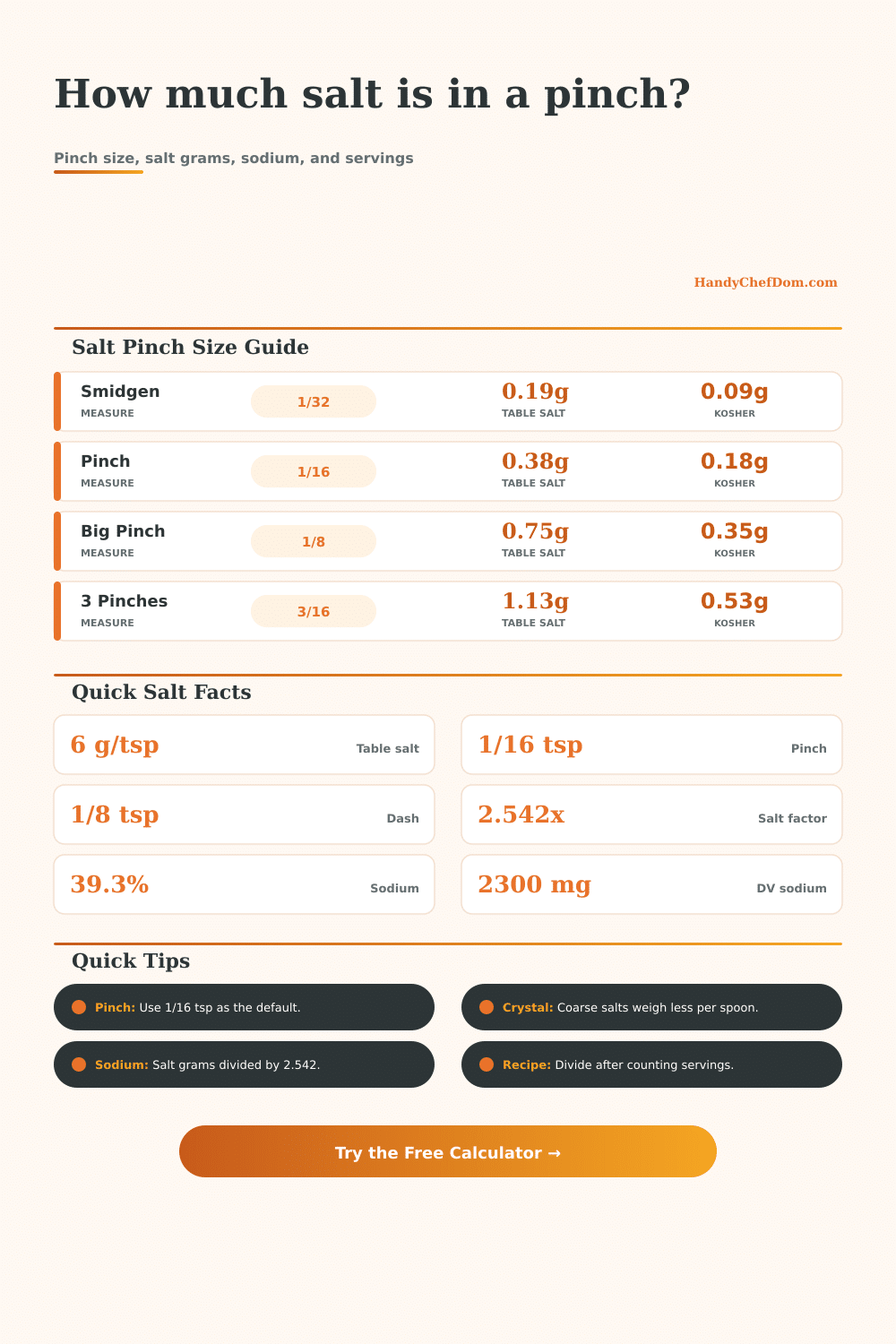
A practical kitchen pinch is often treated as 1/16 teaspoon, while a smidgen is about 1/32 teaspoon and a dash is about 1/8 teaspoon. The same spoon volume weighs very differently for table salt, kosher salt, coarse salt, and flaky salt.
Salt pinch results will appear here.
Weight for the selected salt type.
Useful for batch seasoning estimates.
Share of the target teaspoon line.
Based on 2300 mg daily value.
Fine crystals pack tightly, so a pinch weighs more.
Coarser crystals weigh less than table salt per volume.
Light flakes make a pinch much lower by weight.
Best treated as a finishing salt by volume.
| Kitchen measure | Teaspoon equivalent | Table salt weight | Sodium estimate | Calculator use |
|---|---|---|---|---|
| Smidgen | 1/32 tsp | About 0.19 g | About 74 mg | Tiny correction for delicate foods. |
| Small pinch | About 1/24 tsp | About 0.25 g | About 98 mg | Light seasoning between a smidgen and pinch. |
| Standard pinch | 1/16 tsp | About 0.38 g | About 148 mg | Default pinch estimate for this calculator. |
| Chef pinch | About 1/12 tsp | About 0.50 g | About 197 mg | Common two- or three-finger generous pinch. |
| Dash or big pinch | 1/8 tsp | About 0.75 g | About 295 mg | Large adjustment close to a dash. |
| Salt type | Approx grams per teaspoon | Salt in 1/16 tsp | Sodium in 1/16 tsp | How to read it |
|---|---|---|---|---|
| Table salt, fine crystals | 6.0 g/tsp | 0.38 g | 148 mg | Reference point; one teaspoon table salt is about 6 g. |
| Fine sea salt | 5.8 g/tsp | 0.36 g | 143 mg | Close to table salt when crystals are fine. |
| Fine pink Himalayan salt | 5.7 g/tsp | 0.36 g | 140 mg | Use custom density if the crystals are coarse. |
| Morton kosher salt | 4.8 g/tsp | 0.30 g | 118 mg | Coarser than table salt but still fairly dense. |
| Diamond Crystal kosher salt | 2.8 g/tsp | 0.18 g | 69 mg | Lighter flakes mean less salt by weight per pinch. |
| Coarse sea salt | 4.5 g/tsp | 0.28 g | 111 mg | Large crystals can vary by grind size. |
| Flaky finishing salt | 1.8 g/tsp | 0.11 g | 44 mg | Very light by volume, best for finishing. |
| Pinch count | Standard pinch volume | Table salt grams | Diamond kosher grams | Recipe equivalent |
|---|---|---|---|---|
| 1 pinch | 1/16 tsp | 0.38 g | 0.18 g | Small final adjustment. |
| 2 pinches | 1/8 tsp | 0.75 g | 0.35 g | About one dash by volume. |
| 3 pinches | 3/16 tsp | 1.13 g | 0.53 g | Close to 1/4 tsp by feel. |
| 4 pinches | 1/4 tsp | 1.50 g | 0.70 g | Common recipe salt increment. |
| 8 pinches | 1/2 tsp | 3.00 g | 1.40 g | Large batch adjustment. |
| Salt amount | Sodium math | Sodium estimate | If split 4 servings | Planning note |
|---|---|---|---|---|
| 0.25 g salt | 0.25 g / 2.542 | 98 mg sodium | 25 mg each | Small pinch of fine salt. |
| 0.38 g salt | 0.38 g / 2.542 | 148 mg sodium | 37 mg each | Standard table salt pinch. |
| 0.75 g salt | 0.75 g / 2.542 | 295 mg sodium | 74 mg each | Dash or two pinches. |
| 1.50 g salt | 1.50 g / 2.542 | 590 mg sodium | 148 mg each | About 1/4 tsp table salt. |
| 6.00 g salt | 6.00 g / 2.542 | 2360 mg sodium | 590 mg each | About 1 tsp table salt. |
What’s this? You’ve likely encountered a recipe that calls for a pinch of salt with no clarification as to which salt. It seems like just an innocent guess until you cook it and find it is too bland or too salty. In fact, there is a big difference. A pinch are a volume measurement, but the weight we measure (sodium) doesn’t usually match it. Depending on what’s in your shaker, those two measurements (volume vs). Weight, are rarely in sync. Flaky finishing salts or coarse kosher flakes takes up lots of air spaces in the same volume; fine table salt crystals cram tightly into that little nook between your fingers. That makes a big difference in how much actual sodium gets deposited in whatever you’re cooking. Get this part right, and you’ll cook differently, seasoning with a new appreciation for these differences.
What’s considered “a good pinch” in most cases? It is one-sixteenth of a teaspoon, though it is also fine to convert that into real amounts. When I use fine table salt; which is what that little amount weighs like; it’s almost 400 milligrams by weight, and about 150 milligrams of sodium. Compare this to using Diamond Crystal kosher salt with the same pinch volume. The individual crystals is larger and lighter in weight. They actualy weigh far less, even though your hand gesture was exactly the same. This delivers much less sodium to the pot. That’s why cooking from recipe to recipe and brand to brand can feel all over the map if you don’t account for those amounts.
Why Volume and Weight Are Different for Salt
Once you decide what type of salt you’re using and what pinch size, the calculator does the math for you (on this page). It’s designed to help you see how a pinch scales up when batch-cooking. You can choose between presets for three kosher pinches or a single table pinch. And it translates those vague hand gestures into something tangible: milligrams of sodium and grams of salt, accounting for the variation in crystal density that most home cooks overlook. It can even take your recipe servings as an input. This helps you understand the amount of sodium in the whole pot and how much is in each individual serving.
The secret ingredient is the density of crystals. A teaspoon of table salt contains roughly six grams of salt since its granules are all similar in size and shape. Because kosher salt has varying flake sizes from brand to brand, it can range from something like three grams per teaspoon for the same volume. Flaky finishing salts is even lighter. If you use a “pinch” of iodized table salt but use that same “pinch” volume for sea salt flakes, you’ll be underseasoning your dish by a lot. These differences in weight are pictured side-by-side in the reference tables so you can see why changing salts without accounting for this will ruin your dish.
There’s also the issue of being thrown off by intuition. When it comes to converting salt weight into sodium, we can’t trust our gut. A pinch doesn’t seem like much. A teaspoon seems like nothing. But if you’re making food for yourself or a loved one concerned with their blood pressure, knowing how many grams of sodium you have is important. You know that salt is ~40% sodium by weight. So divide your overall number of grams by about 2.5. Why? Because every time you take a pinch, you’ve added maybe 50mg of sodium towards one hundred milligrams of sodium per serving in your four-serving dish. In sauce, soup, or anywhere else where there’s a lot of liquid and the taste of each individual grain is masked, this compounds even faster.
When it comes to practical seasoning, we need to separate our volume habits from the weight reality. Perhaps you’ve got a trained eye for how much salt “looks” like enough to sprinkle into some boiling pasta water. However, that visual doesn’t account for the fact that you switched brands of salt at the grocery store last week. A standardized conversion bridges this gap. It lets you tailor pinch sizes and densities. You might grab more or less than typical definitions call for, depending on your particular brand of specialty salt or the size of your hands! This means the numbers will better reflect your own kitchen reality instead of a textbook average.
The secret, though, is knowing what is really being measured. A pinch is an action, but salt weight is the consequence. But if you begin to frame your seasonings in terms of serving size and density, suddenly you’re controlling flavors that have always seemed random. You no longer guess as to whether it’s been dosed correctly by adding too big a pinch or too small a one. Because now you can be sure there are exactly this many milligrams in the pan. It turns vague directions into exact science while maintaining the art of the kitchen.
So ultimately, knowledge of your shaker’s contents and their behavior in weight vs volume leads to better seasoning. Until you measure a pinch of something it’s just that, a pinch, and once you do you have data you can rely on. Start by measuring your current salt and using those numbers to adjust your pinching hand gestures so they are consistent every time. That awareness transforms an easy pinch into a dependable tool instead of a roll of the dice.