🦌 Venison to Pork Ratio Calculator
Calculate venison, pork fat or pork shoulder, target sausage fat percentage, finished batch size, grind loss, salt, binder, ice water, and seasoning scaling.
Choose a real sausage style, then adjust the pork source. Pork shoulder alone may be too lean for rich venison sausage, so the calculator checks whether the selected pork can actually reach your target fat.
Best for snack sticks, meatballs, and blends that need a leaner bite.
Good all-purpose venison grind for patties and simple fresh sausage.
Common target for links when venison is very lean.
Richer breakfast style with a tender bite and more pork character.
| Sausage style | Venison to pork ratio | Target fat | Best pork source |
|---|---|---|---|
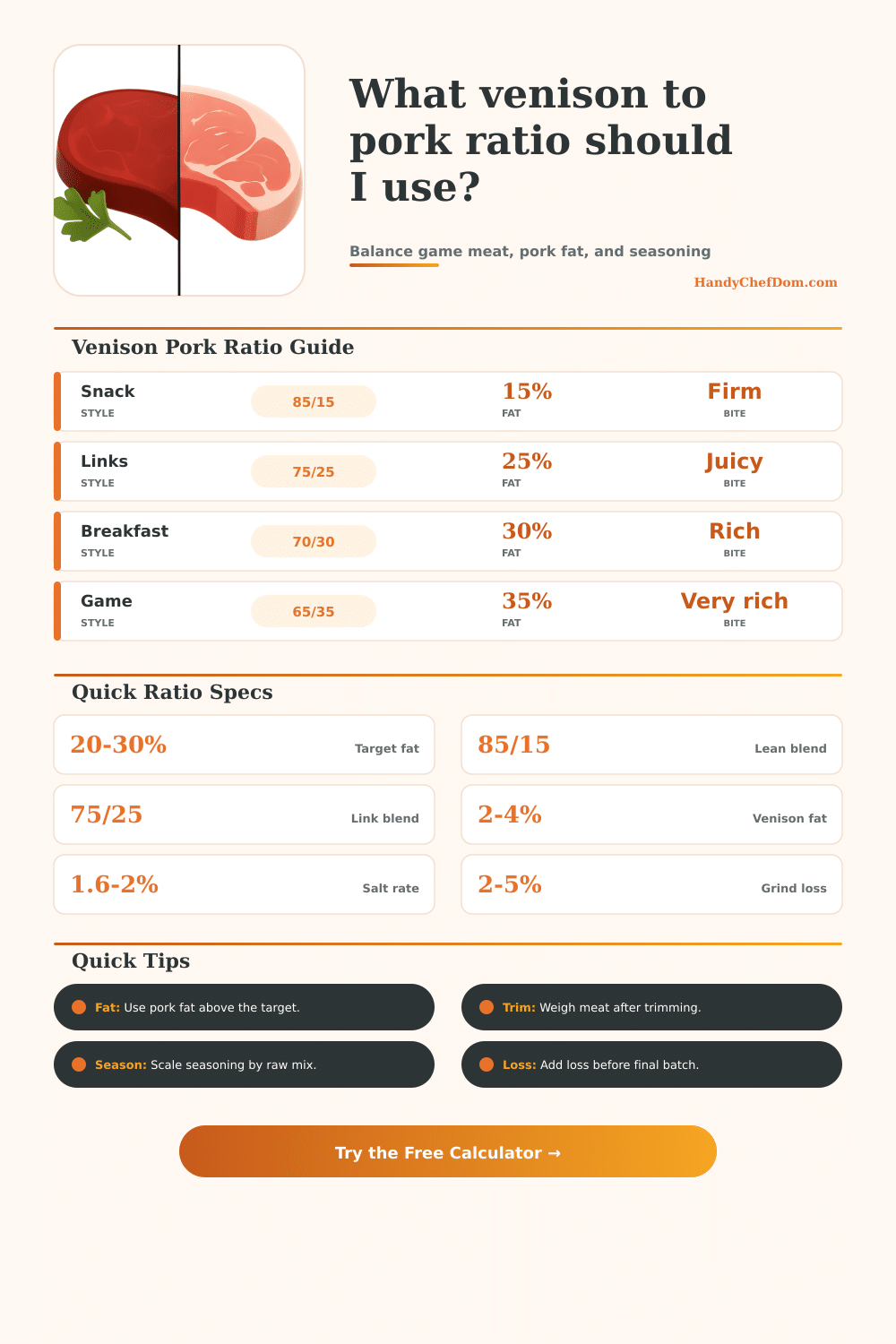
| Snack sticks or lean grind | 85% venison / 15% pork | 14% to 16% | Pork belly or fatty trim |
| Venison burger blend | 80% venison / 20% pork | 18% to 22% | Pork belly or shoulder-fat blend |
| Italian or smoked links | 75% venison / 25% pork | 23% to 26% | Fatty trim or belly |
| Brat-style game links | 72% venison / 28% pork | 27% to 29% | Fatty trim, belly, or back fat blend |
| Breakfast patties | 70% venison / 30% pork | 28% to 32% | Belly or back fat blend |
| Rich game sausage | 65% venison / 35% pork | 33% to 36% | Fatty trim or back fat blend |
| Pork source | Assumed fat | Works best for | Ratio note |
|---|---|---|---|
| Pork back fat | 85% to 95% | Precise fat correction | Small additions change fat quickly |
| Fatty pork trim | 65% to 80% | Classic game sausage | Good when targeting 25% to 35% fat |
| Pork belly | 45% to 60% | Juicy links and patties | Adds pork flavor plus fat |
| Shoulder plus fat blend | 35% to 45% | Balanced links | Useful for 20% to 30% targets |
| Pork shoulder | 18% to 28% | Lean burgers or mild blends | May be too lean for rich sausage |
| Lean shoulder | 12% to 20% | Firm meatballs | Often needs extra back fat |
| Finished batch | Lean 85/15 | Classic 75/25 | Breakfast 70/30 |
|---|---|---|---|
| 5 lb finished | 4.4 lb venison / 0.8 lb pork | 3.9 lb venison / 1.3 lb pork | 3.6 lb venison / 1.5 lb pork |
| 10 lb finished | 8.8 lb venison / 1.5 lb pork | 7.7 lb venison / 2.6 lb pork | 7.2 lb venison / 3.1 lb pork |
| 15 lb finished | 13.1 lb venison / 2.3 lb pork | 11.6 lb venison / 3.9 lb pork | 10.8 lb venison / 4.6 lb pork |
| 25 lb finished | 21.9 lb venison / 3.9 lb pork | 19.3 lb venison / 6.4 lb pork | 18.0 lb venison / 7.7 lb pork |
| 50 lb finished | 43.8 lb venison / 7.7 lb pork | 38.6 lb venison / 12.9 lb pork | 36.1 lb venison / 15.5 lb pork |
| Add-in | Typical rate | Per 10 lb raw mix | Calculator use |
|---|---|---|---|
| Salt | 1.6% to 2.0% | 2.6 to 3.2 oz | Flavor and protein extraction |
| Dry seasoning | 0.8% to 2.5% | 1.3 to 4.0 oz | Spice blend scaling |
| Binder | 1% to 3% | 1.6 to 4.8 oz | Optional texture support |
| Ice water | 3% to 8% | 4.8 to 12.8 oz | Cold mixing liquid |
| Grind loss | 2% to 5% | 0.2 to 0.5 lb | Extra raw mix before stuffing |
This calculator is for fresh grinding and batch scaling. It does not replace tested curing formulas, fermentation controls, or recipe-specific process instructions.
Making sausage from venison require that you find a balance between the amount of venison and the amount of pork that is use in the sausage. Venison have a very low fat content, and therefore will become dry and crumbly if there isnt enough pork to provide moisture to the venison. Too much pork, however, will overpower the flavor of the venison.
The fat percentage of the sausage, which you must decide prior to begin the recipe, will affect the fat content and the moisture levels of the sausage. The type of pork that you use will also affect the fat percentage of the sausages. Pork back fat is almost all fat, while pork belly contain both fat and lean meat.
How to Make Juicy Venison Sausage
Pork shoulder is common and available in many butcher shop, but contains only twenty-five percent fat. Depending off the target fat percentage of the sausages, pork shoulder may not contain enough fat to achieve that percentage. Loss of meat occur during the sausage making process.
The meat may stick to the grinder, the stuffer, or it may remain in the mixing bowl. Three to five percent of the total weight of the raw sausages must be allowed for this loss of meat. The salt and seasonings percentages should be calculated based on the total weight of the raw venison and pork mixture prior to loss of meat.
Calculating these percentages ensure that the seasoning of the sausage will be consistent. Ice water and a binder may also be added to the meat mixture. Adding ice water will keep the mixture cold during the grinding process.
Cold meat will allow the fat to remain in distinct particle within the sausage. Additionally, adding a binder such as milk powder will allow the mixture to retain more moisture. Both the ice water and the binder should be measured according to the total weight of the raw meat mixture prior to grinding.
Because both the fat content of the venison and the pork may vary from batch to batch, the fat content of the sausages may also vary. The fat content of the venison may differ with the specific animal from which the venison was sourced. Additionally, the fat content of pork shoulder may differ according to the supplier of that pork.
To account for these variations in fat percentages, it is recommended that you create a test patty from the same ingredients that you will use to produce the sausages. Tasting this test patty will allow you to ensure that the fat and seasoning percentage are correct. Common mistake in the making of sausages may include not accounting for all of the variables that affect the ingredients.
For example, individuals may use a specific weight of venison, but then add pork without considering whether that pork contain enough fat. Additionally, individuals may create the desired batch size for the sausages, but fail to account for the loss of meat during the sausage making process. Finally, the salt and seasonings may be calculated for only a small batch size of sausages, but not be adjusted according to the recipe calculation for larger batch size.
To successfully create sausages, begin by weighing the amount of trimmed venison. Based off the amount of venison that is weighed, select a pork with a higher fat percentage then the target fat percentage for the sausages. Use a sausage recipe calculator to calculate the weight of the pork, the amount of salt, the amount of seasoning, the amount of binder, and the amount of ice water that should of be added to the venison and pork mixture.
By following these steps, and maintaining the correct ratio of venison to pork, the sausages will hold their shape and remain juicy. Maintaining the correct ratio of fat to protein will ensure that those who consume the sausages experience the venison flavor, as well as that the texture of the sausages will be correct.