🍪 Vanilla Extract Alcohol Calculator
Estimate vanilla extract alcohol from teaspoons, tablespoons, milliliters, ABV, servings, batch size, flavoring type, and bake or simmer reduction.
Use the amount of vanilla extract in the whole recipe before dividing into servings. Alcohol is estimated from extract volume times ABV, then adjusted by the selected heating reduction.
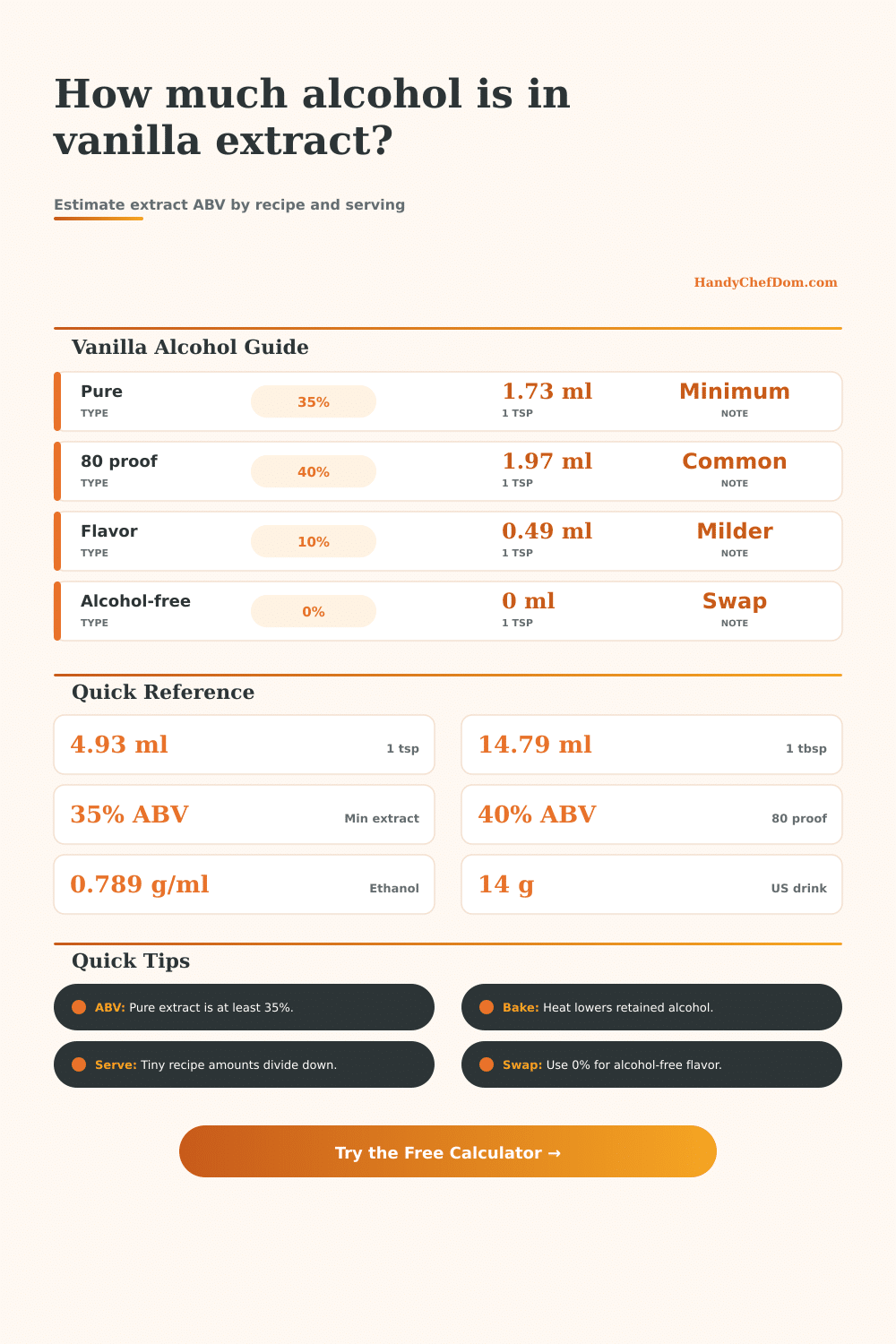
| Vanilla type | Typical ABV | Alcohol in 1 tsp | Calculator note |
|---|---|---|---|
| Pure vanilla extract minimum | 35% | 1.73 ml ethanol | Meets the common extract identity threshold. |
| 80 proof vanilla extract | 40% | 1.97 ml ethanol | Common for homemade extract made with 80 proof alcohol. |
| 100 proof vanilla extract | 50% | 2.46 ml ethanol | Higher alcohol strength and stronger ethanol estimate. |
| Double fold vanilla extract | 35% | 1.73 ml ethanol | Concentrated flavor does not require higher ABV. |
| Vanilla flavoring | Under 35% | Varies by label | Use custom ABV when the label provides a value. |
| Alcohol-free vanilla flavor | 0% | 0 ml ethanol | Use for zero-alcohol recipe calculations. |
| Extract measure | Teaspoons | Tablespoons | Milliliters |
|---|---|---|---|
| Small splash | 1/2 tsp | 0.17 tbsp | 2.46 ml |
| Common recipe spoon | 1 tsp | 0.33 tbsp | 4.93 ml |
| Standard cake amount | 2 tsp | 0.67 tbsp | 9.86 ml |
| One tablespoon | 3 tsp | 1 tbsp | 14.79 ml |
| Double batch measure | 4 tsp | 1.33 tbsp | 19.72 ml |
| Large batch measure | 6 tsp | 2 tbsp | 29.57 ml |
| Recipe handling | Retention preset | Reduction | Best input choice |
|---|---|---|---|
| No heat frosting, cream, drink | 100% | 0% removed | No heat - frosting or drink |
| Brief warm mixing | 85% | 15% removed | Brief warm mixing |
| Short bake or quick pan heat | 65% | 35% removed | Short bake |
| Standard bake | 40% | 60% removed | Standard bake |
| Long bake or uncovered cooking | 25% | 75% removed | Long bake |
| Long simmer | 15% | 85% removed | Long simmer |
| Recipe scenario | Extract | Servings | Per-serving note at 35% |
|---|---|---|---|
| Frosting bowl | 1 tsp | 12 | About 0.11 g ethanol if unheated. |
| Layer cake batter | 2 tsp | 12 | About 0.09 g retained after standard bake. |
| Cookie tray | 2 tsp | 24 | About 0.04 g retained after standard bake. |
| Custard saucepan | 2 tsp | 8 | About 0.12 g retained after gentle simmer. |
| Ice cream base | 3 tsp | 8 | About 0.51 g ethanol if unheated. |
| Holiday triple batch | 6 tsp | 36 | About 0.06 g retained after standard bake. |
When pouring vanilla extract into cake batter, it’s almost autopilot. Sure, it’s the go-to way to bring warmth to a sweet dough but unless you’ve thought hard about it, you probably haven’t considered exactly what else goes in that bottle. What’s in your pantry is actualy an alcohol solution, and knowing its chemistry can make all the difference when it comes time to bake.
No, you’re unlikely to get tipsy off a slice of carrot cake, but how much ethanol remain in the final product once it’s cooked depends on more than just amount of vanilla you started with. You can crunch the numbers yourself with the calculator above. But understanding what they mean is more important then committing them to memory.
The Truth About Alcohol in Vanilla Extract
According to federal regulation, pure vanilla extract has to be at least thirty-five percent alcohol by volume (which means that even if you’re using 80-proof liquor, you’re starting with a concentration of about forty percent). Alcohol isn’t just the way those flavorful compounds gets from bean to bottle; it is also what pulls the compounds out in the first place. In other words, alcohol act as the solvent that pulls those aromatic compounds out of the bean. If your concoction were to lack any alcohol, you’d basically just be mixing some sugar syrup into your cake batter.
Commercial vanilla extracts generaly float around this thirty-five percent benchmark; homemade types tend to use 80-proof vodka, which increases the percentage to forty percent. A difference of only five percent, sure, but that’s enough to greatly change total amount of ethanol present prior to any heating.
Now we get into the juicy part: heat. It’s tempting for many cooks to think that the oven will burn away all the alcohol in an instant during baking, but nope. How much alcohol remain has a lot to do with both temperature and time. If you mix up a frosting cold, there isn’t any fuel for the evaporation process to use, meaning that almost every last drop stays the same as what was originally there.
When cooking something on the stovetop; say, a custard; it’ll lose quite a bit of its ethanol as the water evaporate along with it. This is also why a cookie baked quickly may have more residual alcohol compared to a slow-roasting cake; less time means more leftover booze. That’s why “baked” doesn’t necessarily equal “no alcohol,” as far as this tool is concerned. Its retention percentages takes these situations into account, and thus, you’ll be able to see that when you bake something, it won’t be completely free of booze.
Now things get complicated. When you scale a batch, you also scale the recipes. If you double the recipe to make enough for your holiday party, sure, all the extract is doubled. But how much of it does each serving contain? Surprisingly, not very much. That same amount of ethanol divided among two dozen cupcake means each gets diluted considerably. And this is where per-serving calculations becomes important for people who need to avoid alcohol because of their religion or other dietary needs.
Because we’re talking about such a large quantity of flour and fat, the ethanol isn’t concentrated. Even though there’s more absolute volume in the pot, concentration per serving isn’t as high. It is a tiny amount, but when precision matters, that small amount matters.
Alcohol-free substitutes bring their oddities into the equation. Glycerin- or propylene glycol-based vanilla substitutes (which do contain some ethyl alcohol, though) aren’t just less-flavorful versions of the ethanol-laced real deal; they’re solvents rather than alcohols, which can affect an emulsion’s behavior and occasionally give it a slightly sweeter quality or different mouthfeel from straight extract. When you substitute with one of these, you’ll get the obvious jump to zero on the alcohol scale, but keep an eye out for how the texture behave when used delicately in frostings, for instance. The calculator makes it easy to swap back and forth between regular extract and these zero proof/low-alcohol varieties, so you can see what the effect will be without having to guess.
In the end, vanilla’s all about balancing flavor. The goal is to use just enough extract so you taste the bean, but not so much that the harsh alcohol burn overpowers your senses. If you mix vanilla into a batch of raw batter, knowing how sensitive it is to temperature will help you gauge your pouring. This matters if you add the vanilla at the very end of the baking process instead of when it is hot in the oven. Regardless of whether you’re crafting a moist chocolate loaf or a light-as-air sponge cake, the reasoning applies: Measure what you want, consider how you’ll do it, and hope the math matches your tastebuds.