🐟 Salmon Fillet Protein Calculator
Estimate protein, calories, fat, and omega-3 for individual salmon fillets by ounces or grams, skin style, cooked yield, and servings.
Use a raw fillet weight when you have it. If you only have cooked salmon, choose cooked total weight so the calculator can estimate the raw fillet equivalent from yield.
| Fillet label | Protein per 100 g | Calories per 100 g | Fat per 100 g | Omega-3 per 100 g |
|---|---|---|---|---|
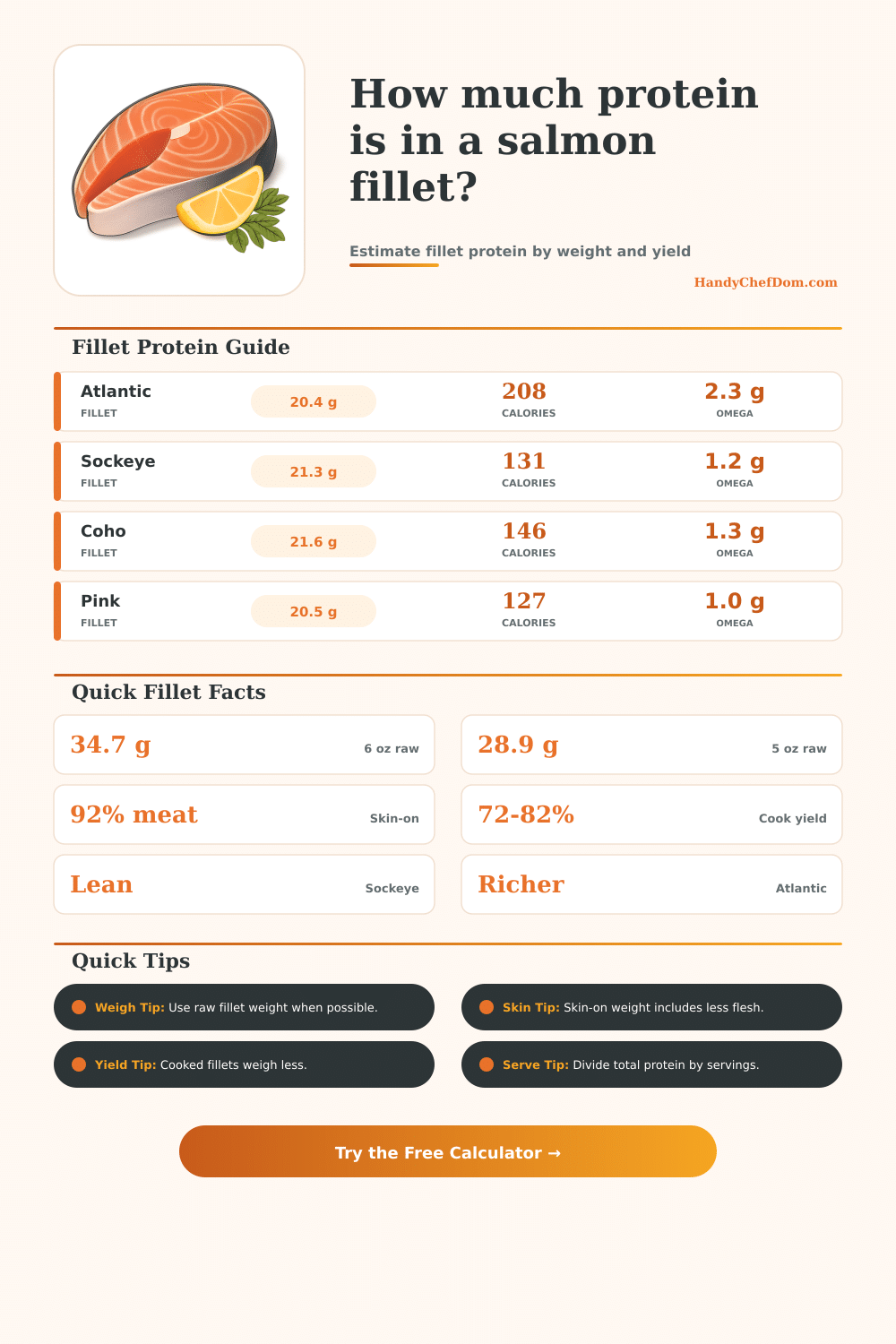
| Atlantic farmed fillet | 20.4 g | 208 kcal | 13.4 g | 2.3 g |
| Center-cut Atlantic fillet | 20.8 g | 212 kcal | 13.8 g | 2.4 g |
| Wild sockeye fillet | 21.3 g | 131 kcal | 4.7 g | 1.2 g |
| Wild coho fillet | 21.6 g | 146 kcal | 5.9 g | 1.3 g |
| King or Chinook fillet | 19.9 g | 179 kcal | 10.4 g | 1.7 g |
| Pink salmon fillet | 20.5 g | 127 kcal | 4.4 g | 1.0 g |
| Keta or chum fillet | 20.1 g | 120 kcal | 3.8 g | 0.9 g |
| Wild mixed salmon fillet | 20.9 g | 145 kcal | 5.8 g | 1.2 g |
| Fillet condition | Protein calculation factor | Cooked yield range | What changes |
|---|---|---|---|
| Skinless raw fillet | 100% flesh weight | 72-82% | Best direct protein estimate |
| Skin-on raw fillet | 92% flesh weight | 70-80% | Skin weight is not counted as flesh protein |
| Cooked total weight | Back-calculated raw equivalent | Use actual yield | Protein density rises as water leaves |
| Individual fillets | Weight multiplied by count | Same as entered | Best for meal prep trays |
| Total package weight | Single raw total | Same as entered | Best for one large side or tray pack |
| Raw fillet size | Approx raw grams | Atlantic protein | Sockeye protein | Typical serving use |
|---|---|---|---|---|
| 4 oz fillet | 113 g | 22.7 g | 23.7 g | Light lunch fillet |
| 5 oz fillet | 142 g | 28.4 g | 29.6 g | Meal prep fillet |
| 6 oz fillet | 170 g | 34.0 g | 35.5 g | Dinner fillet |
| 7 oz fillet | 198 g | 39.7 g | 41.4 g | Large entree fillet |
| 8 oz fillet | 227 g | 45.4 g | 47.3 g | Big portion fillet |
| Fillet plan | Count | Raw size each | Total raw weight | Protein note |
|---|---|---|---|---|
| Couple dinner | 2 fillets | 6 oz | 12 oz | About 68 g Atlantic protein |
| Family dinner | 4 fillets | 6 oz | 24 oz | About 136 g Atlantic protein |
| Meal prep | 6 fillets | 5 oz | 30 oz | About 170 g Atlantic protein |
| Large tray | 8 fillets | 5.5 oz | 44 oz | About 249 g Atlantic protein |
| Party tray | 12 fillets | 4 oz | 48 oz | About 272 g Atlantic protein |
There’s no guessing about food prep; you can put a raw salmon fillet on the scale and use the calculator to turn that weight into actual nutrition. Out come the tweezers, and then comes the seasoning (salt and pepper). What happens next? A number appears on the scale, the raw weight; and now it becomes meaningful. You couldn’t eat it before but now it translates into nutrition.
And there’s where most home cook fall down: they don’t understand that what the scale say isn’t necessarily how much you just ate. Some of the water has evaporated; some of the fat has rendered away. The dense protein-rich meat on your plate have more protein per ounce than the raw flesh from which it came. Knowing the weight changed is what lets you know how much you’ve eaten. You plug in the specifics about your fillets and let the calculator do the rest. No need to guess at any coefficients.
How to Measure Salmon Nutrition Correctly
“First, it prompts for species,” they explain because not all salmon are created equal. Farmed Atlantic salmon is fattier and have fewer calories per gram than its leaner cousins, like wild sockeye or pink salmon. This could make a difference if you’re really monitoring your macros. At first glance, you might think a six-ounce cut of lean Keta will offer similar amounts of protein as a six-ounce cut of fatty chinook king salmon, but it won’t offer up the same amount of fats or energy. For that reason, the app taps into an internal database of nutrition profiles that include those details. Simply choose the label based off your grocery store receipt.
Now we get to the skin, and here’s where things go awry in the name of accuracy. Did you include weight of the skin when weighing the fish? What you’re eating if you weigh your fish with the skin on is scales and heavy connective tissue. So when you punch in that weight, does it includes the weight of the skin? Because if not, the calculator will subtract out the weight of the skin from its estimated count of edible flesh. To estimate amount of meat in the fillet, the program takes off about 92 percent of what you see to account for scale and connective tissue. This matches expected culinary yields for such a cut.
Next, you key in the weight (or weights) of the fish, how many fillets, and what size portions you want to break those fillets down into. Then the computer multiplies by a suitable cooked yield factor. By default, that’ll be roughly seventy-eight percent but you can override the setting if you’d like to use something else. This accounts for amount of water that evaporates when you cook the protein. But when that fish ends up on your table, the texture isn’t going to be the same, because cooking also affects weight: Salmon muscle fiber tightens as it cooks, squeezing water out of the flesh. A cooked fillet, so, will weigh less then it did before cooking. This yield is the basis for the tool’s worked-out estimate of how your portion will appear at the end of the journey from fridge to fork.
It will tell you precisely how many grams of protein remain on the journey from fridge to fork. And it accounts for loss of omegas (because heat affects fat, causing it to melt slightly during cooking). Because these little losses accumulate over a week’s worth of meal prep, it help provide a more accurate picture of what nutrients are actualy being consumed.
Most people don’t bother with yield. They assume that when something loses weight in cooking, the lost substance was either fat or water (water evaporates). Otherwise, they think it’s gone forever (protein doesn’t cook away). Nope, it’s just more concentrated. The reference table on the page compares raw and cooked states across different species. It makes it concrete when you see them together. You know that it’s better, really better, for accuracy to measure your food before and again after cooking… Even though it means a return trip to the scale. But if you must weigh before cooking, tell the measuring device so it will adjust to match proper reduction factor.
Amino acids in particular are stable at typical cooking temps and has kept an impressive amount of their protein even after being cooked. In fact, you retain upwards of ninety-eight percent of your protein. So what varies? These consist of water and fat. And that’s fine if you’re looking for some dietary consistency. Not worrying about overcooking your food by two minutes and losing half your protein budget takes the edge off your anxiety. It makes it easier when you’re trying to get the timing just right. You can concentrate on perfecting that crust without worrying that you’ll end up with nothing but a nutritional train wreck.
Whether it’s for taste or nutrition purposes, salmon stands tall amongst the most reliable methods for meeting protein targets while enjoying fatty goodness. You can rotate between various types of salmon, which caters to all kinds of tastes and budgets. If you’re watching carbs, go lean; if you have a big appetite, get some fat on that belly. Just make sure you align what you expect with what you purchased. Don’t expect a king salmon filet to act like cheap, low-quality salmon. They’re unique ingredients; don’t think of them as interchangeable proteins.
Knowing how your fish will change once cooked is half the battle; weighing it beforehand provides a clean starting point. This translates into a do-it-yourself nutritional plan that’s easy to grasp and even easier to use. Numbers direct hands, and hands serve up meals to fill bellies and satisfy souls.