🍜 Salt per Ramen Noodles Calculator
Estimate sodium, salt equivalent, daily value percent, and seasoning packet impact for instant ramen bowls, drained noodles, broth swaps, and shared servings.
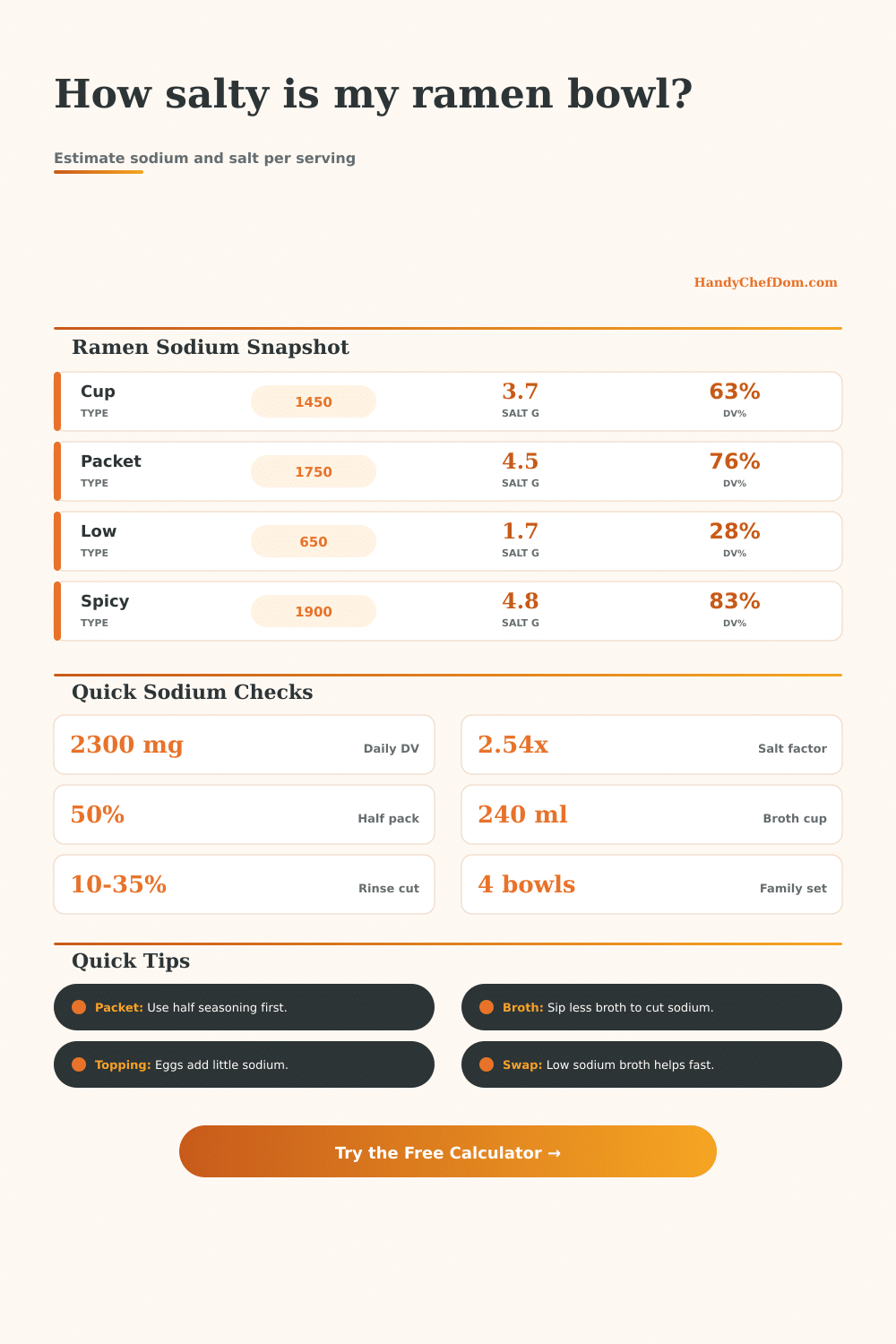
Enter the noodle pack count, seasoning fraction, broth you actually consume, and salty add-ins. The calculator converts sodium milligrams into salt equivalent grams using a 2.54 sodium-to-salt factor.
| Ramen Type | Typical Sodium | Salt Equivalent | Use In Calculator |
|---|---|---|---|
| Instant cup | 1450 mg | 3.7 g | Single lunch cups |
| Packet | 1750 mg | 4.4 g | Classic dry packs |
| Spicy pack | 1900 mg | 4.8 g | Hot soup packs |
| Low sodium | 650 mg | 1.7 g | Reduced labels |
| Fresh kit | 950 mg | 2.4 g | Chilled noodles |
| Dry sauced | 1300 mg | 3.3 g | No broth bowls |
| Seasoning Used | 1750 mg Packet | Salt Equivalent | Packet Impact |
|---|---|---|---|
| 25% | 438 mg | 1.1 g | Light soup base |
| 50% | 875 mg | 2.2 g | Half packet hack |
| 75% | 1313 mg | 3.3 g | Still quite salty |
| 100% | 1750 mg | 4.4 g | Full label amount |
| 125% | 2188 mg | 5.6 g | Extra soup base |
| 150% | 2625 mg | 6.7 g | Double-sachet style |
| Drain Or Broth Choice | Reduction Range | Where It Helps | Calculator Field |
|---|---|---|---|
| Drain noodles | 10-20% | Dry noodle bowl | Drain reduction |
| Drain and rinse | 20-35% | Less surface salt | Drain reduction |
| Leave broth | 0% | Soup style ramen | Broth volume |
| Sip half broth | 15-30% | Partial soup bowl | Broth volume |
| Low sodium broth | 25-70% | Broth swap | Low swap |
| No powder broth | 50-90% | Homemade stock | Low swap |
| Topping Or Add-In | Typical Sodium | Salt Equivalent | Best Entry Field |
|---|---|---|---|
| Soft egg | 70 mg | 0.2 g | Toppings sodium |
| Tofu cubes | 15 mg | 0.0 g | Toppings sodium |
| Veg mix | 40 mg | 0.1 g | Toppings sodium |
| Kimchi | 300 mg | 0.8 g | Toppings sodium |
| Ham strips | 450 mg | 1.1 g | Toppings sodium |
| Soy sauce | 900 mg | 2.3 g | Extra sauce |
This calculator estimates sodium from label-style values and common ramen add-ins. Use your package nutrition label when you have it, especially for medical sodium targets.
Ramen is easy: put water on stove, throw in some noodles, and dump powdered pack. It is cheap, quick, and dependable, but it comes at a cost. Until you become parched mid-afternoon.
The ramen craving? Your body is demanding hydration from all of that sodium. The ramen isn’t simply carbs with flavor. Sure, but the big issue is seasoning packet that has so much salt it can overshadows the rest of your daily intake. Knowing how much sodium is consume will let you have your ramen and eat it too. Without being left dehydrated and bloated afterward.
How to Eat Ramen with Less Salt
You also has power over the seasoning packet. That little envelope in most instant ramen packs has anywhere from 1,500-2,000 milligrams of sodium. If you eat it all, you’re ingesting up to a third of your recommended daily intake in one meal. That’s a big strain on the body.
It is a half packet. See what happens when you use just half the package. It still tastes good (and sheds nearly half the sodium). The flavors won’t taste very different; your tongue adjust fast. Give it a shot.
A second variable people don’t pay attention to are how much broth they consume. When eating out of a cup (like ramen), you probably slurp up all of the broth. When eating in a bowl, you might sip part of it away, leaving the rest. Why does this matter? Each cup of broth has salt dissolved into it. When you strain half the liquid, you greatly reduce amount of sodium from the liquid. This doesn’t require any additional ingredients. Just eat the noodles, sip as much or little broth as you like, then leave the remainder in the bowl. It’ll make you feel wasteful, but your kidneys will appreciate the self-restraint.
Other toppings are eye-openers, they look like healthful additions but turn out not to be. Fresh spinach! A soft-boiled egg! What could of been wrong? Plenty: Those two items alone bring back a hefty load of sodium that’s been eliminated from elsewhere on the plate. The kimchi brings saltiness as well as salt used for preservation. The spoonful of soy sauce goes into the same pot, bringing concentrated sodium that can rival the ramen packet in tiny quantities.
The tool lets you add individual ingredients so you can track what happens to the overall total. This way you don’t make error of assuming that dish is low-sodium just because you’ve added some condiments that undo everything else.
There’s also the rinse. You can boil the noodles, drain the water, then add new seasoning or broth after rinsing. That will remove some of the sodium trapped inside noodle during cooking. It will also wash off some of the starch on its surface. Not a perfect answer, but it knocks down overall sodium content by a notable amount. And it alters texture of the pasta by making it firmer, which is something many people likes about it. We’ve accounted for that drop below so you have a true sense of what’s left. If you’re watching real closely it’s worth a try.
In the end though, it’s all about choice. You choose your toppings, your broth, and your water. If you begin to measure those inputs, what was previously a convenient-yet-guilt-inducing meal becomes a flexible base upon which to build a well-balanced dinner. So long as you’re mindful of the salt sources, there’s no need to be afraid to add veggies or some protein. It’s not about giving up ramen, it’s about understanding it. With full knowledge of what goes in, you can enjoy the bowl with confidence instead of concern about the after-effects. The salt remains in the bowl and not your belly.