🥧 Cornstarch To Thicken Pie Filling Calculator
Estimate cornstarch tablespoons and grams from fruit cups, released juice, sugar, pie size, fruit type, set target, and bake or chill plan.
Enter the fruit volume first, then add any measured juice, maceration syrup, or thawed liquid. The formula scales cornstarch by fruit type, sugar level, pie capacity, set target, and whether the filling will be sliced warm, cooled, or chilled.
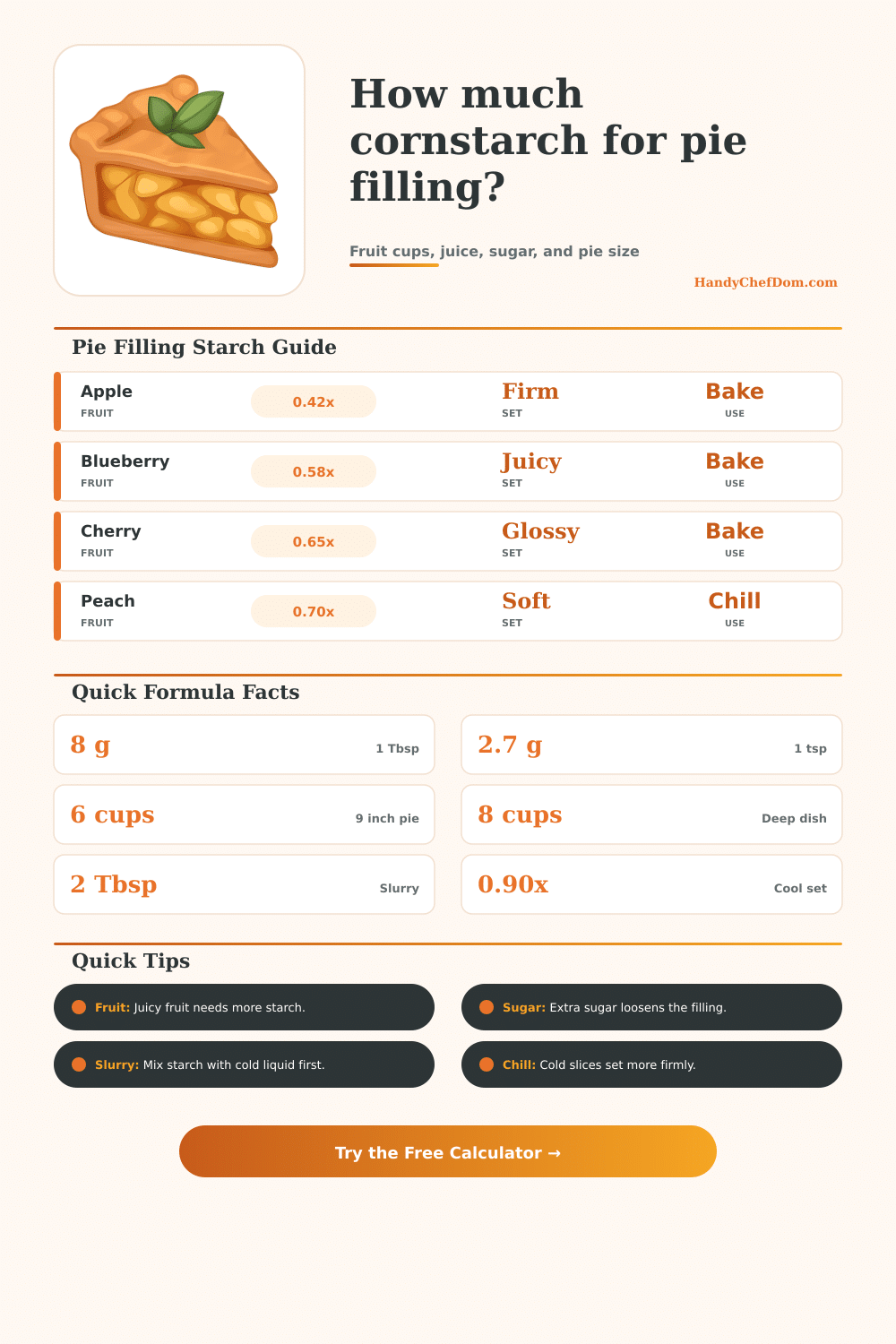
| Fruit Type | Base Cornstarch | Juice Behavior | Calculator Note |
|---|---|---|---|
| Apple slices | 0.42 Tbsp per cup fruit | Moderate juice, firm pieces | Usually needs less starch than berries for the same pie size |
| Blueberries | 0.58 Tbsp per cup fruit | Juicy with skins | Needs a stronger set when served warm or packed deep |
| Pitted cherries | 0.65 Tbsp per cup fruit | Loose cherry juice | Measured syrup and canned liquid change the result quickly |
| Peach slices | 0.70 Tbsp per cup fruit | Soft juicy slices | Chilled slices can use a slightly lower starch target |
| Strawberries | 0.85 Tbsp per cup fruit | Very juicy and soft | Needs the most support when mixed with extra syrup |
| Blackberries | 0.70 Tbsp per cup fruit | Juicy with seeds | Firm target helps the filling hold a cut edge |
| Pie Size Or Pan | Filling Capacity | Typical Fruit Range | Fit Reading Used |
|---|---|---|---|
| Hand pie batch | 2.5 cups filling | 2 to 2.5 cups fruit | Small format usually prefers a firm set target |
| 6 inch pie | 3.5 cups filling | 3 to 3.5 cups fruit | Good for compact test batches and small pies |
| 8 inch pie | 5 cups filling | 4.5 to 5 cups fruit | Useful when scaling down a 9 inch pie formula |
| 9 inch pie | 6 cups filling | 5.5 to 6.5 cups fruit | Baseline used by many fruit pie formulas |
| 9 inch deep dish | 8 cups filling | 7 to 8.5 cups fruit | Needs more total starch because filling is deeper |
| Quarter sheet slab | 14 cups filling | 12 to 14 cups fruit | Shallow slices often use the slab set target |
| Set Target | Multiplier | Texture Aim | Best For |
|---|---|---|---|
| Soft spoonable | 0.85x | Loose and glossy | Warm desserts, bowls, and spooned servings |
| Sliceable pie | 1.00x | Balanced slice | Standard cooled pie wedges |
| Firm clean slices | 1.18x | Neater cut edge | Juicy berries, deep dish, or travel pies |
| Slab or hand pie | 1.35x | Strongest hold | Small pieces, shallow slab pies, and packed fillings |
| Cornstarch Amount | Approx Grams | Teaspoons | Slurry Liquid |
|---|---|---|---|
| 1 Tbsp | 8 g | 3 tsp | 2 Tbsp cold liquid |
| 2 Tbsp | 16 g | 6 tsp | 4 Tbsp cold liquid |
| 3 Tbsp | 24 g | 9 tsp | 6 Tbsp cold liquid |
| 4 Tbsp | 32 g | 12 tsp | 8 Tbsp cold liquid |
| 5 Tbsp | 40 g | 15 tsp | 10 Tbsp cold liquid |
| 6 Tbsp | 48 g | 18 tsp | 12 Tbsp cold liquid |
More than many baker do, I care about the starchiness of my pie fillings. If they’re not sufficiently starchy, your slices will slide off the plate when lifted; if they contain to much starch, the filling will look like pudding instead of fruit. You’ll notice this not only while eating the warm pie but also after it’s cooled and cut into the following day.
So, when reaching for the cornstarch, first I measure out my sugar and my juice and my fruit. The kicker: How much liquid is in there? If it’s flooding the bottom crust in minutes, that’ll change things. But if it take hours to release its liquid, that matters as well. The sugar will loosen the final texture and draw out moisture, so you must consider how much water was in the fruit plus how much sugar will be added. And then remember: because starch hardens as it cools, a pie that is cut right away need to be firmer different than one left in the fridge overnight.
How to Get Your Pie Just Right
So all those factors come into play, which is why I’ve got the math covered for you in the calculator above. You just plug in your info (pan size, measured juice from the fruit, sugar amount, and whether it’ll be eaten warm or cold) and go. It tracks the effective liquid load. Whether it comes from fruit juice, added syrup, or dissolved sugar, all that liquid thicken the starch. The tool treats it as one pool that it aims to thicken.
The rest is just adjusting that baseline based off how firm you want the texture to be, such as clean slices versus a spoonable filling. Spoonable filling). Use more total starch for deep-dish pie so the filling hangs together. Use a stronger set for hand pies or shallow slabs so they stands up to being picked up.
Then there’s the fact that the serving temperature affects results in ways people don’t think about. A slice pulled directly from the oven and appearing perfectly filled might be too soft when it reach room temperature, which is why chill plan is important. On the other hand, a recipe made to be eaten cold will be too firm when served warm. Tweak the service setting in the calculator, and see how many more starchy grams offset this change; without having to pull multipliers out of your hat.
Fruit isn’t one-size-fits-all (this is another popular error). Soft fruits act differently depending on whether they are slices of peaches or apples or berries with their skin on. The calculator take that into account by adjusting the basic starch factor for each. Look at the table of references on the page, which spell it out for you: Now you know why an apple needs less help than a strawberry in a comparable-sized pie.
As you get the hang of it, you will notice if your filling is runnier than expected and add a little extra buffer when you put it in oven instead of just hoping for the best. But the real value is having those tradeoffs laid out side-by-side. See how a soft spoonable set compares with a firmer sliceable set, or see how swapping from chilled to cooled affects the final result.
It’s that kind of comparison that allows you to make a call: Is that added starch worth it for traveling? Or does a somewhat softer filling work okay for a same-day-eating pie? While the numbers goes into the background, choosing gets easier and you would of noticed if things go wrong.