🦃 Turkey Resting Time Calculator
Plan when to pull, tent, carve, and serve turkey with resting estimates shaped by cut, weight, cooking method, stuffing, room warmth, and carryover heat.
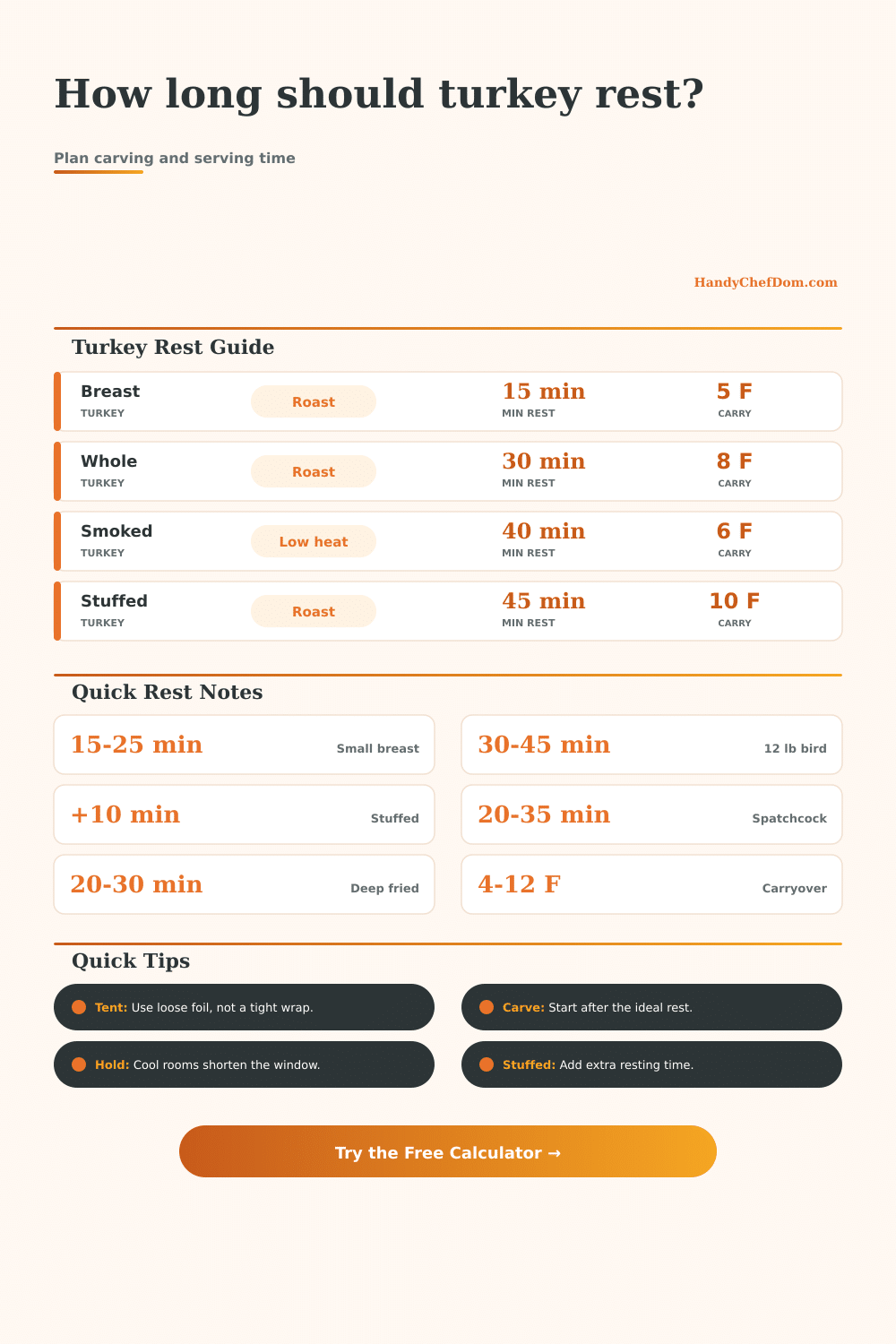
Use the finished turkey weight and your serving clock. The calculator estimates minimum rest, ideal rest, carve start, pull time, quality holding window, and carryover temperature.
| Cut | Weight | Min | Ideal |
|---|---|---|---|
| Breast | 3-6 lb | 15-20 | 20-30 |
| Breast | 7-9 lb | 20-25 | 28-38 |
| Whole | 8-12 lb | 25-30 | 35-45 |
| Whole | 13-16 lb | 30-40 | 45-60 |
| Whole | 17-22 lb | 40-55 | 60-80 |
| Parts | 2-8 lb | 10-18 | 15-25 |
| Method | Min Add | Ideal Add | Carry |
|---|---|---|---|
| Roast | 0 | 0 | +2 F |
| Convec | -2 | -3 | +1 F |
| Smoked | +5 | +8 | -1 F |
| Fried | -5 | -8 | +1 F |
| Grilled | 0 | +2 | 0 F |
| Slow | +8 | +12 | +3 F |
| Tent | Rest Add | Hold Add | Skin |
|---|---|---|---|
| None | -2 | -10 | Crisp |
| Loose | 0 | +10 | Good |
| Tight | +5 | +20 | Soft |
| Towel | +10 | +90 | Soft |
| Drafty | 0 | -25 | Fast cool |
| Warm | +2 | +10 | Slow cool |
| Task | Small | Medium | Large |
|---|---|---|---|
| Move pan | 3 min | 5 min | 7 min |
| Tent bird | 2 min | 3 min | 4 min |
| Carve | 8 min | 12 min | 18 min |
| Platter | 3 min | 5 min | 8 min |
| Gravy wait | 5 min | 8 min | 10 min |
| Serve cue | 2 min | 3 min | 5 min |
Before carving that hot turkey, stop. If you cut into it right away, all those juices spills out onto the cutting board and make the once-tender white meat stringy and dry. The wait time gives muscle fibers time to relax. But it also lets the meat soak up some of those delicious liquids again.
To be honest, most home cooks guesses on how long to wait. Some go by a twenty-minute rule of thumb. But a twenty-pound roast is not a five-pound breast. When cooking such a big bird, the dense insides retains their heat longer. As a result, they require more time to settle down. With calculator, you get an estimate based off your individual weight. Knowing science helps you make adjustments as plans change.
Why You Must Wait Before Cutting the Turkey
Once the turkey’s off the heat, the temp inside keep going up. Carryover will bumped the middle a few more degrees. Pulling it at one-sixty-five could send it to one hundred and seventy-five by the time you carve it. A lot of chefs wants to pull just a bit under that because they know there’ll be some buffer room. Letting it do its thing finish the job.
While you wait, treat your bird gently. Foil tenting is standard advice, but you has to be careful with how you do it. Tight wrapping retains steam. Steam soaks skin. Loosely tented bounces heat back. It also releases moisture.
Drafty kitchens loses heat faster. That shortens your useful holding window. Keeping that kitchen warm will keep the bird warmer longer, so it’ll be juicier longer. And it increases food safety risk. That’s why the tool use those factors to adjust suggested window.
Another issue is stuffing. Stuffed cavities is insulators. They slow down the cooling in the middle. The outside of meat continues to cool at a normal rate. That difference mean the middle stays warmer longer. For even cooking, you want a longer wait than usual. If it’s tightly packed, consider adding ten minutes or so.
A flat bird (like a spatchcocked bird) lies flat. More of its surface area are exposed to the air. It cools down faster. And it doesn’t require as long a pause. Understanding this difference help avoid under-resting a dense roast. But it also helps avoid over-resting a flat bird.
Carving time is an often-overlooked aspect of planning phase. You’re going to be moving the pan, tenting it, carving it, and plating it, and all of these steps takes time. A big bird might take fifteen minutes by yourself just to carve. Pulling it out at very last second means you’re going to rush. Now meat has been sitting there losing heat while it’s exposed. Know exactly when to pull it so you can plan backwards from when you want to serve. This turns that chaotic moment into a controlled sequence.
It also have handy reference tables so that you can get an idea of other techniques. But the goldmine is in your own estimate. Whatever method you use (smoking or deep frying), you’re trying to achieve two things. You want maximum tenderness and minimum dryness. It is a small window. Makes all the difference between a good dinner and a great one. Learning this pause will make you a master of the roast. The clock stops, the juices settle, and meal gets memorable. You should of waited for it.