🍗 Rotisserie Chicken Shelf Life Calculator
Plan when to chill, serve, reheat, or freeze leftover rotisserie chicken using practical storage timing and portion planning.
Use the time the chicken was purchased or finished cooking. This planner estimates fridge deadline, freezer quality window, hours remaining, portion pacing, and reheating notes.
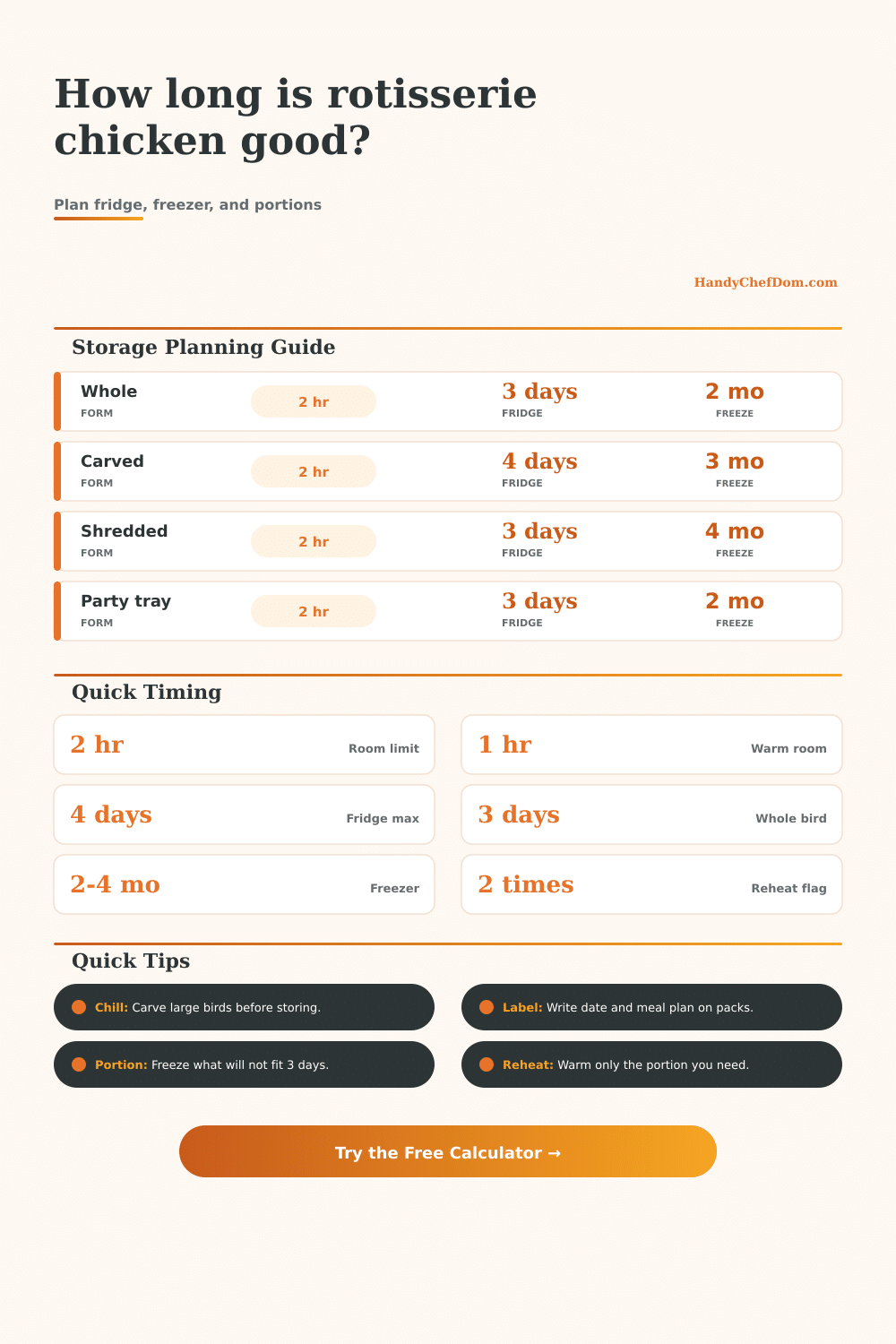
| Form | Chill | Fridge | Note |
|---|---|---|---|
| Whole | 2 hr | 3 days | Carve |
| Carved | 2 hr | 4 days | Seal |
| Shredded | 2 hr | 3 days | Pack |
| Mixed | 2 hr | 3 days | Sort |
| Tray | 2 hr | 3 days | Split |
| Warm | 1 hr | Same day | Review |
| Pack | Best | Freeze | Note |
|---|---|---|---|
| Whole | Wrap | 2 mo | Bulky |
| Carved | Box | 3 mo | Sauce |
| Shred | Flat bag | 4 mo | Fast thaw |
| Vac seal | Vacuum | 4 mo | Best |
| Tray | Small box | 2 mo | Label |
| Broth | Cup pack | 3 mo | Soup |
| Serv | Meals | Pace | Use |
|---|---|---|---|
| 2 | 1 | Today | Dinner |
| 4 | 2 | 2 days | Lunch |
| 6 | 3 | 3 days | Soup |
| 8 | 4 | Freeze | Packs |
| 12 | 6 | Freeze | Tray |
| 20 | 10 | Split | Party |
| Step | Time | Temp | Plan |
|---|---|---|---|
| Buy | Start | Hot | Clock |
| Cool | 2 hr | Room | Fridge |
| Store | 3 days | 40 F | Use |
| Reheat | Once | 165 F | Serve |
| Freeze | Today | 0 F | Label |
| Thaw | Night | Fridge | Cook |
The rotisserie chicken was never realy about rotissering; it’s about convenience. And so you’re careful with that bird. When you bring it home and cook it, your nose tell you everything will be okay.
Everything seems so simple: Just reheat it. Use it in a few different meals. But there’s a problem: Time. Once the chicken come off of the heat, the clock begins ticking. And it doesn’t stop if you’re busy, or tired, or otherwise distracted.
How to Keep Rotisserie Chicken Safe
Your only job is to get that chicken into fridge as fast as possible. Speed = safety. There are no hard-and-fast rules about when to store; there’s just a way to manage the risk. Plug your circumstances (how/when did you buy the chicken) based off a calculator. This works best if you know what goes in it.
Depending on how the chicken was cut affect the window of safety. Whole birds retain their inner heat for hours after their exterior cools. This trapped heat create an environment where bacteria thrive. By cutting up the bird you open it up to allow its temperature fall more quickly. More surface area exposed to the air equal quicker cooling. Cut-up or shredded meat will frequently last a bit longer in the fridge different than a whole, uncut bird. These are small but important details.
Another thing is temperature. Bacteria grows slower in your fridge than outside, but it doesn’t stop. If you live in a warm house and your fridge run warm, that’s going to speed up how long the chicken spoils. How hot is too hot? No higher than 40 degrees. That’s the safe zone. 45 is iffy. A lot of us think our appliances is working just fine. Often they’re not. You can buy a thermometer for your fridge door, which tells you the real temperature. Is the number too high? Then the leftover has fewer hours remaining. The calculator uses this truth to take your cooking environment and turn it into customized safety plan.
Nope, Freezing doesn’t kill anything, including bacteria. So if you put your chicken in the freezer after it’s gone bad, it will stay that way when you pull it back out. The quality reference table lists approximate times. Chicken freezes well. Whole birds thaw slower then shredded packs. Thinner layers helps. Thick blocks take longer to thaw. The outside could of been spoiled by the time the inside defrosts. Portion the chicken before freezing it. It’s not only convenient, it also keeps it safe & useable.
Most errors occur during reheating. To kill active bacteria, heat to 165 degrees Fahrenheit. This doesn’t eliminate their toxin residue. Only warm what will be eaten. Each time you reheat a big batch, you prolong its exposure to the danger zone. The calculator also keeps track of your number of reheats and tells you when the overall risk is high. If you’ve warmed it up two times, toss it.
Before that point, use your senses. If something smells funny or just doesn’t look right, listen to your intuition. Because of its convenience, rotisserie chickens demand discipline. Don’t treat them as a chore. Carve, pack, and label the meat. Treat it as insurance. Trust your nose. Chill quickly.
If something smells funny, it’s funny. That can’t be fixed by reheating. The clock stops only when chicken is gone.