🥣 Salt per Soy Sauce Calculator
Estimate total sodium, salt equivalent, per-serving sodium, percent Daily Value, and retained marinade salt from soy sauce amounts and label data.
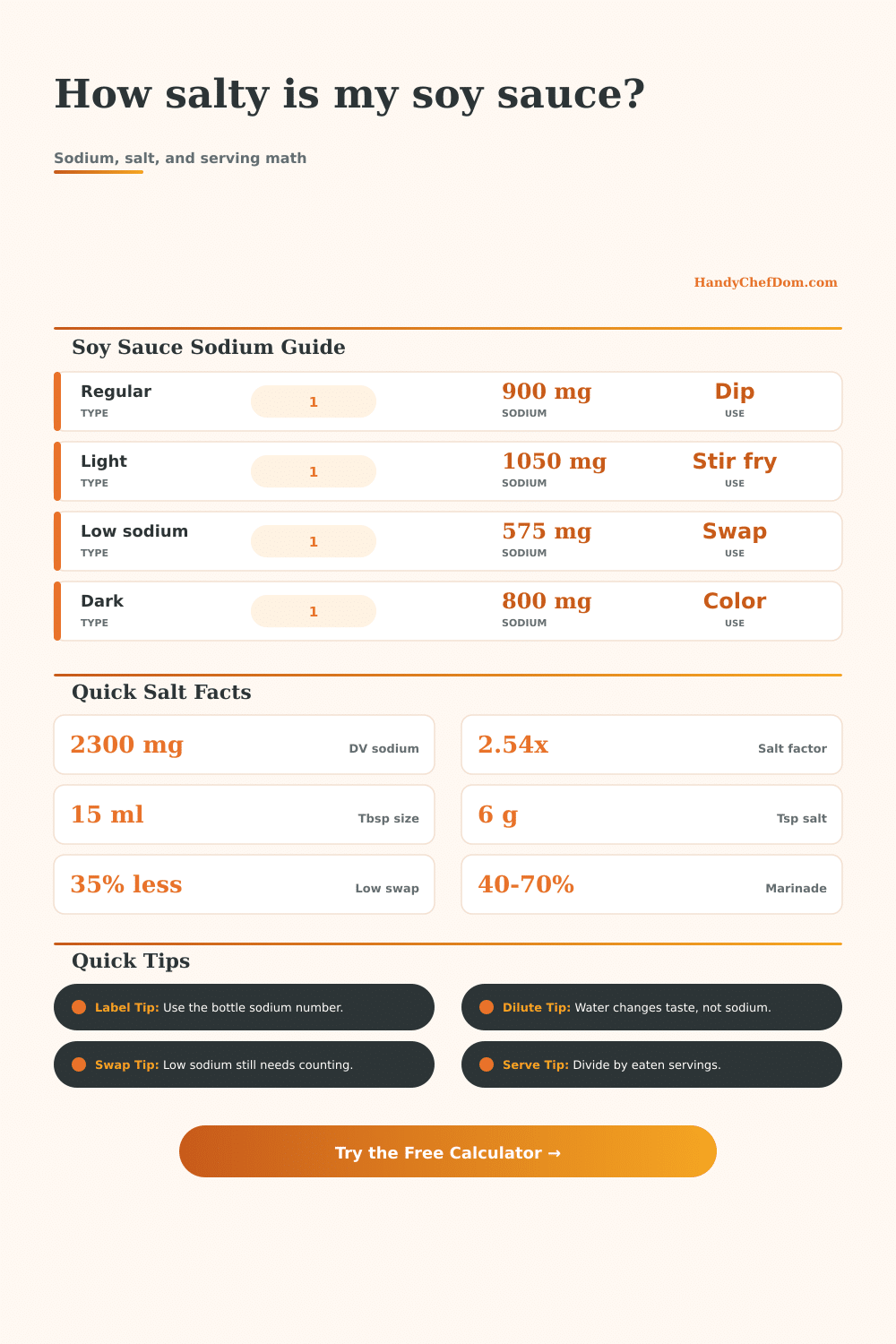
Use the sodium number from your bottle whenever possible. The default type values are practical estimates, and the calculator converts sodium to salt equivalent with sodium x 2.54.
| Soy Sauce | Default Sodium | Best Use | Salt Impact |
|---|---|---|---|
| Regular soy sauce | 900 mg per tbsp | Sushi dips, fried rice, pantry sauces | Classic high-salt baseline |
| Light soy sauce | 1050 mg per tbsp | Stir fries, quick seasoning, dumpling dips | Often the saltiest option |
| Low sodium soy sauce | 575 mg per tbsp | Family meals, lower-sodium swaps, soups | Lower but not sodium free |
| Tamari | 980 mg per tbsp | Gluten-free style sauces and marinades | Similar to regular soy sauce |
| Dark soy sauce | 800 mg per tbsp | Color, glaze, noodle sauce, braises | Rich taste with moderate sodium |
| Measure | Milliliters | Regular Sodium | Salt Equivalent |
|---|---|---|---|
| 1 teaspoon | 5 ml | 300 mg | 0.76 g salt |
| 1 tablespoon | 15 ml | 900 mg | 2.29 g salt |
| 2 tablespoons | 30 ml | 1800 mg | 4.57 g salt |
| 1/4 cup | 60 ml | 3600 mg | 9.14 g salt |
| 1/2 cup | 120 ml | 7200 mg | 18.29 g salt |
| Recipe Use | Typical Amount | Servings | Planning Note |
|---|---|---|---|
| Sushi Dip | 1 tbsp | 2 servings | Direct serving, count nearly all sodium |
| Stir Fry Sauce | 2 tbsp | 4 servings | Dilution spreads sodium through the pan |
| Teriyaki Marinade | 4 tbsp | 6 servings | Retention matters if marinade is discarded |
| Soup Seasoning | 3 tbsp | 6 servings | Broth volume lowers mg per ml, not total sodium |
| Fried Rice Batch | 2.5 tbsp | 5 servings | Per-serving sodium is usually the key number |
| Low-Sodium Swap | Regular Share | Low Share | Use Case |
|---|---|---|---|
| No swap | 100% | 0% | Use label value as entered |
| Replace 25% | 75% | 25% | Small reduction with familiar taste |
| Replace 50% | 50% | 50% | Balanced sodium cut for sauces |
| Replace 75% | 25% | 75% | Lower-sodium family cooking |
| Full low sodium | 0% | 100% | Best for strict sodium targets |
Percent Daily Value uses the entered sodium Daily Value. The default 2,300 mg reflects current U.S. label guidance for adults and children 14 years or older.
It’s the sound of a soy sauce cap coming off. Snap! Then a black drop of the salty stuff fall into its own little bowl. You grab some sushi between your chopsticks and dunk it without knowing that one bite will deliver almost a third of your day‘s worth of sodium.
Maybe you use soy sauce as you would any other condiment: mustard, ketchup, whatever. But soy sauce is different animal. It’s a concentrated brine. It are a salty, fermented punch in the mouth. And it behaves unlike the table salt you shake onto a steak. Knowing that is the first step in controlling your consumption.
Why Soy Sauce Is Different From Table Salt
The calculator above takes care of all those complicated conversions for you; there’s no need to do the mental math during the dinner hour. Salt is not the same as sodium and nutrition labels do not list salt. They display sodium. Sodium is only half of the sodium chloride molecule which constitutes table salt. 54.
Almost everyone forget to convert it. Because of this, they massively overestimate their consumption of salt. One tablespoon of something with 900 milligrams of sodium means you’re actualy consuming more than two grams of salt. That’s a lot of salt for a condiment.
This page’s tool does the math for you. Given a label value (in milligrams) and a serving size (in whatever units), it multiply them together, spitting out the number of grams of salt you’re really working with. It removes the imprecision of the label and hands you a concrete amount to deal with.
And that’s where context comes into play: A tablespoon or two of soy sauce used on a big pile of fried rice isn’t remotely similar to a few drops poured into a dip to eat with raw fish. When you’re seasoning a whole pot of fried rice, that soy sauce get distributed among all those grains of rice and any vegetables or proteins they hold. When you pour it into a dish of raw fish though, each drop lands right in your mouth.
The actual amount that hits your own personal bowl is far less then what ends up in the pot as a whole. That’s also why this calculator requests the number of servings in a recipe. It calculates the overall quantity (in this case, sodium) divided by the number of people eating it. This way, you don’t freak out about a high number if individual serving size is actually not too bad.
And then there’s the issue of substitution. When many people want to reduce amount of salt in something, they immediately reach for low sodium soy sauce; as though it’s some kind of quick fix. It isn’t. It’s simply less salty. With the calculator, you can model substituting part of an ingredient, and then you’ll be able to see what would happen if, say, you use only half the usual soy sauce.
You will find a helpful fact: You can cut your intake significantly without having to completely throw out the taste. Perhaps you’ll discover that a 50 percent substitution leave the dish mostly recognizable and reduces your intake dramatically. And that transforms an unclear desire to eat in a slightly more healthy way into a clear strategy.
Another layer of complexity that few people consider is marinating. Not all the liquid from your marinade remain on the meat after marinating. Some gets absorbed, some will be discarded, and some cooks off during cooking. You can account for this fact by changing your percentage input for the portion that remains. And if you’re tossing the marinade, then the amount of sodium you’ll actualy take up is less than what the label says.
If you don’t account for this, you’ll overestimate. Including it will result in a more honest picture of how much you’re taking up.
So in summary: Respect your soy sauce. It is powerful. It is salty. It is easy to abuse. When you’re translating that ambiguous milligram number on the side of the package into real-life grams of table salt (and then adapting accordingly) you’re reclaiming power over your own flavorings.
Instead of wondering, you’ll know. Next time you’re reaching for that bottle, you’ll know exactly what that bottle full of darkness is bringing to your plate. You would of also known what it is bringing to your diet each day.