🍲 Protein Portions Calculator
Divide cooked chicken, beef, salmon, tofu, eggs, yogurt, lentils, or mixed grill into practical containers, plates, bowls, cups, and snack packs.
Enter the cooked protein you have after resting or draining. The calculator converts it into portion targets, meal containers, plate splits, snack packs, and raw-weight yield estimates.
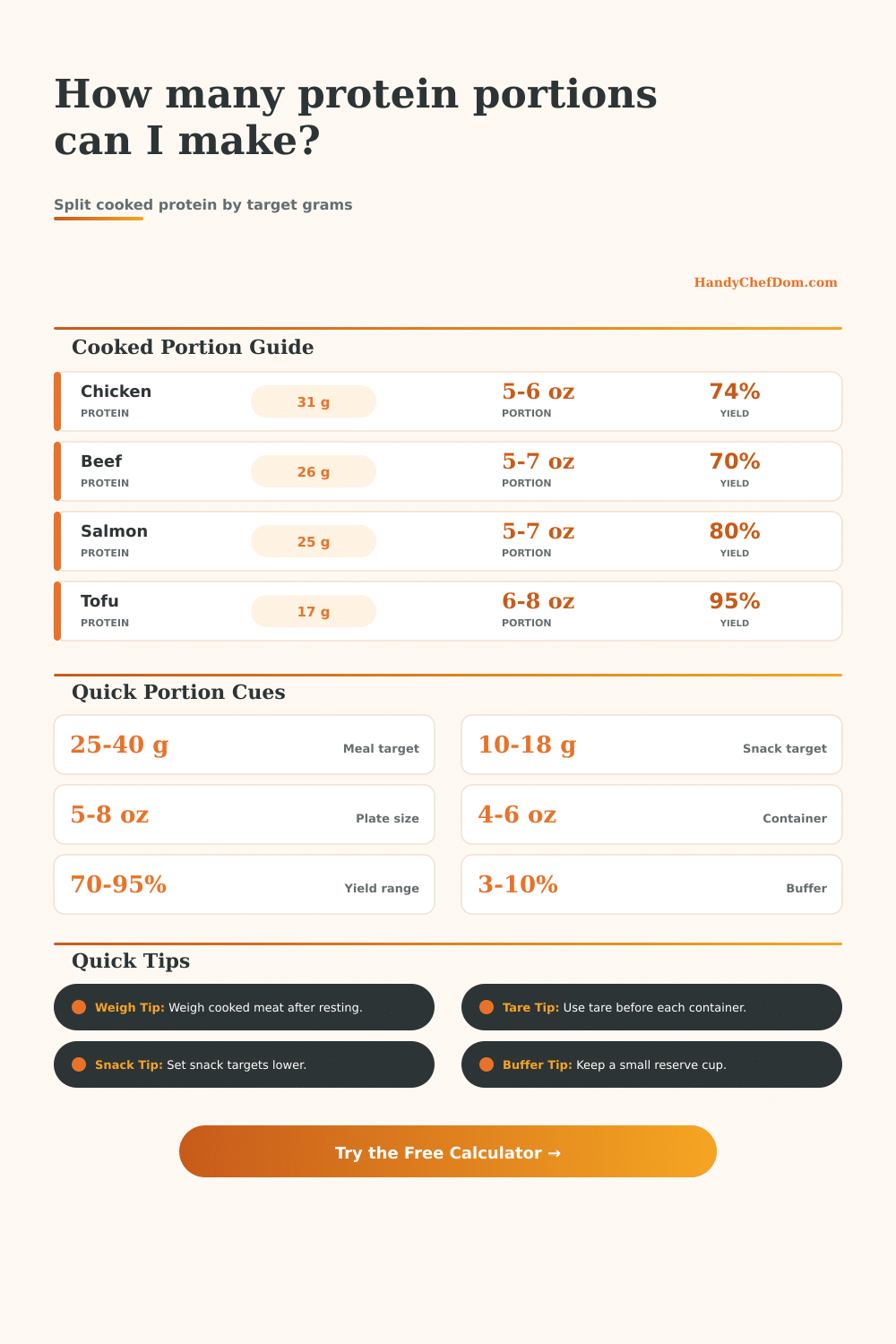
| Cooked Protein | Protein per 100 g | Typical Cooked Portion | Best Portion Use |
|---|---|---|---|
| Chicken breast | 31 g | 4 to 6 oz | Meal prep containers |
| Lean beef | 26 g | 5 to 7 oz | Bowls and plates |
| Salmon fillet | 25 g | 5 to 7 oz | Dinner plates |
| Firm tofu | 17 g | 6 to 8 oz | Lunch boxes |
| Hard cooked eggs | 13 g | 2 to 3 eggs | Snack packs |
| Greek yogurt | 10 g | 170 to 250 g | Breakfast cups |
| Cooked lentils | 9 g | 1 to 1.5 cups | Plant-based prep |
| Mixed grill | 27 g | 5 to 8 oz | Shared platter splits |
| Portion Style | Calculator Behavior | Best For | Watch Point |
|---|---|---|---|
| Equal containers | Divides all usable cooked weight | Even meal prep rows | Protein may vary from target |
| Target packs | Fills only target-size portions | Macro counted containers | May leave leftovers |
| Dinner plates | Uses people as the split count | Family service | Use plate count, not boxes |
| Snack packs | Uses the smaller size multiplier | Eggs, yogurt, lentils | Check cup weight |
| Mixed prep | Prioritizes planned meals plus reserve | Grill trays and combos | Buffer prevents short scoops |
| Preset | Cooked Weight | Protein Target | Portion Goal |
|---|---|---|---|
| Chicken Container Prep | 3.5 lb cooked | 35 g each | 8 containers |
| Beef Bowl Portions | 4 lb cooked | 32 g each | 10 bowls |
| Salmon Dinner Plates | 2.25 lb cooked | 34 g each | 4 plates |
| Tofu Lunch Boxes | 1.8 kg cooked | 24 g each | 6 boxes |
| Egg Snack Packs | 0.9 kg cooked | 12 g each | 8 snack packs |
| Greek Yogurt Cups | 1.5 kg chilled | 20 g each | 6 cups |
| Lentil Meal Prep | 2.2 kg cooked | 22 g each | 8 containers |
| Mixed Grill Portions | 5.5 lb cooked | 40 g each | 12 portions |
| Protein Type | Typical Cooked Yield | Raw Weight for 1 lb Cooked | Portioning Note |
|---|---|---|---|
| Chicken breast | 72 to 78% | 1.3 to 1.4 lb | Rest before weighing |
| Lean beef | 68 to 75% | 1.3 to 1.5 lb | Drain before dividing |
| Salmon fillet | 78 to 84% | 1.2 to 1.3 lb | Portion gently |
| Firm tofu | 92 to 98% | 1.0 to 1.1 lb | Pressing changes yield |
| Hard cooked eggs | 88 to 92% | 1.1 lb | Count pieces after weighing |
| Greek yogurt | 100% | 1.0 lb | Stir before scooping |
| Cooked lentils | 190 to 220% | 0.45 to 0.55 lb dry | Drain well for consistency |
| Mixed grill | 70 to 82% | 1.2 to 1.4 lb | Average mixed cuts |
The problem with meal prepping is that math is never clear. I know I’ve got a bunch of cooked chicken left over, but how long will that actualy go? A portioning tool removes any guesswork out of equation. It separates the meal into something you can use. You’re no longer shoveling food from one container to another; you’re assigning nutritional value to upcoming days.
Raw weight is not the same as cooked weight. A lot of people makes this mistake. A pound of chicken breast loses a lot of weight after cooking. Simply input your cooked weight and protein density into calculator; the math are done for you. You don’t have to guess about conversion factors. If you go by package weight, you’ll under-estimate how much protein is contained in each serving. Water evaporates when you cook it, it leaves behind concentrated nutrients. That means you can reaches your daily goals without consuming so much meat.
The Problem with Meal Prep Math
Proteins also behave different than in cooking. High-density-protein foods like chicken breast shrink a lot, losing roughly a quarter of their weight. Beef is less predictable because it shrinks based off its fat content and cut. Tofu, with its higher water retention, act differently yet again. For example, a larger scoop of tofu equals the same amount of protein as a smaller scoop of chicken. To hit your target number of grams, you’ll need to vary the portion size based on food. See the reference table below.
As you can see from the reference table, protein per hundred grams varies by food type. When targeting a certain number of grams, don’t expect tofu to act like a steak. Adjust your volume appropriately.
How you do something matters based off what it is you’re doing. Are you filling the same containers at work? Or are you feeding your family with four plate tonight? Different situations call for different logic. When filling containers, we want them all the same. You want uniformity so your macros stays consistent across every container. When plating, we can distribute. Here, who cares if one serving has more than another? Switching between modes does that. It changes the yield calculation. It will also change whether or not it factor in a buffer.
Why the buffer? Because you get some extra ounces and now final container isn’t empty. Now it looks like you know what you’re doing vs rushing to finish.
And then there are snacks. Snacks tend to be another source of protein in addition to the primary meals. Yogurt and hard-boiled eggs aren’t as dense as grilled meat. The former is primarily protein with a little bit of water. It’s heavy, but it has less protein per ounce than dense, lean beef. Knowing that prevents you from over-packing a cup of yogurt which seems so empty compared to other options. It’s not empty. It’s just hydrated.
When meal prepping, logistics are much more important than food. Think of it as a limited resource across a period of time. How long will it last? It would of lasted until Friday. Don’t run out before Wednesday! Planning this out eliminates stress.
When you figure out how to measure out cooked foods and account for shrinkage, things becomes obvious. Now you don’t worry about getting hungry anymore. Open the container, put it in your mouth, go on with life. It is not because the containers look good, but because you do not know what is inside, so you know exactly what is inside, and that makes you feel at ease on that Sunday afternoon. No need to stress about the scale.