🥣 Gelatin Protein Calculator
Estimate protein from powdered gelatin, sheets, hydrolyzed collagen-style gelatin, or envelopes while accounting for recipe type, bloom strength, liquid volume, servings, and final yield.
Choose the unit system and gelatin form first. The calculator converts tablespoons, envelopes, and leaf counts into dry gelatin grams, then estimates batch protein, protein per serving, gel concentration, and hydrated yield.
| Gelatin Form | Kitchen Measure | Dry Weight Basis | Protein Estimate |
|---|---|---|---|
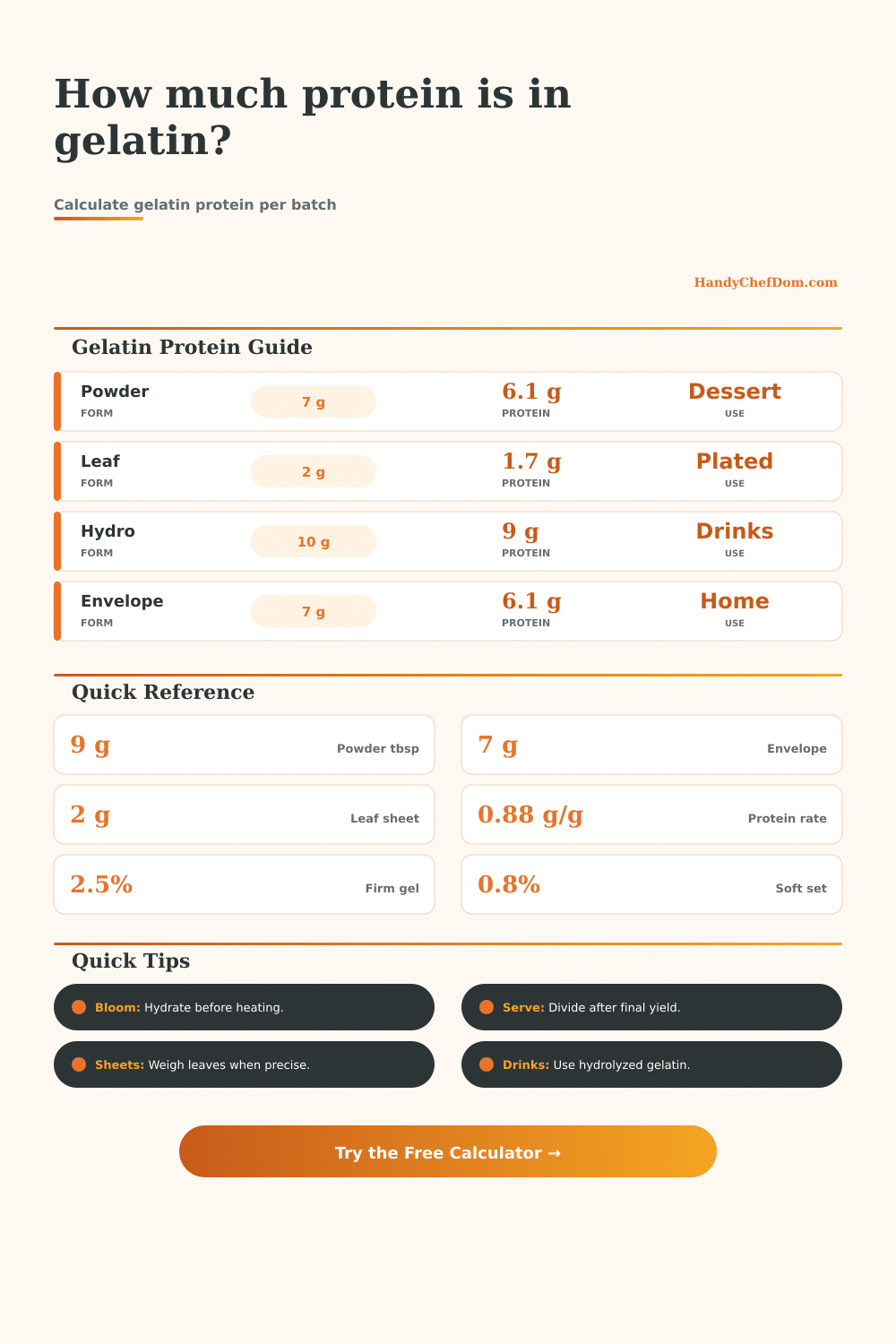
| Granulated powder | 1 level tablespoon | About 9 g | About 7.9 g protein |
| Fine powdered gelatin | 1 level tablespoon | About 8 g | About 7.0 g protein |
| Standard envelope | 1 packet | About 7 g | About 6.2 g protein |
| Bronze leaf gelatin | 1 sheet | About 3.3 g | About 2.9 g protein |
| Silver leaf gelatin | 1 sheet | About 2.5 g | About 2.2 g protein |
| Gold leaf gelatin | 1 sheet | About 2.0 g | About 1.8 g protein |
| Platinum leaf gelatin | 1 sheet | About 1.7 g | About 1.5 g protein |
| Hydrolyzed gelatin powder | 1 tablespoon | About 10 g | About 9.0 g protein |
| Recipe Type | Typical Concentration | Protein Pattern | Calculation Note |
|---|---|---|---|
| Classic dessert gel | 1.4% to 1.8% | Moderate per serving | Often based on one envelope for two cups liquid. |
| Panna cotta or cream gel | 0.7% to 1.2% | Lower per serving | Gentle set means less dry gelatin in each cup. |
| Mirror glaze or coating | 1.0% to 1.6% | Spread across dessert | Use final coating yield for serving protein. |
| Firm gummies or cubes | 2.5% to 5.0% | Higher per bite | Concentration rises as dry gelatin increases. |
| Savory aspic or terrine | 1.8% to 2.8% | Moderate to high | Firm slices usually need more gelatin than cups. |
| Mousse stabilizer | 0.4% to 0.8% | Small contribution | Gelatin is spread through a larger aerated batch. |
| Hydrolyzed drink or smoothie | 3% to 8% | Direct protein dose | Protein stays high, but the mixture does not gel. |
| Bloom Strength | Relative Strength | Common Form | Protein Impact |
|---|---|---|---|
| 125 bloom | Soft strength | Bronze style sheets | Protein depends on weight, not bloom number. |
| 160 bloom | Medium strength | Silver style sheets | May need more grams for a firm texture. |
| 200 bloom | Standard strength | Gold style sheets | Good baseline for conversions. |
| 225 bloom | Common powder strength | Unflavored powder | Protein is calculated from dry grams. |
| 250 bloom | High strength | Platinum style sheets | May set firmly with fewer dry grams. |
| Hydrolyzed | No gel strength | Drink powder | Protein counts, but bloom set does not apply. |
| Liquid Volume | Soft Set Gelatin | Classic Set Gelatin | Firm Set Gelatin |
|---|---|---|---|
| 1 cup / 240 ml | 2 to 3 g | 3.5 to 4.5 g | 6 to 8 g |
| 2 cups / 480 ml | 4 to 6 g | 7 to 9 g | 12 to 16 g |
| 4 cups / 960 ml | 8 to 12 g | 14 to 18 g | 24 to 32 g |
| 6 cups / 1.44 L | 12 to 18 g | 21 to 27 g | 36 to 48 g |
| 8 cups / 1.92 L | 16 to 24 g | 28 to 36 g | 48 to 64 g |
| 12 cups / 2.88 L | 24 to 36 g | 42 to 54 g | 72 to 96 g |
Most home cooks treat gelatin like a simple on-off switch. Just dissolve it in some liquid, let it set, and serve dinner. But anyone who’s had their panna cotta slip from its spoon know that there’s a bit more to it than that. What makes the difference between success and failure, between something that looks like it came from a pro versus an amateur. Is recognizing that gelatin is a type of protein: one that responds different based on how much of it you’re using and what form it takes.
Now there’s a tool for that: The calculator above does this for you by converting the common units of measurement, like leaf sheets or envelopes or tablespoons (down to one universal unit: dry grams). Why? Because 1 Tbsp of loose powder is not going to weigh the same as 1 Tbsp of coarse granules. Because 1 Tbsp of loose powder is not going to weigh the same as 1 Tbsp of coarse granules. Unless you have a kitchen scale, you’re essentially winging it. Standardizing the input to grams eliminates the guesswork involved with measuring in cups and tablespoons. You can plug in how much you’ve got, and it converts it to amount needed to achieve the desired consistency. This works regardless of whether you just bought a sheet of silver leaf or a box of powder. No more doing math in your head when your cream is still piping hot.
How to Use Gelatin Correctly
Most recipes don’t give much advice on what you should of know about bloom strength. Bloom is gelling power (per gram) of your dry gelatin. Higher bloom number = stronger gelatin. Why does this matter? You can get away with using fewer grams of higher bloom gelatin to get the same set as lower bloom. This factor lets you adjust how strong the finished dish is, and it’s something you’ll need to do when switching from one type/grade of sheet gelatin to another. Use a weaker bloom without adjusting the weight, and your dessert won’t set. Use a stronger bloom without adjusting, and it’ll turn out tough. With the help of the tool, you can figure out how to balance that tradeoff and end up with the texture you’re after, not just some solid block.
Regular gelatin (used in Jell-O) works different than the “collagen powder” sold for smoothies, which is actualy called hydrolyzed gelatin. Hydrolyzed doesn’t set. Instead, it totally dissolves into the drink. The calculator handles this by splitting up the gelling calculation and the protein calculation. So yes, you can certainly include hydrolyzed gelatin for that nice mouth-feel and nutrition bonus; just remember that you also need to include something like agar or regular gelatin to give your mixture some structure. This is another thing people commonly mix-up: having all the protein in the world in your smoothie won’t do anything if there’s no structural ingredient to hold everything together. Does the batch want to be gel-like? Or it is just thickening? The tool highlights that separation by displaying the protein value separately from the gelling value.
Another critical factor is concentration. How much gelatin compared to the amount of liquid in the whole thing? For example, if you’re going for a delicately set cream, you may need just a half-percent of gelatin; to get a gummy effect, you’d be looking at something like 3 percent or even more. Those numbers translate into what fraction of your finished product is water-and-sugar solution versus actual protein. It is a tiny detail, but it can make all the difference between a good and great result. Too little gelatin, and you’ve got soup. Too much, and it can overtake the flavor of whatever’s mixed with it (too many chocolaty-chewy bits, anyone?). The pages’ reference tables spell out those details, so you can place your recipe somewhere within the larger area of gelatin science.
And that brings us to two final pieces: batch yield and serving size. When I trim the edge off a terrine or transfer my mixture to molds, some gets lost. To compensate for this loss, I enter a yield percent into the calculator (typically about ninety-six percent). This way, I am accurately reporting how much protein gets onto the plate rather than how much there was in the pot. That’s just good practice; it prevents you from overestimating the nutrients you’ve consumed.
With these tools, gelatin becomes less mysterious. No more pinches and handfuls; instead, exact amounts ensures success. Using precise amounts instead of vague measurements ensures a reliable result every single time. Does a savory jelly need neat slices? A mirror glaze needs to be shiny. It’s all the same math. Measure, modify for concentration, and leave the rest to the chemistry. The next time you open that pack of gelatin, you’ll know not just what to add but also exactly why and how it works.